

Thursday 27 February 2025
Scientists have made a significant breakthrough in developing an optical neural network that can solve complex partial differential equations (PDEs) using a novel training method. This achievement has far-reaching implications for fields such as physics, engineering, and computer science.
The team used a type of artificial intelligence called a physics-informed neural network (PINN), which is designed to learn the behavior of physical systems governed by PDEs. These equations describe how various quantities change over time and space in response to different conditions. For example, they can be used to model heat transfer, fluid flow, or electrical currents.
Traditionally, solving PDEs requires extensive computational resources and complex algorithms. However, PINNs use a neural network architecture that is trained to mimic the behavior of physical systems, allowing it to learn the solution to a PDE in a more efficient and scalable manner.
The challenge lies in training the neural network without relying on traditional backpropagation methods, which require a differentiable model of the physical system. Instead, the team developed a zeroth-order optimization algorithm that uses only forward propagation, making it possible to train the network on photonic hardware.
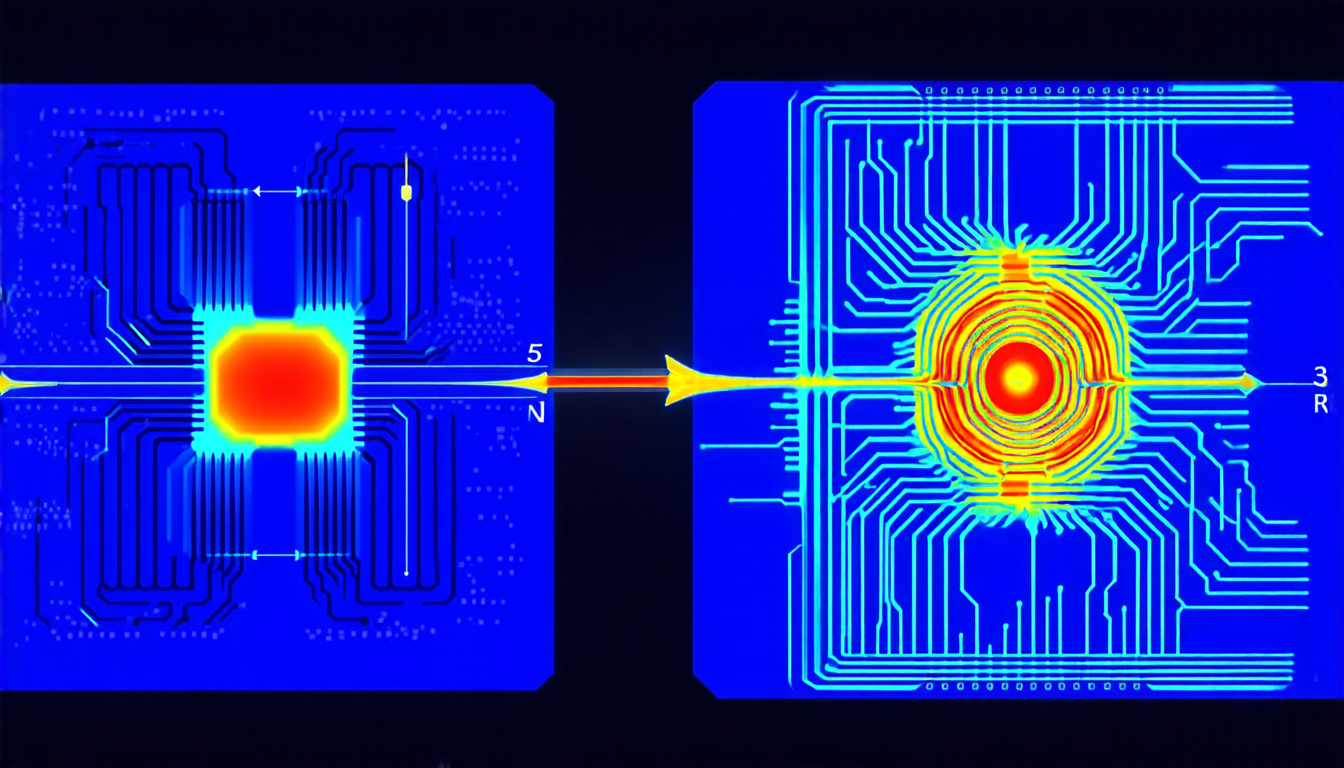
The researchers demonstrated their approach by solving a one-dimensional heat equation using an optical neural network fabricated on a chip. The network consisted of micro-ring resonators and was trained using a tunable laser and photodetector.
The results showed that the PINN was able to learn the solution to the heat equation with high accuracy, even in the presence of fabrication errors and environmental noise. This achievement has significant implications for fields such as optics, photonics, and quantum computing, where complex PDEs are common and solving them efficiently is crucial.
One potential application of this technology is in real-time simulation and analysis of physical systems. For example, it could be used to optimize the performance of optical communication systems or predict the behavior of complex materials under different conditions.
The development of PINNs on photonic hardware also opens up new possibilities for edge computing and the Internet of Things (IoT). By integrating these devices into small form factors, they can be used to solve complex problems in real-time without requiring extensive computational resources.
While this achievement is significant, it is just one step towards realizing the full potential of PINNs. Future research will focus on scaling up the technology to larger neural networks and more complex PDEs, as well as exploring new applications in fields such as biology and medicine.
Cite this article: “Optical Neural Network Solves Complex Partial Differential Equations”, The Science Archive, 2025.
Optical Neural Network, Pinn, Pdes, Physics-Informed, Artificial Intelligence, Heat Equation, Photonic Hardware, Micro-Ring Resonators, Edge Computing, Iot





