

Thursday 27 February 2025
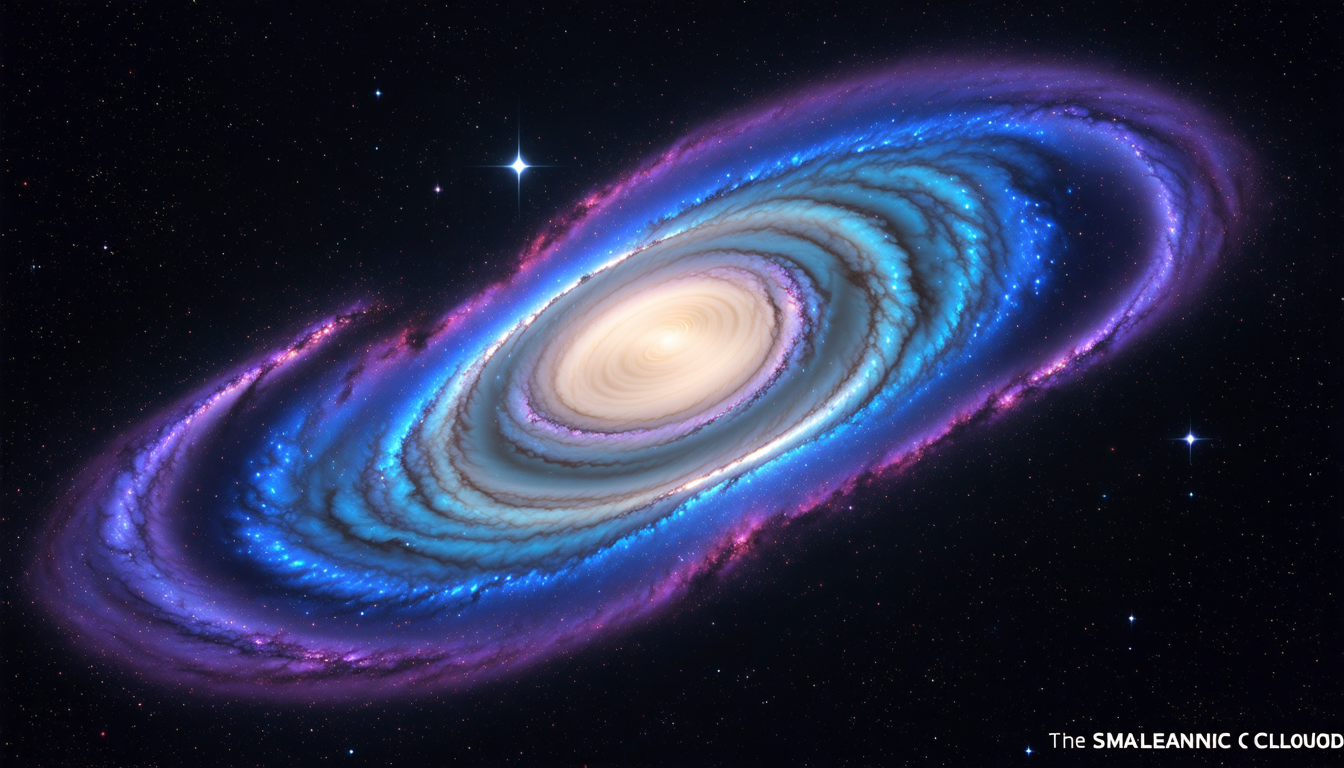
The Small Magellanic Cloud, a satellite galaxy of our own Milky Way, has long been an enigma. Its unusual shape and rapid rotation have puzzled astronomers for decades. Now, a new study sheds light on the SMC’s evolution, revealing that it’s not just its stars that are moving rapidly, but also its gas.
The researchers used data from the European Space Agency’s Gaia spacecraft to create a detailed map of the SMC’s motion. They found that the galaxy is rotating at a rate of about 89 kilometers per second, which is surprisingly fast given its size. But what’s more interesting is that this rotation isn’t uniform throughout the galaxy – in some areas, stars and gas are moving faster than others.
One area where the gas is particularly active is the southeastern part of the SMC. Here, the researchers detected a region where gas is inflowing at high speeds, which they attribute to the gravitational pull of the Large Magellanic Cloud, the SMC’s larger companion galaxy. This infalling gas is likely responsible for triggering star formation in this region.
The study also revealed that the SMC’s rotation is changing over time. The galaxy’s central regions are rotating more slowly than its outer regions, which could be due to the gravitational influence of the LMC. As a result, the SMC’s shape is being distorted, with its stars and gas becoming increasingly stretched out along its axis.
This research has important implications for our understanding of galaxy evolution. The SMC is thought to have formed from the merger of smaller galaxies, and its unusual rotation pattern could be a relic of this process. The study also highlights the importance of gas in shaping the structure and evolution of galaxies – without it, stars wouldn’t form.
The Gaia spacecraft has revolutionized our understanding of the Milky Way’s neighborhood, and the SMC is one of many fascinating targets that have benefited from its precise measurements. As astronomers continue to analyze the data, they’re likely to uncover even more secrets about this enigmatic galaxy and its place in the universe.
Cite this article: “Unlocking the Secrets of the Small Magellanic Clouds Rapid Rotation”, The Science Archive, 2025.
Small Magellanic Cloud, Galaxy Evolution, Satellite Galaxy, Milky Way, Gaia Spacecraft, Star Formation, Rotation Rate, Large Magellanic Cloud, Gravitational Influence, Galaxy Merger





