

Friday 28 February 2025
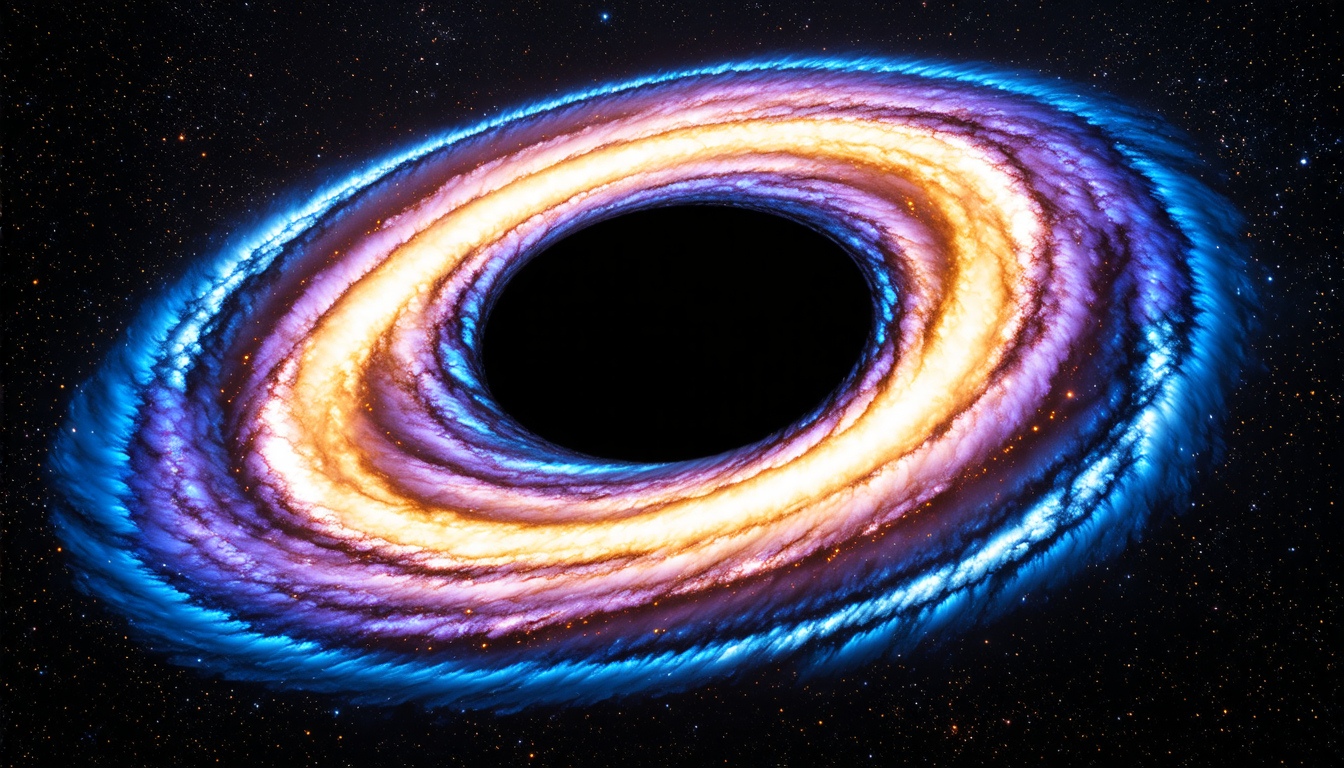
A swirling vortex of energy has been discovered at the heart of our galaxy, where the supermassive black hole known as Sagittarius A* (Sgr A*) resides. This finding has significant implications for our understanding of the universe’s most extreme environments and the role that black holes play in shaping their surroundings.
At the center of Sgr A*, a strong magnetic field is thought to be driving the creation of electron-positron pairs, which are particles with opposite charges. These pairs are formed when intense electromagnetic fields tear apart the fabric of space-time, releasing vast amounts of energy in the process. The resulting particle soup is a key component of the black hole’s magnetosphere, a region where charged particles are accelerated to incredible speeds by the powerful magnetic field.
The discovery was made using complex computer simulations that modeled the behavior of these particles in the vicinity of Sgr A*. By studying the dynamics of these particles, scientists were able to pinpoint the location and characteristics of the vortex-like structure. This finding is significant because it provides a new window into the inner workings of black holes, which are notoriously difficult to study directly.
The magnetic field at the heart of Sgr A* is incredibly strong, with strengths rivaling those found near neutron stars. However, unlike these stellar remnants, the magnetic field in the black hole’s vicinity is not fixed or steady – it is dynamic and constantly changing. This turbulence creates a region where charged particles are accelerated to incredible speeds, releasing vast amounts of energy as they interact with the surrounding magnetic field.
The implications of this finding are far-reaching. For one, it provides new insights into the behavior of black holes in general, which could have significant implications for our understanding of the universe’s most extreme environments. Additionally, the discovery of a strong magnetic field at Sgr A*’s center raises questions about the role that black holes play in shaping their surroundings – do they influence the formation and evolution of nearby stars and planets?
The study of these phenomena is not without its challenges, however. The intense radiation emitted by Sgr A* makes it difficult to directly observe the region around the black hole, forcing scientists to rely on indirect methods such as computer simulations.
Despite these challenges, researchers are eager to continue studying this phenomenon in greater detail. By better understanding the dynamics of charged particles in the vicinity of Sgr A*, scientists hope to gain a deeper appreciation for the extreme environments that exist at the heart of our galaxy.
Cite this article: “Unlocking the Secrets of Sagittarius A”, The Science Archive, 2025.
Black Holes, Galaxy, Magnetic Field, Particles, Charged, Acceleration, Energy, Radiation, Simulation, Sagittarius A*





