

Friday 28 February 2025
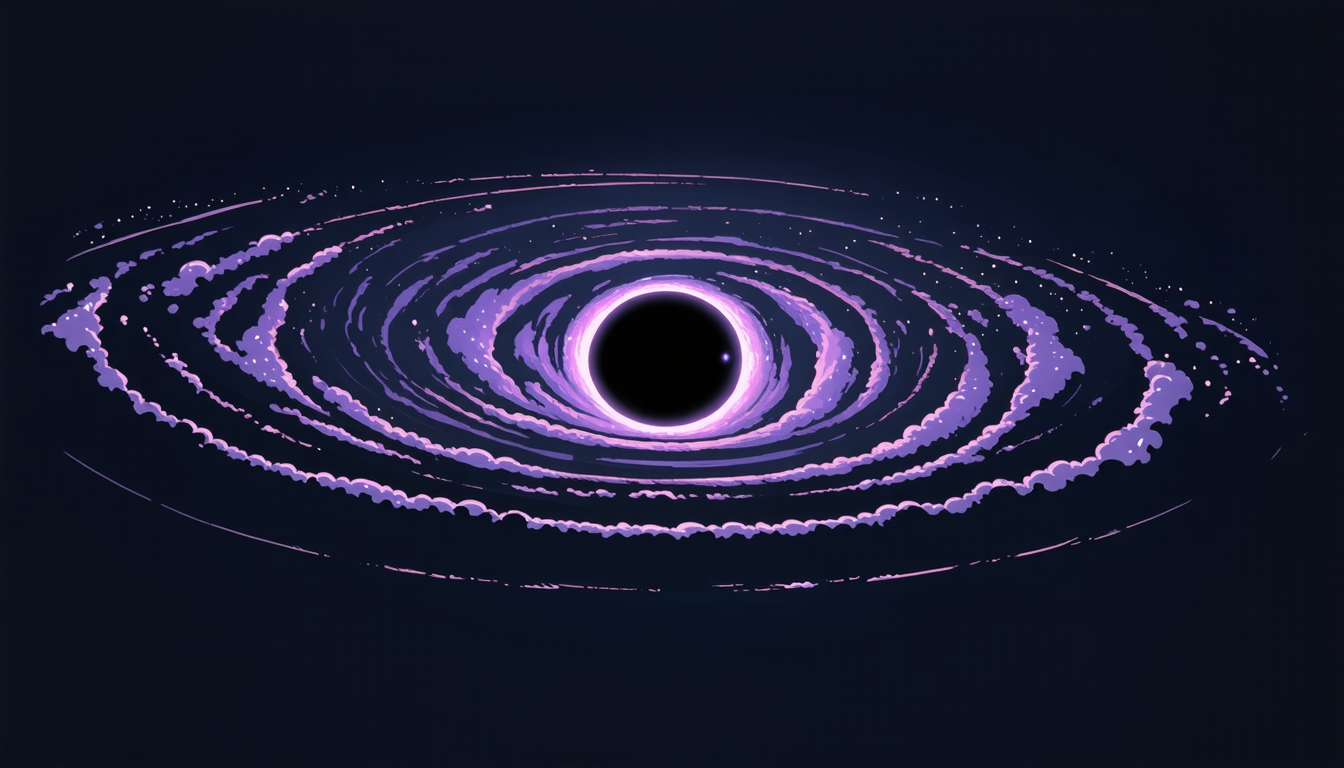
Scientists have long been fascinated by the mysteries of black holes, those regions of spacetime where gravity is so strong that nothing, not even light, can escape once it gets too close. But simulating these cosmic behemoths on a computer has always been a challenge. Now, researchers have developed a new approach to modeling black hole evolution that promises to revolutionize our understanding of these enigmatic objects.
The problem with simulating black holes is that they require incredibly complex calculations to accurately capture their behavior. You see, black holes are surrounded by an event horizon, a point of no return where the gravitational pull becomes so strong that anything that crosses it gets trapped forever. But what happens beyond this horizon is shrouded in mystery, making it difficult for scientists to model its evolution.
Traditionally, researchers have used numerical relativity simulations to study black hole behavior. These simulations involve solving Einstein’s field equations, which describe the way gravity warps spacetime, using a grid of points that cover the entire spacetime around the black hole. However, this approach has limitations. For one, it can be computationally expensive and requires massive amounts of data storage.
To overcome these challenges, scientists have developed a new method called conformal covariant Z4 (CCZ4). This approach uses a different mathematical framework to model the behavior of spacetime around black holes. Instead of using a grid of points, CCZ4 uses a set of equations that describe the curvature of spacetime in terms of its intrinsic properties, such as the distance between nearby points.
The beauty of CCZ4 is that it allows scientists to simulate black hole evolution with much greater accuracy and efficiency than traditional methods. By solving these equations, researchers can gain insights into the behavior of black holes over long periods of time, including their merger and collision events.
One of the most exciting applications of CCZ4 is its potential to help us better understand the behavior of supermassive black holes at the centers of galaxies. These behemoths have masses millions or even billions of times that of our sun, and their evolution can have a profound impact on the formation of stars and planets.
Another area where CCZ4 shows promise is in the study of black hole spin. Black holes can rotate rapidly, and this rotation can affect the way they interact with their surroundings. By simulating these effects using CCZ4, scientists can gain insights into how black holes influence the formation of galaxies and star clusters.
Cite this article: “Simulating Black Hole Evolution: A New Approach to Understanding Cosmic Behemoths”, The Science Archive, 2025.
Black Holes, Spacetime, Gravity, Simulation, Numerical Relativity, Einstein’S Field Equations, Conformal Covariant Z4, Ccz4, Supermassive Black Holes, Galaxy Formation





