
Friday 28 February 2025
The Time Difference of Arrival (TDOA) problem has long been a thorn in the side of localization and tracking enthusiasts. Despite its importance, solving for the source position in 3D space using TDOA measurements has remained an open challenge – until now. A recent paper has cracked the code on exact linear solutions for the general 3D problem, and we’re excited to dive into the details.
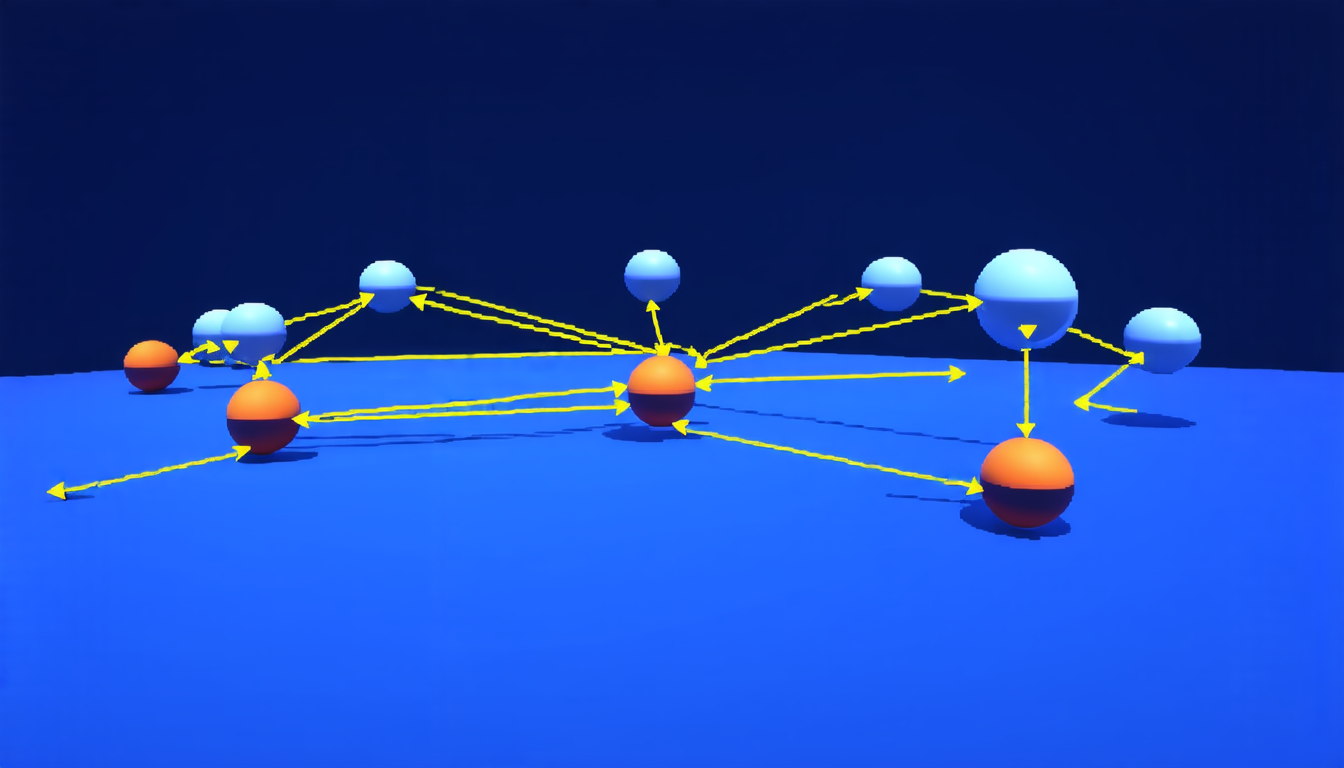
The TDOA approach relies on measuring the time difference between when a signal arrives at multiple sensors. In theory, this information can be used to pinpoint the source position in space. However, as the number of sensors increases, so does the complexity of the calculations required to solve for the source position. For 4 and 5 sensors, exact linear solutions have remained elusive – until now.
The new paper presents a pair of algebraic solutions that bypass the need for iterative methods or least-squares projections. The first solution, applicable to 5-sensor scenarios, involves inverting just three linear equations. The second, for 4-sensor cases, requires solving one quadratic equation after inverting three more linear ones.
But how well do these solutions perform in practice? To test their mettle, the authors ran a series of numerical experiments using varying sensor and source positions over 1,000 Monte Carlo instances. In each case, they compared the calculated source position to the actual truth, with no measurement noise introduced. The results were nothing short of impressive: for all but a tiny fraction of cases, the inferred source position matched the true one within numerical error.
One notable aspect of these solutions is their ability to handle ambiguity resolution. In 4-sensor scenarios, two possible source positions can arise from the calculations – but the new method ensures that only the viable solution is selected. This is especially important in real-world applications, where incorrect choices could lead to inaccurate tracking or localization.
The lack of need for iteration or least-squares projections also makes these solutions particularly appealing for on-platform calculation. With rapid processing times and minimal computational resources required, these methods are well-suited for deployment in a wide range of scenarios – from autonomous vehicles to precision navigation systems.
In the context of TDOA, the authors’ work represents a significant milestone. By providing exact linear solutions for 4- and 5-sensor cases, they’ve opened up new possibilities for localization and tracking applications.
Cite this article: “Cracking the Code: Exact Linear Solutions for TDOA Localization in 3D Space”, The Science Archive, 2025.
Time Difference Of Arrival, Localization, Tracking, Algebraic Solutions, Linear Equations, Quadratic Equation, Monte Carlo Simulations, Sensor Positioning, Source Position, Ambiguity Resolution