

Friday 28 February 2025
As cities continue to grow and urbanization becomes a dominant force, finding innovative solutions to traffic congestion is more pressing than ever. One promising approach is lane-free traffic, where vehicles navigate without traditional lanes, allowing for smoother flow and increased capacity. But what happens when not all vehicles are connected and automated? A new study sheds light on the impact of human-driven cars on lane-free traffic.
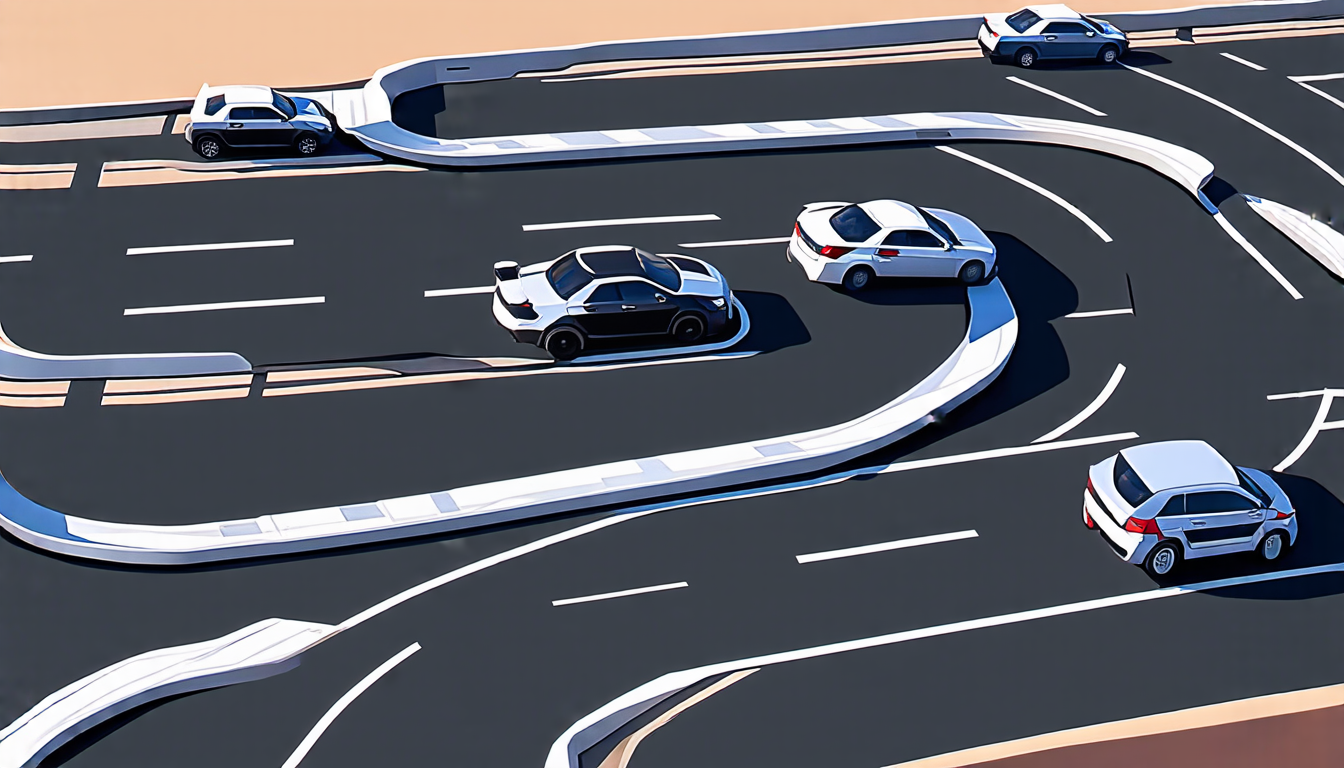
Researchers simulated a ring road with connected autonomous vehicles (CAVs) following potential lines, a type of dynamic guidance system that helps maintain safe distances and optimize traffic flow. They then introduced human-driven vehicles (HDVs) into the mix, mimicking real-world scenarios where not all vehicles are equipped with advanced technology.
The results were striking: even a small percentage of HDVs significantly disrupted lane-free traffic flow, reducing its maximum capacity by as much as 16%. As the number of HDVs increased, so did the impact on traffic efficiency. The study found that to reap the benefits of lane-free traffic, at least 60% of vehicles would need to be CAVs.
To mitigate these effects, the researchers developed an adaptive potential line (APL) controller, which forms corridors with modified PLs around HDVs. This approach improved traffic flow by up to 23.6%. The study highlights the importance of designing lane-free traffic systems that can adapt to a mix of connected and human-driven vehicles.
This research has significant implications for urban planners and policymakers seeking to reduce congestion and improve traffic efficiency in the face of rapidly evolving transportation technology. As cities continue to grapple with the challenges of growing populations and increasingly complex transportation networks, innovative solutions like lane-free traffic may hold the key to a smoother, more sustainable future.
The study’s findings also underscore the need for further research into the interactions between human-driven vehicles and connected autonomous ones, as well as the development of strategies to minimize disruptions in mixed-traffic scenarios. As the world hurtles towards a future where automation plays an increasingly prominent role on our roads, understanding how these different types of vehicles interact is crucial for building safer, more efficient, and more sustainable transportation systems.
Cite this article: “Mixing Human and Autonomous Vehicles: A Challenge for Lane-Free Traffic Systems”, The Science Archive, 2025.
Lane-Free Traffic, Autonomous Vehicles, Traffic Congestion, Urbanization, Simulation, Potential Lines, Human-Driven Cars, Adaptive Control, Mixed Traffic, Transportation Technology





