

Friday 28 February 2025
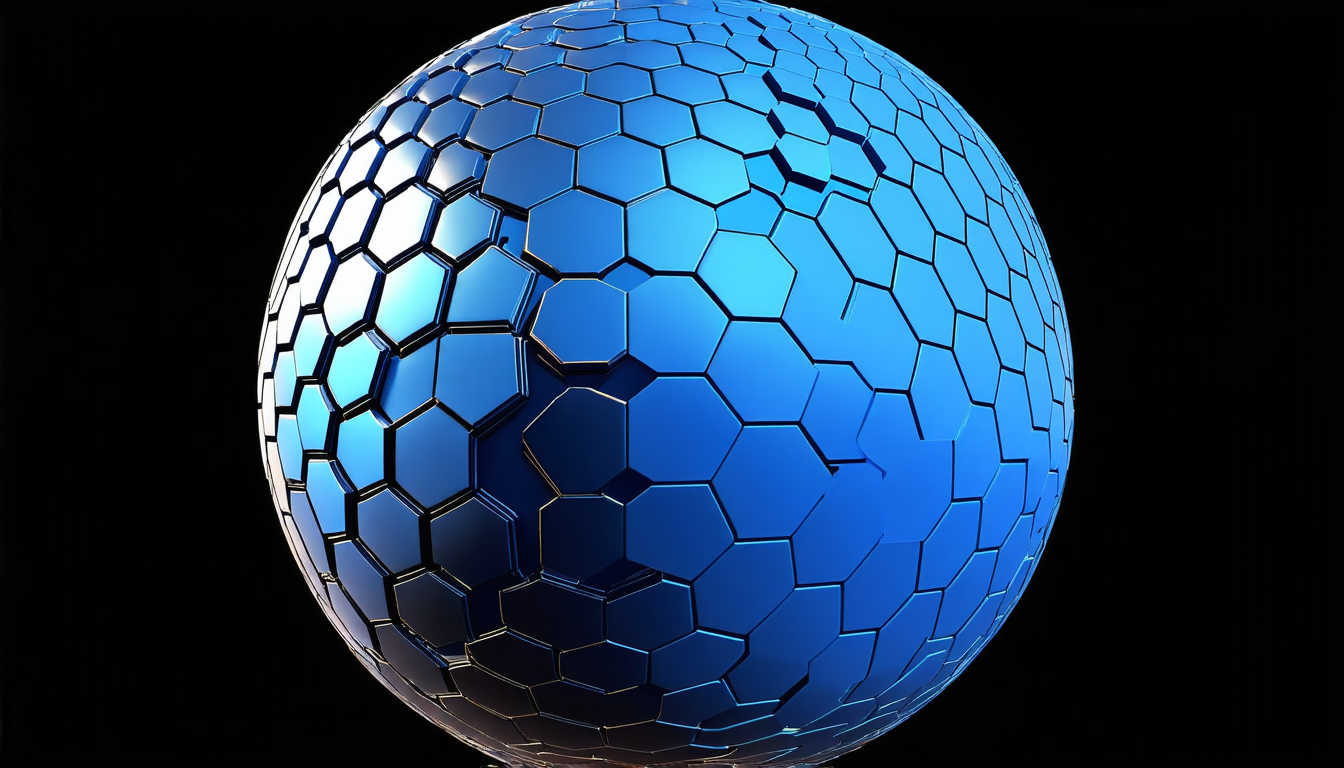
Scientists have been studying the behavior of particles on curved surfaces for some time now, and their latest findings are fascinating. By confining soft-core particles on a spherical surface, researchers have discovered new types of defects that emerge when two different lattice patterns try to coexist.
The study began with an experiment where scientists created a mixture of hexagonal and square lattices on a sphere. These patterns are commonly found in nature, from the arrangement of molecules in biological systems to the structure of crystals. By manipulating the particles’ interactions, researchers were able to create a situation where both lattice patterns tried to occupy the same space.
As expected, this led to some interesting phenomena. The scientists observed that defects began to form when the two lattices couldn’t coexist peacefully. These defects took the shape of domain and counter-domain structures, where one lattice pattern would enclose another within its boundaries.
But here’s where things get really interesting. The researchers found that these defects were not just random occurrences; they were actually a result of the inherent frustration between the two lattices. You see, hexagons and squares have different geometric properties, which makes it difficult for them to fit together seamlessly on a curved surface.
As a result, the particles began to adopt new shapes and arrangements in order to minimize their energy and find a way to coexist. This led to the emergence of more complex defect structures, including multiple domains and counter-domains within each other.
The significance of this research goes beyond just understanding the behavior of particles on curved surfaces. It has implications for our understanding of materials science, where defects can greatly affect the properties of a material. By studying these defects in action, scientists may be able to design new materials with specific properties or even create new forms of matter.
Moreover, this research highlights the importance of geometry and topology in shaping the behavior of particles. The way that lattices are arranged on a surface can have a profound impact on their interactions and resulting structures. This is especially relevant in fields like biology, where the arrangement of molecules on a surface can affect everything from protein function to cell behavior.
In the end, this research provides a fascinating glimpse into the intricate dance between geometry, topology, and materials science. By exploring the behavior of particles on curved surfaces, scientists are able to uncover new principles that govern the natural world – and potentially unlock new technologies and discoveries in the process.
Cite this article: “Curved Surfaces Reveal Hidden Defects in Particle Behavior”, The Science Archive, 2025.
Particles, Curved Surfaces, Lattice Patterns, Defects, Materials Science, Geometry, Topology, Hexagons, Squares, Spherical Surface





