

Friday 28 February 2025
Researchers have made a significant breakthrough in understanding the behavior of quantum dots, tiny particles that can emit light when excited by energy. By analyzing the fluctuations in intensity of this emitted light, scientists have been able to identify distinct patterns and groupings among the dots.
The study focused on developing a new statistical model that takes into account the inherent randomness of quantum dot behavior. The researchers used a combination of machine learning techniques and mathematical modeling to analyze the data and uncover hidden patterns.
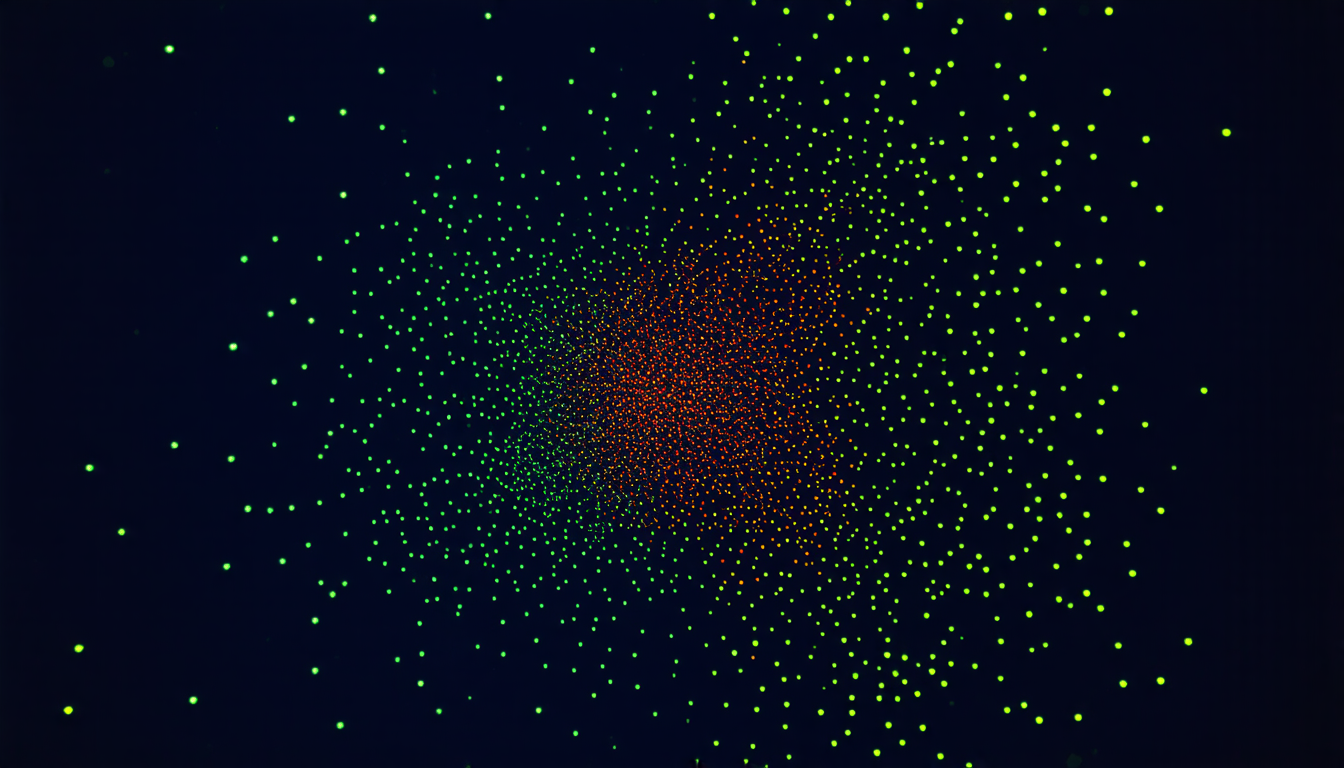
One of the key findings was the identification of five distinct clusters, each with its own unique characteristics. These clusters were determined by analyzing the probability of transitioning between different states within the dot, as well as the duration spent in these states.
The researchers found that some dots were more likely to transition quickly between high and low intensity states, while others exhibited longer periods of stability at a medium intensity level. This information can be used to better understand the behavior of quantum dots and potentially improve their performance in applications such as LEDs and solar cells.
The study also demonstrated the ability to identify subtle changes in dot behavior over time, allowing for more accurate predictions of their future behavior. This could be particularly useful in industries where precise control is critical, such as in the manufacture of high-performance electronics.
In addition to its practical applications, this research has important implications for our understanding of quantum mechanics and the behavior of tiny particles at the atomic level. The study’s findings provide new insights into the complex interactions that govern the behavior of quantum dots, and could ultimately lead to a deeper understanding of the fundamental laws of physics.
The researchers’ approach was based on a combination of machine learning algorithms and mathematical modeling techniques. They used a technique called hidden Markov models (HMMs) to analyze the data and identify patterns in the dot’s behavior. The HMMs were trained using a dataset of over 10,000 individual measurements from hundreds of quantum dots.
The study’s findings have significant implications for the development of new technologies that rely on the behavior of quantum dots. By better understanding these tiny particles, scientists can create more efficient and precise devices that take advantage of their unique properties.
In addition to its practical applications, this research has important implications for our understanding of quantum mechanics and the behavior of tiny particles at the atomic level. The study’s findings provide new insights into the complex interactions that govern the behavior of quantum dots, and could ultimately lead to a deeper understanding of the fundamental laws of physics.
Cite this article: “Unlocking the Secrets of Quantum Dot Behavior”, The Science Archive, 2025.
Quantum Dots, Machine Learning, Statistical Model, Fluctuations, Intensity, Randomness, Hidden Patterns, Cluster Analysis, Quantum Mechanics, Atomic Level.





