

Friday 28 February 2025
Radio localization, a technology that helps us pinpoint our location using radio signals, has become increasingly important in recent years. With the rise of wireless networks and devices, it’s crucial to ensure that our location data remains private and secure. A new approach to radio localization aims to achieve this by incorporating beamforming techniques to minimize energy leakage to unauthorized nodes.
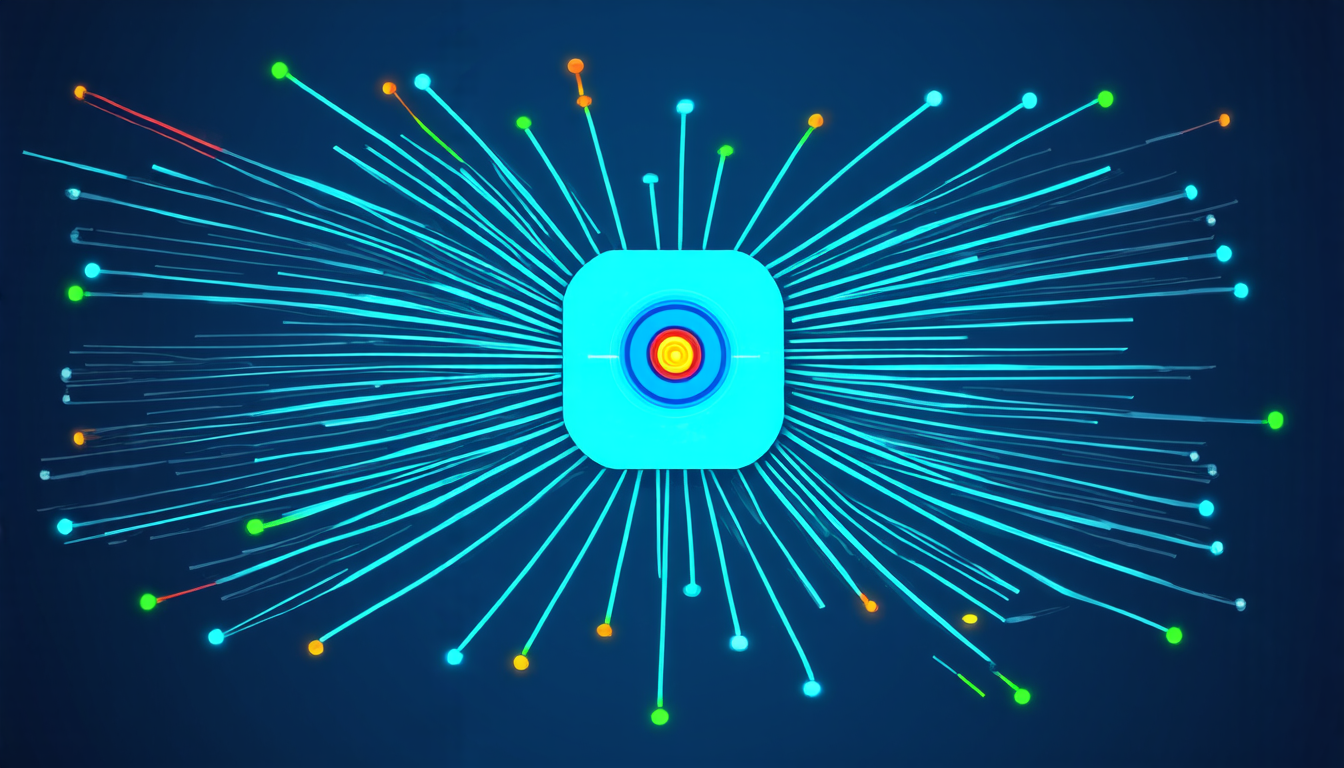
Beamforming is a method used in wireless communication systems to direct radio signals towards specific targets, such as devices or antennas. In the context of radio localization, it’s essential to focus these signals on legitimate receivers while minimizing signal strength at unauthorized nodes. This helps protect user privacy by preventing unwanted location data transmission.
Researchers have developed an optimization framework that uses penalty dual decomposition (PDD) to solve this problem. The approach involves formulating an optimization problem that minimizes the Cramér-Rao bound (CRB), a measure of the lower bound on the variance of an estimator, for legitimate localization while constraining energy leakage to unauthorized nodes.
The team used simulations to evaluate their approach and compared it with two benchmarks: one that ignores location privacy constraints and another that uses a low-complexity power allocation scheme. The results show that the proposed beamforming strategy significantly outperforms these benchmarks in terms of achieving lower CRB values for a given level of energy leakage.
The advantage of this approach lies in its ability to manage energy leakage by judiciously exploiting spatial degrees of freedom. This allows it to maintain full transmit power while satisfying location privacy constraints, unlike the benchmarks which must reduce transmit power to meet these constraints.
The implications of this research are significant for wireless communication systems that rely on radio localization. By incorporating beamforming techniques into their design, developers can create more secure and private location tracking systems. This is particularly important in applications such as autonomous vehicles, smart cities, and IoT devices, where accurate location data is critical but privacy concerns are increasingly relevant.
In the future, researchers plan to extend this work by exploring other beamforming strategies and evaluating its performance in real-world scenarios. As wireless communication systems continue to evolve, it’s essential to develop technologies that balance accuracy with privacy, ensuring that our location data remains secure and protected from unauthorized access.
Cite this article: “Secure Radio Localization through Beamforming Techniques”, The Science Archive, 2025.
Radio Localization, Beamforming, Wireless Communication, Privacy, Security, Location Tracking, Optimization Framework, Penalty Dual Decomposition, Cramér-Rao Bound, Energy Leakage.





