

Friday 28 February 2025
The fundamental laws of physics have long been thought to be incompatible with each other, particularly when it comes to gravity and quantum mechanics. The former describes the large-scale behavior of objects in the universe, while the latter governs the tiny world of atoms and subatomic particles. However, researchers have recently made significant progress in reconciling these two theories.
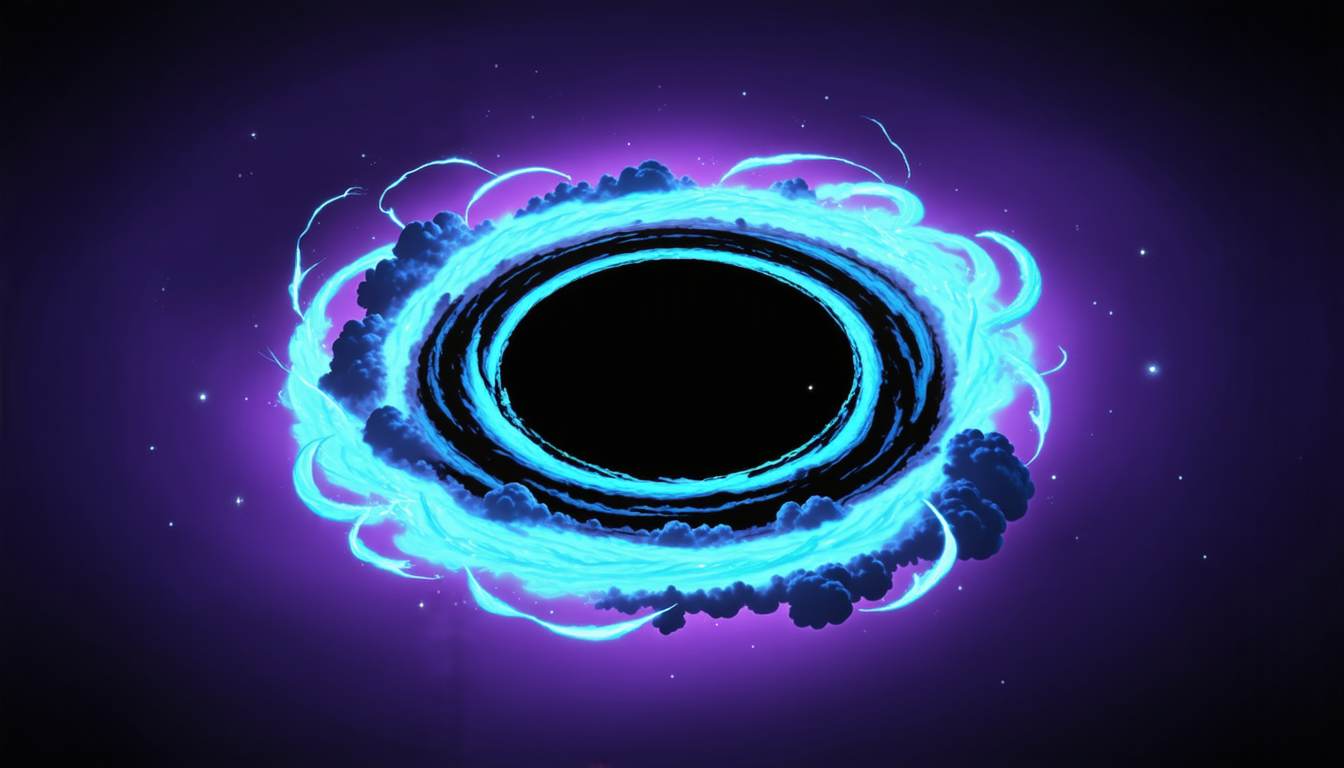
One of the key challenges is understanding how black holes behave within this framework. Black holes are regions of spacetime where gravity is so strong that not even light can escape once it gets too close. The laws of quantum mechanics suggest that black holes should emit radiation, known as Hawking radiation, due to virtual particles constantly appearing and disappearing in the vicinity of the event horizon.
But here’s the problem: this radiation seems to be incompatible with the laws of gravity. Researchers have been struggling to reconcile these two theories for decades, but a recent paper has provided new insights into how black holes might behave within this framework.
The authors used a mathematical technique called crossed products to study the behavior of black holes in a specific type of spacetime known as AdS/CFT. This approach allowed them to explore the relationship between gravity and quantum mechanics in greater detail than ever before.
One of the key findings was that the entropy, or disorder, of a black hole is not fixed but rather depends on the observer’s perspective. In other words, the information contained within a black hole is not lost forever but can be recovered by an outside observer. This challenges our traditional understanding of black holes and has significant implications for our understanding of the universe.
The authors also found that the entropy of a black hole is related to the area of its event horizon, which is the point of no return around a black hole. This relationship was first proposed by Jacob Bekenstein in the 1970s and has since been confirmed through various experiments and observations.
These findings have significant implications for our understanding of black holes and the behavior of matter at the quantum level. They also highlight the need for further research into the nature of spacetime and the laws that govern it.
In the end, this study provides a deeper understanding of the intricate dance between gravity and quantum mechanics, and it may ultimately lead to new insights into the fundamental nature of reality itself.
Cite this article: “Reconciling Gravity and Quantum Mechanics: New Insights on Black Hole Behavior”, The Science Archive, 2025.
Black Holes, Gravity, Quantum Mechanics, Hawking Radiation, Entropy, Disorder, Ads/Cft, Spacetime, Event Horizon, Quantum Level





