

Friday 28 February 2025
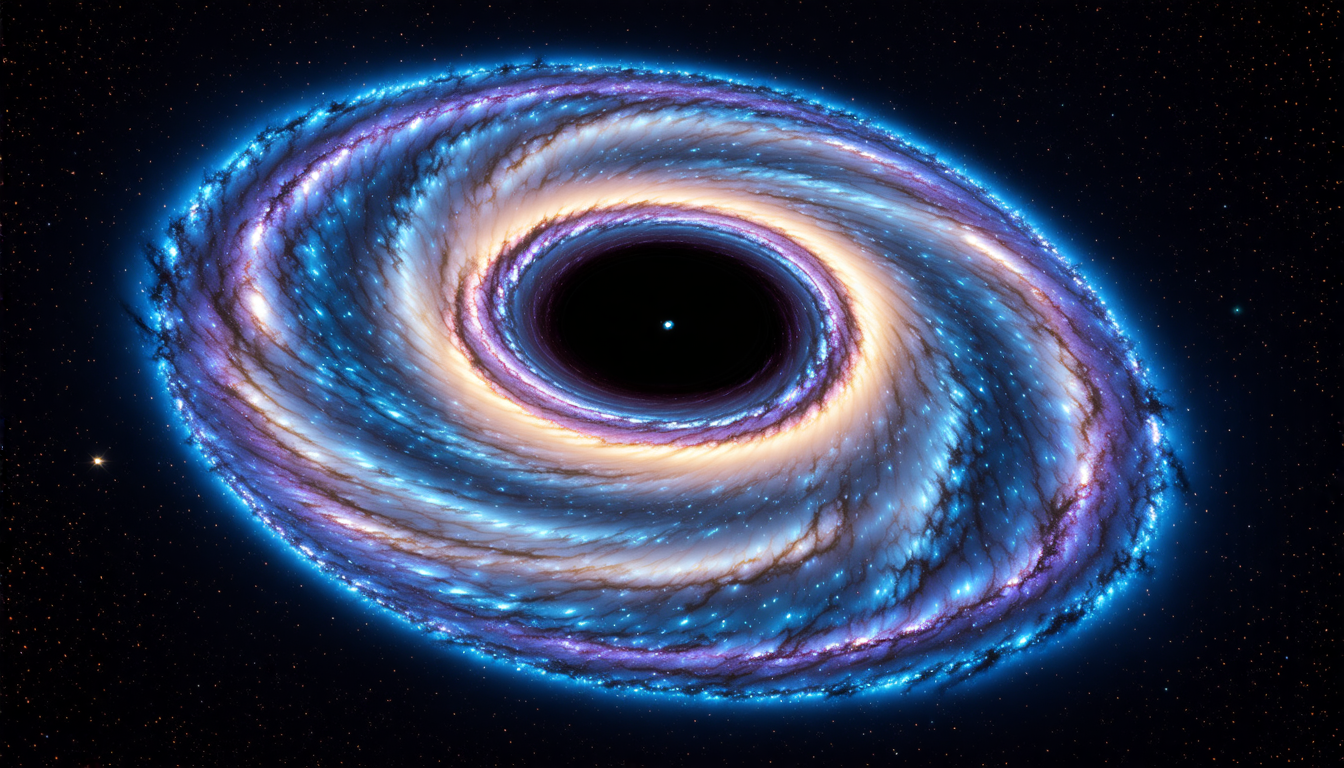
Astronomers have long been fascinated by the behemoths at the hearts of galaxies, supermassive black holes that warp space and time around them. These monsters are thought to reside in the centers of most galaxies, including our own Milky Way, and play a crucial role in shaping the evolution of these cosmic systems.
But despite their importance, very little is known about these black holes, particularly when it comes to their masses. Scientists have long struggled to accurately measure the masses of supermassive black holes, which are often shrouded in thick clouds of gas and dust that make them difficult to observe directly.
Now, a team of astronomers has made a significant breakthrough in this field, using observations from the Keck Observatory in Hawaii to determine the mass of the supermassive black hole at the heart of a galaxy called Holmberg 15A. This galaxy is located about 650 million light-years away and is one of the brightest cluster galaxies in the local universe.
To make their measurement, the team used a technique called stellar kinematics, which involves observing the motions of stars near the black hole to infer its mass. By analyzing the motion of hundreds of stars in Holmberg 15A, the scientists were able to determine that the supermassive black hole at its center has a mass of approximately 2.16 billion times that of our sun.
This measurement is significant not just because it provides new insights into the properties of this particular galaxy, but also because it offers a rare glimpse into the life cycle of supermassive black holes. By studying the masses and distributions of these black holes, scientists can gain a better understanding of how they form and evolve over time.
The discovery also raises interesting questions about the relationship between supermassive black holes and their host galaxies. For example, it’s possible that the massive stars in Holmberg 15A were once more numerous, but were eventually consumed by the growing black hole, which would have had a profound impact on the galaxy’s evolution.
The study of supermassive black holes is an active area of research, with scientists using a variety of techniques to learn more about these enigmatic objects. From X-ray and gamma-ray observations to radio astronomy and even gravitational wave detection, researchers are employing every tool at their disposal to uncover the secrets of these cosmic behemoths.
Cite this article: “Unlocking the Secrets of Supermassive Black Holes”, The Science Archive, 2025.
Supermassive Black Holes, Galaxy Evolution, Keck Observatory, Stellar Kinematics, Mass Measurement, Holmberg 15A, Astronomy, Black Hole Formation, Gravitational Waves, X-Ray Observations





