

Friday 28 February 2025
Researchers have made a significant breakthrough in understanding the properties of two-distance graphs, a type of mathematical structure that has been studied for decades. The discovery could have far-reaching implications for fields such as computer science and network analysis.
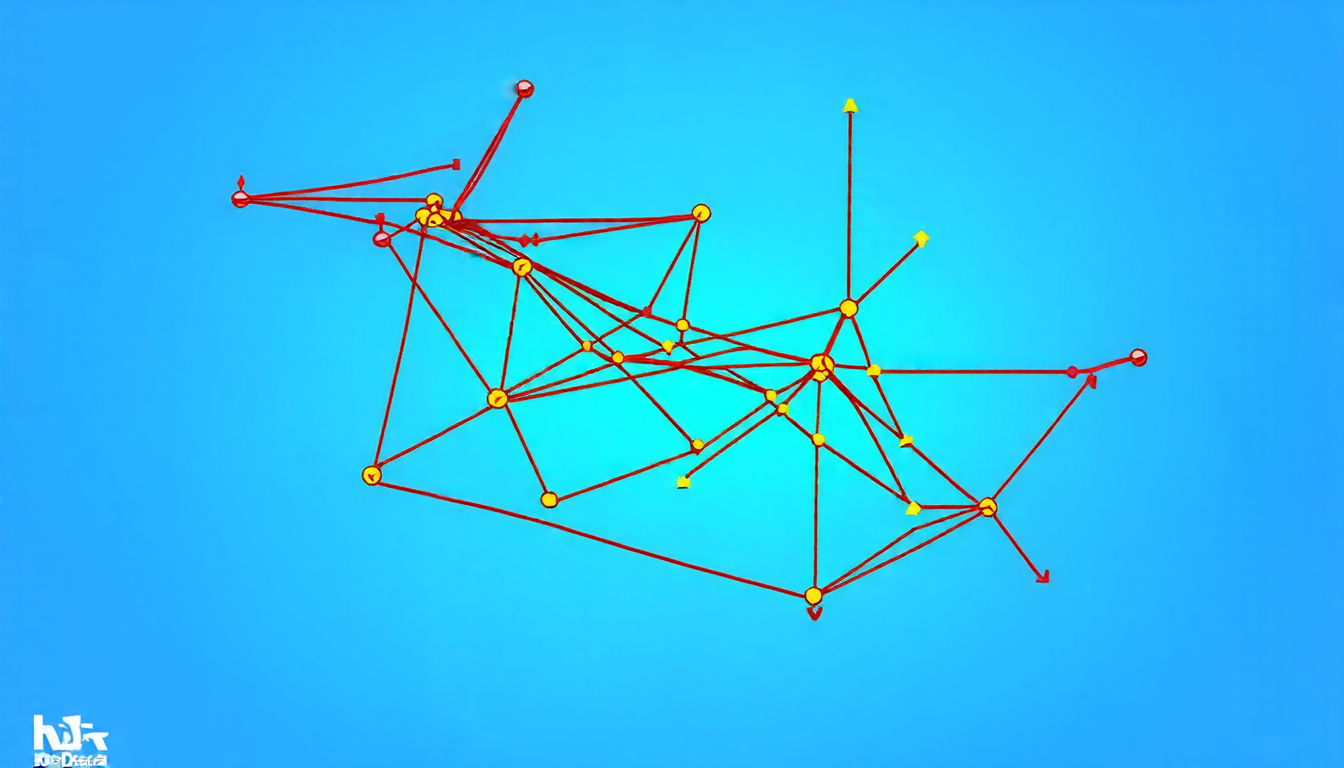
A two-distance graph is a mathematical object that consists of a set of vertices connected by edges. The distance between any two vertices is either 1 or 2, meaning that the shortest path between them is either one edge long or two edges long. These graphs have been studied extensively in mathematics because they exhibit many interesting and counterintuitive properties.
One of the key findings of the research is a new upper bound on the diameter of two-distance graphs. The diameter of a graph refers to the longest distance between any two vertices, and it has important implications for how well the graph can be traversed. In the past, researchers have been able to show that the diameter of a two-distance graph cannot exceed 2k+2, where k is the number of edges in the graph.
However, this new research suggests that the actual diameter may be significantly smaller than previously thought. In fact, the authors have shown that for graphs with a certain number of vertices, the diameter can actually be as small as 1. This is a significant finding, because it means that two-distance graphs may be more efficient and easier to traverse than previously believed.
The research also sheds light on the connectivity of two-distance graphs. Connectivity refers to whether or not there are any isolated vertices in the graph – in other words, vertices that are not connected to any other vertex by an edge. The authors have shown that for certain types of two-distance graphs, all vertices are actually connected, making it easier to traverse the graph.
The implications of this research are far-reaching. For example, computer scientists may be able to use these findings to develop more efficient algorithms for traversing complex networks. Network analysts may also be able to use this knowledge to better understand how information flows through social and biological systems.
In addition to its practical applications, this research has also shed new light on the fundamental properties of two-distance graphs. Mathematicians have long been fascinated by these objects because they exhibit many interesting and counterintuitive properties. This research has helped to deepen our understanding of these properties, and may even lead to new areas of study.
Overall, this breakthrough in understanding two-distance graphs is an important advance in mathematics and computer science.
Cite this article: “Unlocking the Secrets of Two-Distance Graphs”, The Science Archive, 2025.
Mathematics, Computer Science, Network Analysis, Graph Theory, Two-Distance Graphs, Diameter, Connectivity, Vertex, Edge, Algorithm.
Reference: Oleksiy Al-saadi, Joseph Natal, “Diameter Constraints in $2$-distance Graphs” (2025).





