

Friday 28 February 2025
A new approach to understanding complex networks has been developed by researchers, offering a more interpretable and efficient way of predicting node labels in directed graphs.
Directed graphs are everywhere – from social networks to citation databases – and understanding how nodes relate to each other is crucial for making predictions about their behavior. Traditional methods rely on machine learning models that can be opaque and difficult to interpret, leaving users wondering why certain predictions were made.
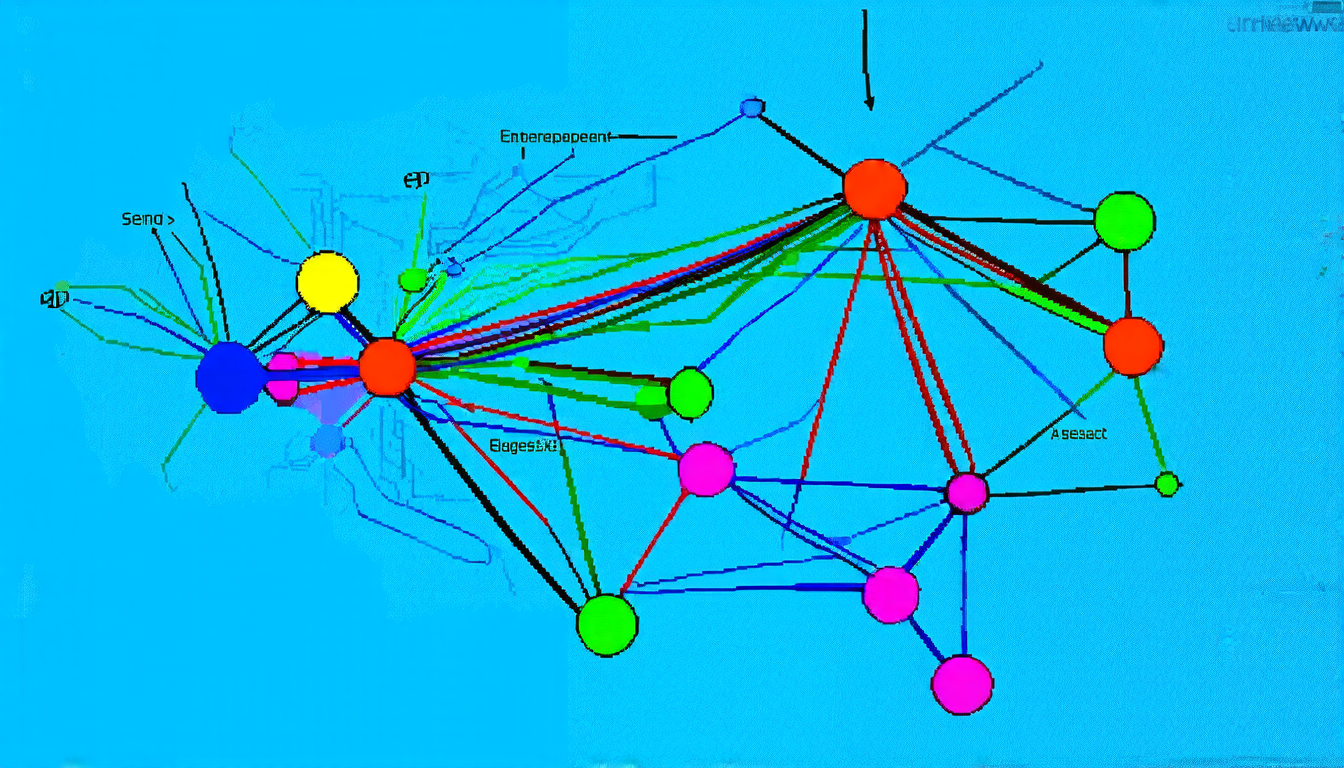
The new approach uses a probabilistic model to describe the underlying behavior of the data presented in a directed graph. This model allows researchers to define the degree and label distribution, as well as the behavior of labels connected nodes. By using this framework, scientists can make more accurate predictions about node labels while also gaining insight into why certain predictions were made.
The team tested their approach on two datasets – one adapted from the Math Genealogy Project, which has not been used for this purpose before, and another, the ogbn-arxiv dataset. In both cases, the new method outperformed traditional machine learning models and offered more interpretable results.
One of the key advantages of the new approach is its ability to handle directed graphs, where the relationships between nodes are asymmetric. Traditional methods often struggle with this type of data, leading to inaccurate predictions. The probabilistic model developed by the researchers can capture these asymmetries, allowing for more accurate predictions and better understanding of the underlying behavior.
The team’s findings have significant implications for a wide range of fields, from social network analysis to citation prediction. By providing a more interpretable and efficient way of making predictions about node labels, this approach could revolutionize how researchers analyze complex networks.
In the future, the researchers plan to explore the application of their model to graphs that do not satisfy the homophily property – where connected nodes are likely to have different labels. This could lead to valuable insights and satisfactory predictive performance in such graphs.
The new approach offers a promising direction for understanding complex networks and making accurate predictions about node labels. By providing a more interpretable and efficient way of analyzing directed graphs, this research has the potential to transform our understanding of these intricate systems.
Cite this article: “Deciphering Complex Networks: A Probabilistic Approach to Node Label Prediction”, The Science Archive, 2025.
Directed Graphs, Complex Networks, Node Labels, Predictive Modeling, Machine Learning, Probabilistic Model, Homophily Property, Social Network Analysis, Citation Prediction, Interpretability





