

Friday 28 February 2025
The intricate dance of ripples and curvature in graphene, a material known for its remarkable strength and conductivity, has long been a subject of fascination among scientists. While researchers have made significant progress in understanding the properties of this wonder material, there is still much to be discovered about how it behaves under different conditions.
A recent study delves into the effects of ripples, curvature, and grain boundaries on the thermal conductivity of graphene. Thermal conductivity is a crucial property that determines how well a material can dissipate heat, making it essential for applications such as electronics and energy storage.
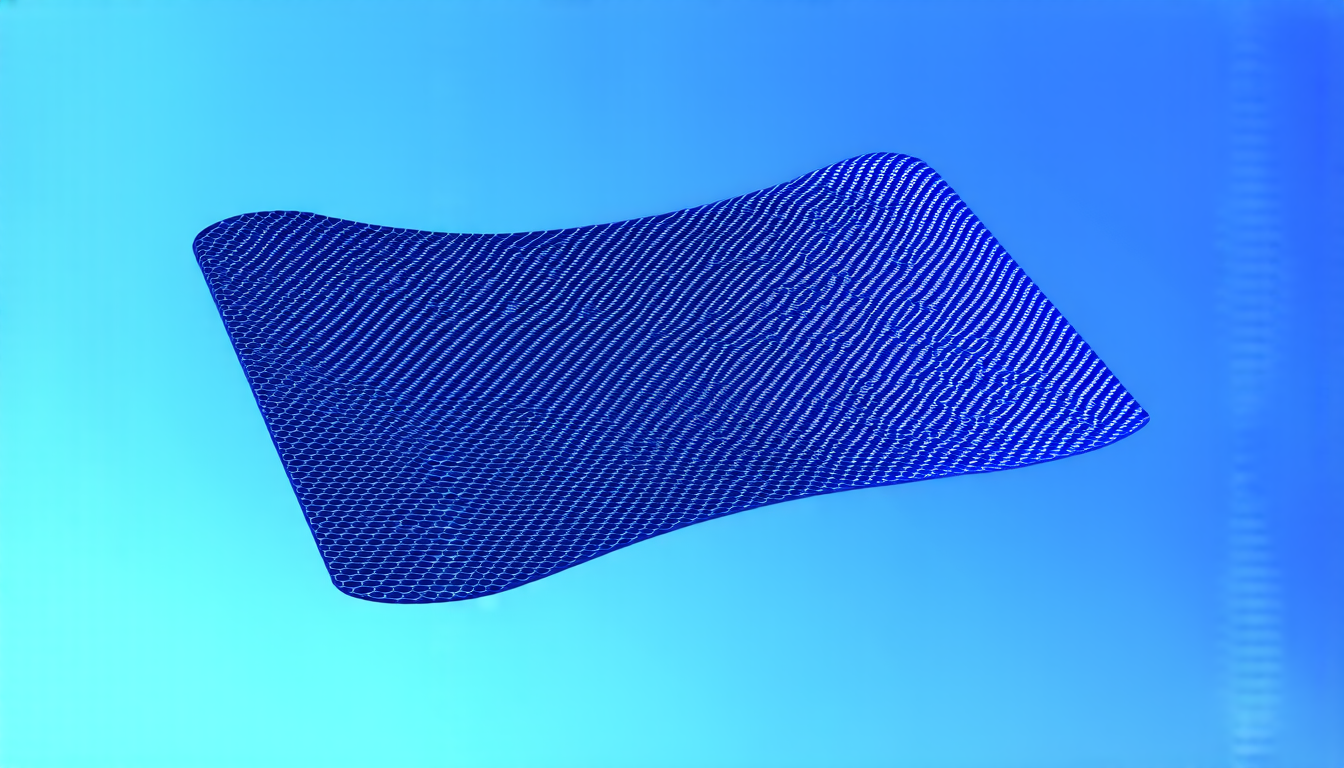
The researchers used advanced computer simulations to model the behavior of graphene under various conditions. They found that ripples in the material’s surface can significantly reduce its thermal conductivity, a phenomenon previously observed but not fully understood.
Moreover, the team discovered that curvature, or bending, of the graphene sheet also impacts its thermal conductivity. The degree of reduction depends on the magnitude and direction of the curvature, with more extreme curvatures leading to greater reductions in conductivity.
The researchers also explored the effects of grain boundaries, which are natural defects in the material’s structure that can occur when it is grown or processed. They found that these boundaries can significantly affect thermal conductivity, particularly at higher temperatures.
One of the most surprising findings was the discovery that ripples alone can reduce thermal conductivity by up to 61% in larger unstrained samples. This highlights the importance of considering the material’s surface roughness and curvature when designing applications that rely on its thermal properties.
The study’s results have significant implications for the development of new technologies that utilize graphene, such as more efficient electronics and energy storage devices. By better understanding how this remarkable material behaves under different conditions, scientists can optimize its use in a wide range of applications.
The researchers’ findings also underscore the importance of considering the intricate interactions between ripples, curvature, and grain boundaries when designing materials with specific properties. This knowledge will be crucial for developing new materials that can meet the demands of emerging technologies.
In this study, the researchers have taken a significant step towards unlocking the secrets of graphene’s thermal conductivity. By continuing to explore the material’s behavior under different conditions, scientists may uncover even more surprising insights into its remarkable properties and potential applications.
Cite this article: “Ripples, Curvature, and Grain Boundaries: Unveiling the Thermal Conductivity Secrets of Graphene”, The Science Archive, 2025.
Graphene, Thermal Conductivity, Ripples, Curvature, Grain Boundaries, Surface Roughness, Electronics, Energy Storage, Materials Science, Nanotechnology.





