

Friday 28 February 2025
The quest for a deeper understanding of the universe is an ongoing one, driven by humanity’s innate curiosity about the mysteries that lie beyond our planet. One area where scientists have made significant strides in recent years is in the field of exoplanetary science, which has led to the discovery of thousands of planets orbiting other stars. Among these discoveries are a select few that hold great promise for helping us better understand how planetary systems form and evolve.
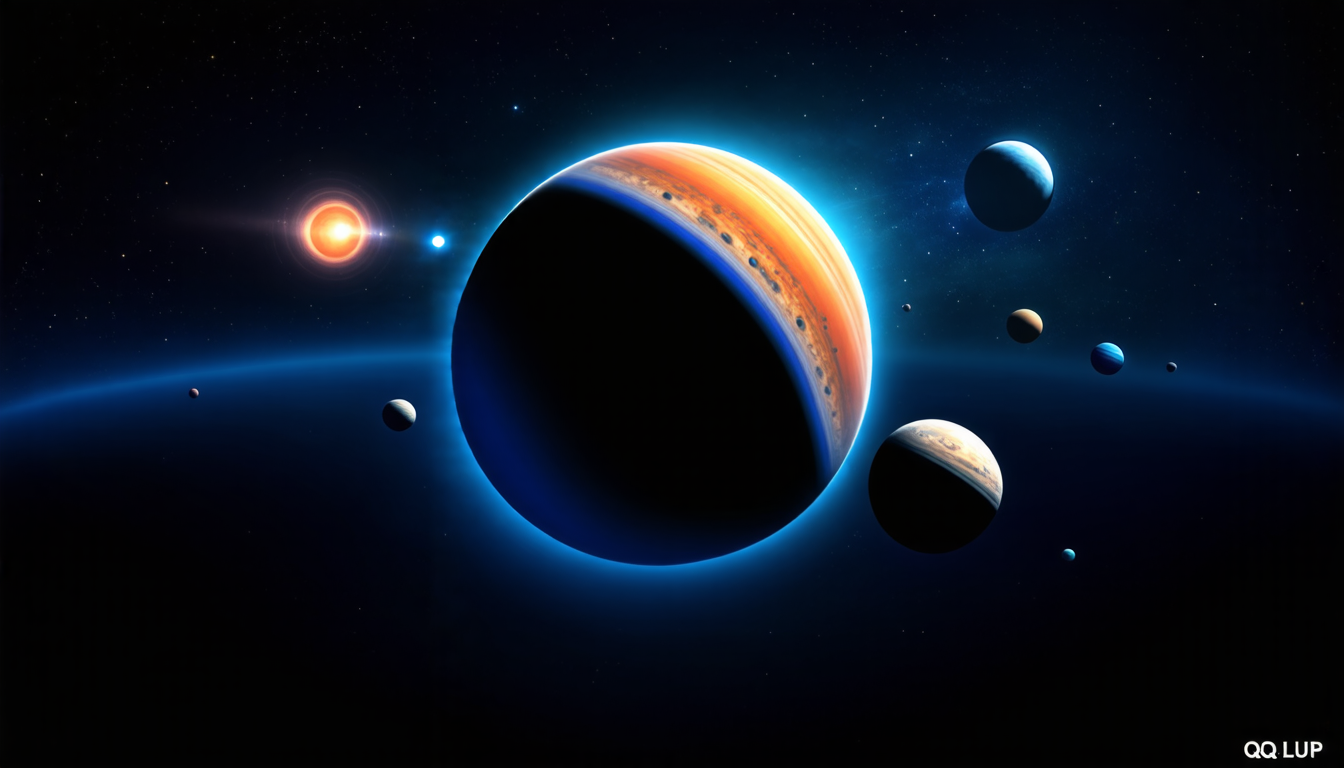
One such system is GQ Lup, located about 42 light-years from Earth. It consists of a young star, GQ Lup A, and its companion, GQ Lup B, a massive planet orbiting the star at a distance that’s relatively close by astronomical standards. The team behind this study has been studying GQ Lup B for several years now, seeking to learn more about its composition and atmospheric properties.
Their latest findings have shed new light on the chemical makeup of GQ Lup B, which is thought to be a super-Jupiter, a type of planet that’s much larger than our own Jupiter. The researchers used advanced spectroscopic techniques to analyze the planet’s atmosphere, focusing on the presence of certain elements and molecules.
What they found was intriguing: the ratio of carbon-12 to carbon-13 in GQ Lup B’s atmosphere is surprisingly similar to that found in its host star, GQ Lup A. This suggests that the two may have formed from a common source material, rather than being distinct entities that developed separately. The implications of this discovery are significant, as it could challenge our current understanding of planetary formation and evolution.
The study also revealed other interesting details about GQ Lup B’s atmosphere. For example, it appears to contain more water vapor and heavier elements like sodium and calcium than previously thought. These findings have important implications for our understanding of the planet’s composition and potential habitability.
One of the most significant aspects of this research is its use of advanced computational models to simulate the behavior of GQ Lup B’s atmosphere. These models allowed the researchers to test different scenarios and refine their predictions, ultimately leading to a more accurate understanding of the planet’s properties.
The study’s findings have far-reaching implications for our understanding of exoplanetary science and the search for life beyond Earth. By studying systems like GQ Lup, scientists can gain valuable insights into how planets form and evolve, which in turn can inform the design of future missions aimed at detecting biosignatures or even establishing human settlements on other worlds.
Cite this article: “GQ Lup: A Glimpse into the Formation and Evolution of Exoplanetary Systems”, The Science Archive, 2025.
Exoplanetary Science, Gq Lup, Super-Jupiter, Spectroscopy, Carbon-12, Carbon-13, Planetary Formation, Evolution, Habitability, Biosignatures, Computational Modeling





