

Friday 28 February 2025
Soft hairs on surfaces can significantly impact the flow of fluids around them, a phenomenon that’s crucial in many biological and industrial systems. Researchers have long studied this interaction at the microscale, but a new study sheds light on how it plays out at the macroscale.
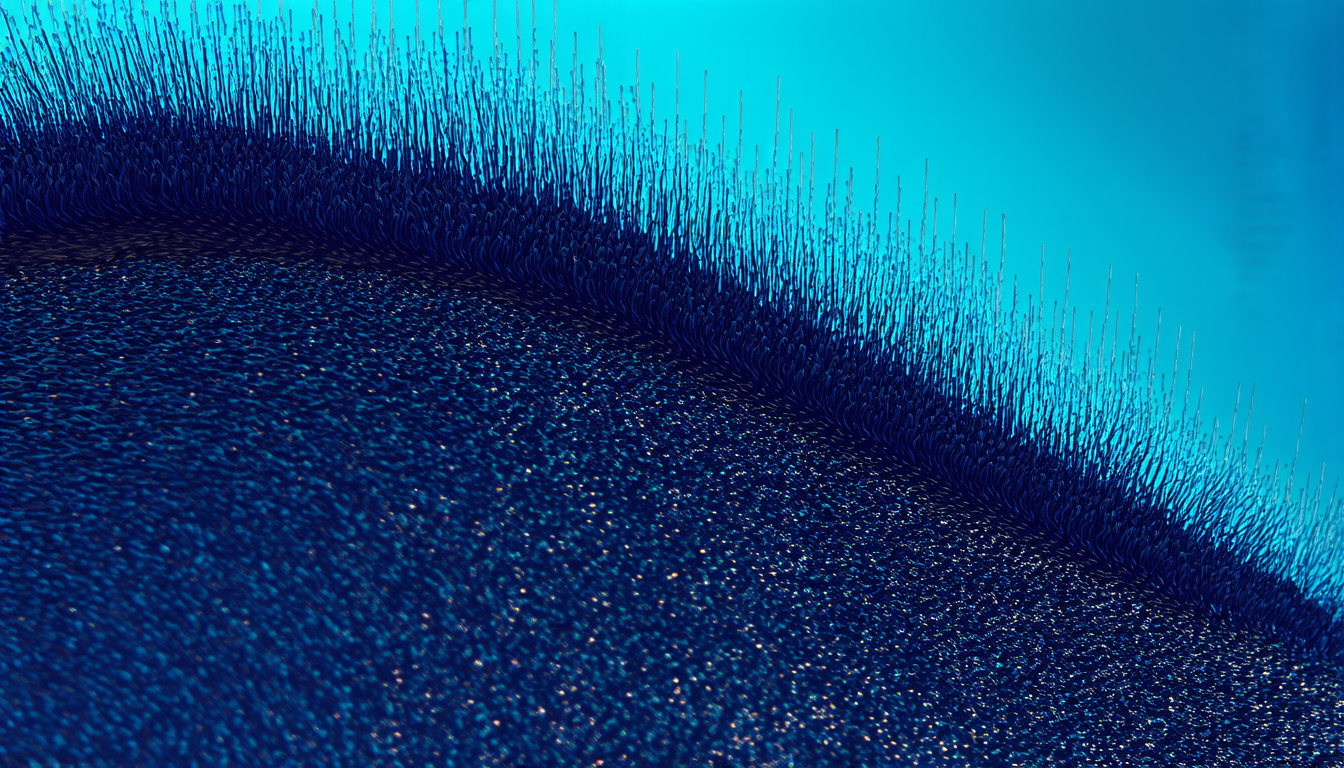
The study focuses on dense arrays of elastic hairs protruding from surfaces, like those found on fur or grass blades. These soft structures can alter the flow properties around them, which has significant implications for fluid dynamics and engineering applications. To better understand this interaction, scientists created a model that simulates the behavior of these hairs in response to fluid flows.
The researchers used a combination of experimental and theoretical approaches to investigate pressure-driven flows in laminar channels obstructed by dense arrays of elastic hairs. They designed an experimental setup with a channel containing a bed of hairs made from silicone elastomer, which was then subjected to various flow rates. The team observed how the hairs deformed under these conditions and measured the resulting changes in fluid flow.
The results showed that the system exhibited a nonlinear hydraulic resistance that depended on the density of the hair bed, the Young modulus of the hairs, and the channel height. By modeling this behavior using a deformable porous media framework, the researchers were able to predict how the hair beds would respond to different flow conditions.
One key finding was that the hair tips deformed significantly under high flow rates, which in turn affected the flow properties around them. This deformation also changed the effective permeability of the hair bed, allowing for more accurate predictions of fluid flow.
The study’s findings have significant implications for various fields, including biology, engineering, and materials science. For instance, understanding how soft hairs interact with fluids can help researchers design more efficient microfluidic devices or develop new biomimetic materials.
Moreover, this research could lead to advancements in the development of novel sensors, filters, and actuators that rely on fluid-structure interactions. The study’s authors also suggest that their findings may have implications for the design of artificial organs, such as prosthetic limbs or implantable devices.
Overall, this research provides new insights into the complex interplay between soft hairs and fluids, shedding light on a crucial aspect of biological systems and engineering applications. By better understanding these interactions, scientists can develop more effective solutions for real-world problems.
Cite this article: “Soft Hair Dynamics: Unlocking Insights into Fluid Flow Interactions”, The Science Archive, 2025.
Fluid Dynamics, Soft Hairs, Fluid Flow, Porous Media, Deformable Materials, Microscale, Macroscale, Biomimetic Materials, Microfluidic Devices, Hydraulic Resistance
Reference: Etienne Jambon-Puillet, “Dense array of elastic hairs obstructing a fluidic channel” (2025).





