

Friday 28 February 2025
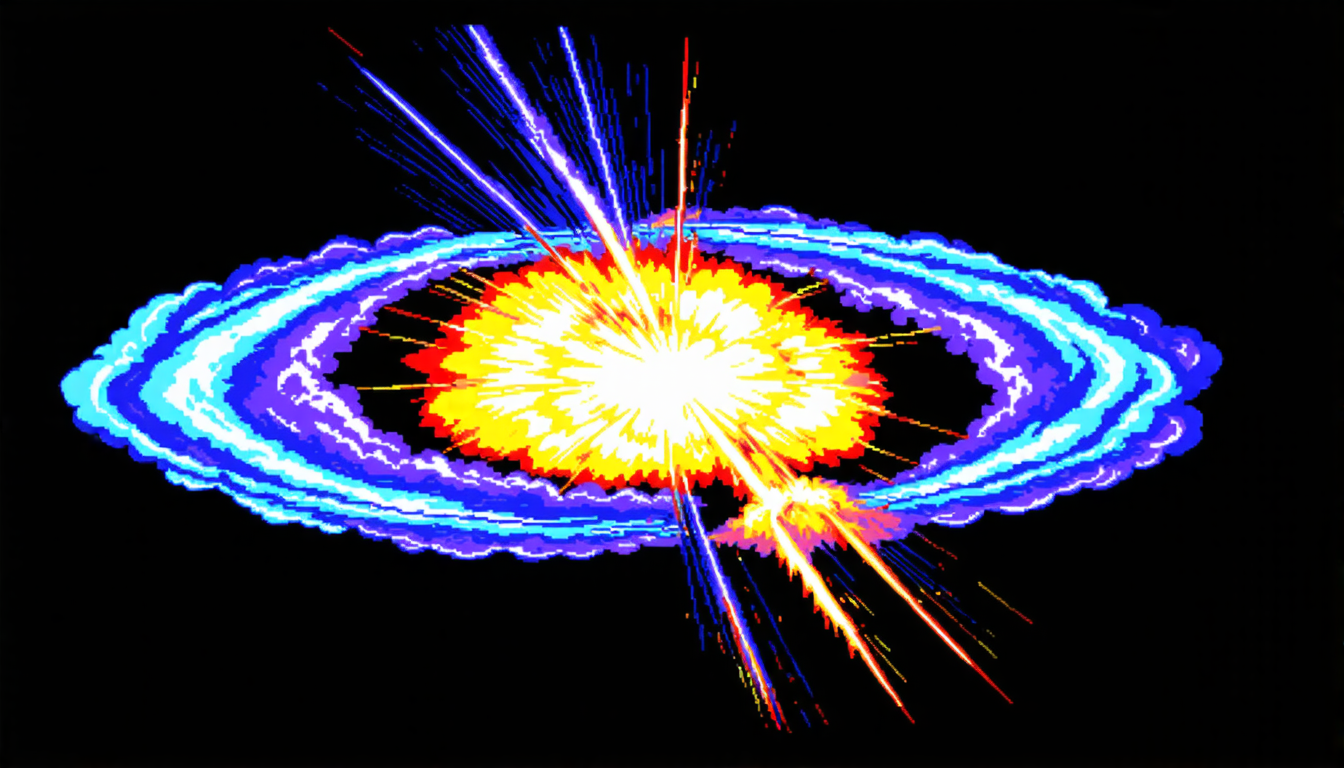
Scientists have been studying a distant explosion known as Gamma-Ray Burst (GRB) 200131A, and their findings are shedding light on the mysterious events that occur in the universe. GRBs are brief, intense explosions of energy that release enormous amounts of radiation into space.
The team used a combination of robotic telescopes and archival data to study the afterglow of GRB 200131A, which was detected by the Swift satellite just over a minute after the initial explosion. The afterglow is the lingering glow that remains in the sky after the initial burst has faded.
By analyzing the light curve of the afterglow, the scientists were able to identify two distinct components: an early reverse shock and a later forward shock. The reverse shock is thought to be caused by the explosion itself, while the forward shock is the result of the explosion interacting with the surrounding material in space.
The team’s findings suggest that GRB 200131A occurred at a distance of about 3.4 billion light-years from Earth, and that it was likely caused by the collapse of a massive star. The explosion released an enormous amount of energy, equivalent to tens of thousands of times the total energy output of our sun.
One of the most interesting aspects of GRB 200131A is its early optical afterglow, which was detected just 63 seconds after the initial burst. This is remarkably fast, and it suggests that the explosion may have been powered by a relativistic fireball that expanded at nearly the speed of light.
The team’s analysis also revealed evidence for a late-time jet break, which is thought to be caused by the interaction between the explosion and the surrounding material in space. This jet break is an important clue for understanding the physics of GRBs, as it can provide insights into the properties of the explosion and the environment in which it occurred.
Overall, the study of GRB 200131A provides new insights into the mysterious events that occur in the universe, and it highlights the importance of continued research into these phenomena. By studying GRBs, scientists can gain a better understanding of the fundamental laws of physics and the behavior of matter under extreme conditions.
Cite this article: “Unveiling the Mysteries of Gamma-Ray Burst 200131A”, The Science Archive, 2025.
Gamma-Ray Burst, Grb 200131A, Swift Satellite, Afterglow, Reverse Shock, Forward Shock, Relativistic Fireball, Jet Break, Astrophysics, Physics





