

Saturday 01 March 2025
The intricate dance of election outcomes has long fascinated researchers and pollsters alike. For decades, scientists have sought to understand the complex interplay of factors that influence voter behavior, from demographics and party loyalty to economic conditions and media coverage.
Now, a new study has shed light on another crucial aspect of election dynamics: the role of voter turnout in shaping electoral outcomes. By analyzing data from Indian elections over several decades, researchers have uncovered a surprising pattern: the distribution of vote shares among candidates is not random, but rather follows a predictable pattern that can be explained by the number of voters who turn out to cast their ballots.
The study’s authors used a statistical model called the Random Voting Model (RVM) to simulate election outcomes under different scenarios. By varying factors such as voter turnout and the number of candidates in each race, they were able to generate a range of possible outcomes that mirrored real-world elections.
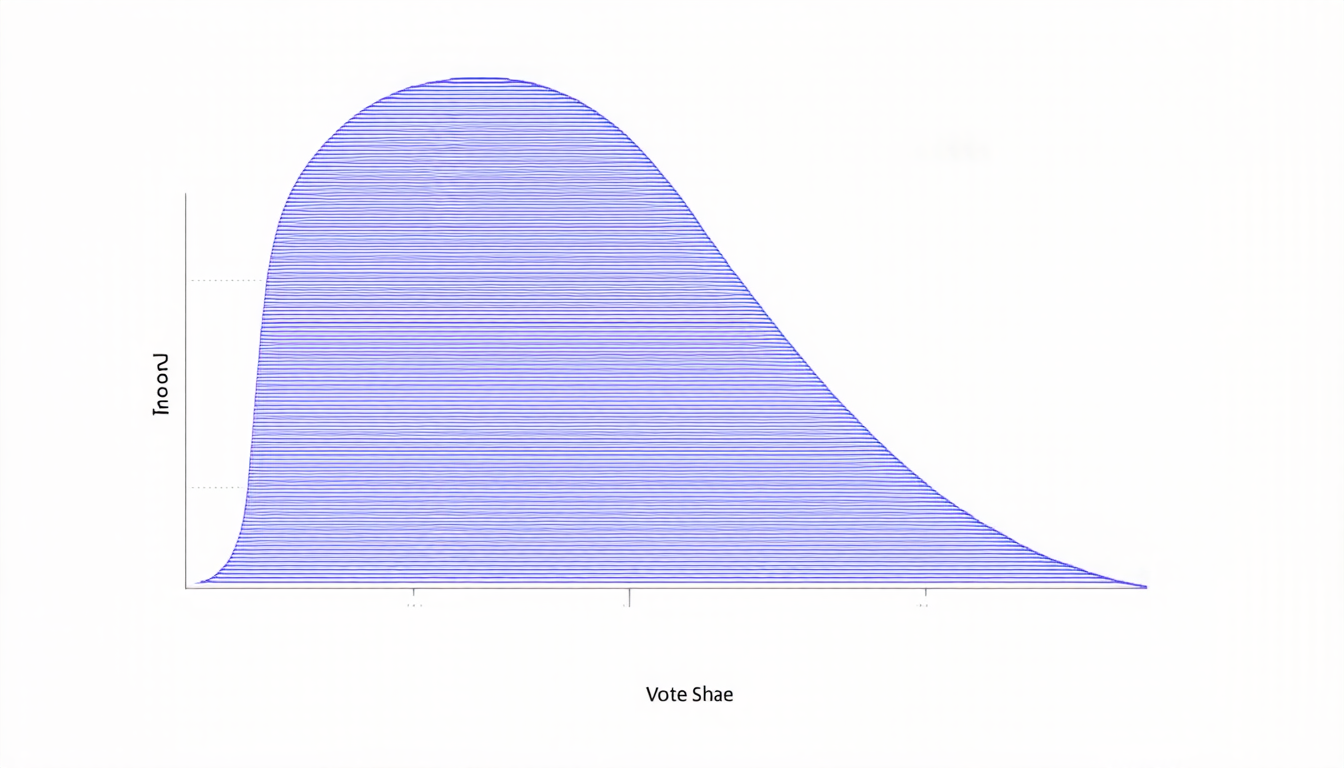
One of the key findings was that the distribution of vote shares is highly dependent on voter turnout. When more people turn out to vote, the margin between winning and losing candidates tends to narrow, while the distribution of votes becomes more skewed towards the winner.
This pattern holds true across different electoral scales, from polling booths to parliamentary constituencies. The researchers found that the scaled distributions of vote shares and margins are surprisingly consistent, regardless of the number of voters or candidates involved.
But what does this mean for election outcomes? In practical terms, it suggests that voter turnout is a critical factor in determining which candidate wins and by how much. By understanding these patterns, pollsters and political strategists may be able to better predict electoral outcomes and tailor their campaigns accordingly.
The study’s authors also explored the implications of their findings for democratic systems around the world. They argued that a better understanding of voter behavior can help policymakers design more effective election systems, from voter registration drives to campaign finance reforms.
As researchers continue to refine our understanding of election dynamics, one thing is clear: the outcome of any given election is always subject to multiple factors and uncertainties. But by unlocking the secrets of voter turnout, scientists may be able to provide valuable insights that can inform and improve the democratic process.
Cite this article: “The Role of Voter Turnout in Shaping Election Outcomes”, The Science Archive, 2025.
Election, Voter Turnout, Vote Shares, Statistical Model, Random Voting Model, Election Outcomes, Polling Booths, Parliamentary Constituencies, Campaign Strategy, Democratic Systems.





