

Saturday 01 March 2025
For centuries, mathematicians have been fascinated by the properties of algebraic curves and surfaces. These mathematical objects are defined as sets of points in space that satisfy certain equations, and they play a crucial role in many areas of mathematics, physics, and computer science.
Recently, a team of researchers made a significant breakthrough in understanding the behavior of algebraic hypersurfaces – high-dimensional analogues of curves and surfaces. In their study, they showed that there exists a point on such a hypersurface that does not lie on any degree d hypersurface defined over a finite field with q elements.
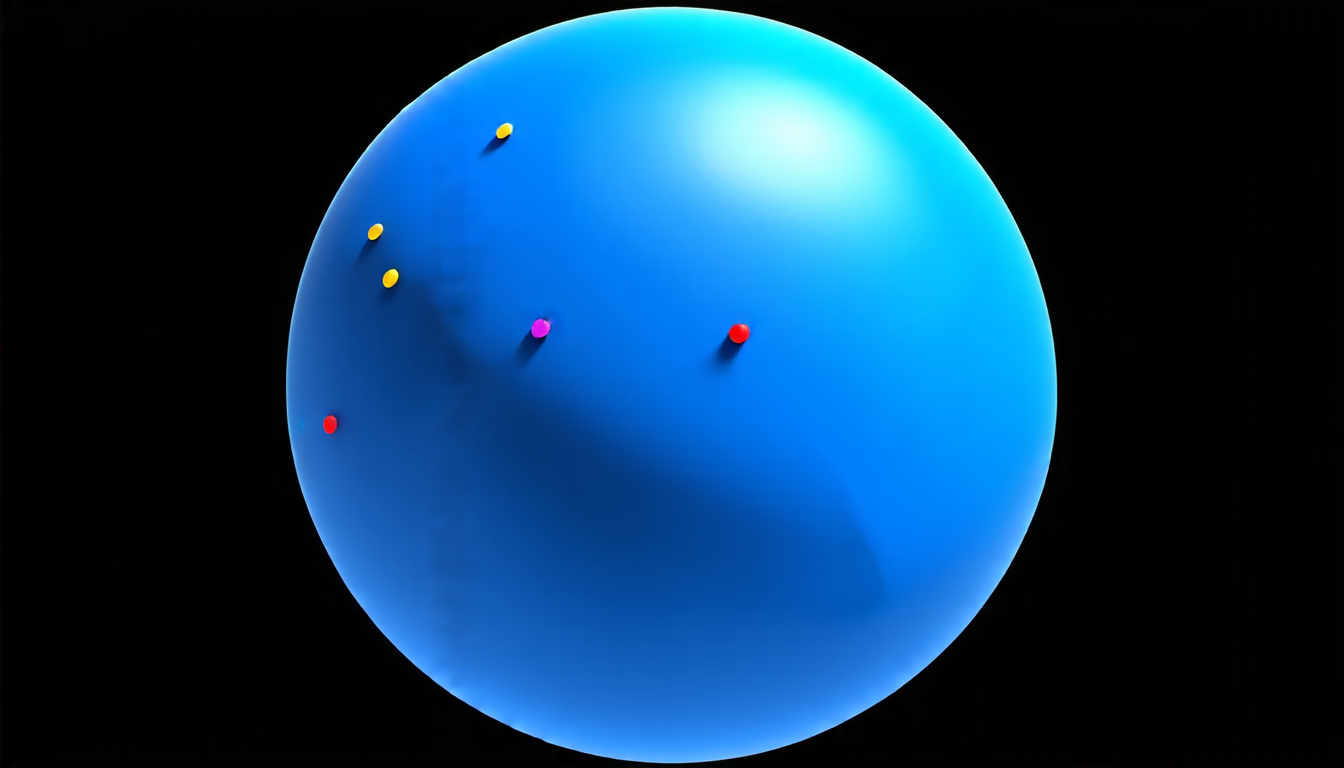
To put this result into perspective, consider a sphere in three-dimensional space. The sphere is an algebraic surface defined by the equation x^2 + y^2 + z^2 = 1. Now imagine trying to find a point on the sphere that does not lie on any plane passing through it. This seems like an impossible task, as there are infinitely many planes that can be drawn through the sphere.
However, the researchers’ result shows that this is possible even in higher-dimensional spaces. Specifically, they proved that for any positive integers n and d, and separable field extension L/K with degree r, there exists a point P in Pn(L) such that the vector space of degree d forms over K that vanish at P has the expected dimension.
The significance of this result lies in its implications for various areas of mathematics and computer science. For instance, it has important consequences for coding theory, cryptography, and computational complexity theory. It also sheds light on the properties of algebraic curves and surfaces, which are essential in many applications, such as computer vision, robotics, and machine learning.
The researchers used a combination of techniques from algebraic geometry, number theory, and combinatorics to prove their result. They first established a connection between the dimension of the vector space of degree d forms vanishing at P and the Galois orbit of P. Then, they used this connection to construct a linear system of hypersurfaces passing through P that satisfies certain properties.
The study is remarkable not only for its mathematical significance but also for its potential applications in various fields. For instance, it can be used to improve the design of error-correcting codes and cryptographic algorithms. It also has implications for the study of algebraic curves and surfaces, which are essential in many areas of mathematics and computer science.
Cite this article: “A Breakthrough in Algebraic Hypersurfaces”, The Science Archive, 2025.
Algebraic Geometry, Algebraic Hypersurfaces, Coding Theory, Cryptography, Computational Complexity Theory, Computer Vision, Robotics, Machine Learning, Number Theory, Combinatorics.





