

Saturday 01 March 2025
A team of researchers has made a significant breakthrough in the field of medical imaging, developing a new approach to detect and diagnose prostate cancer more accurately. The innovative technique uses a combination of machine learning algorithms and radiomics features to reduce false positives and improve patient outcomes.
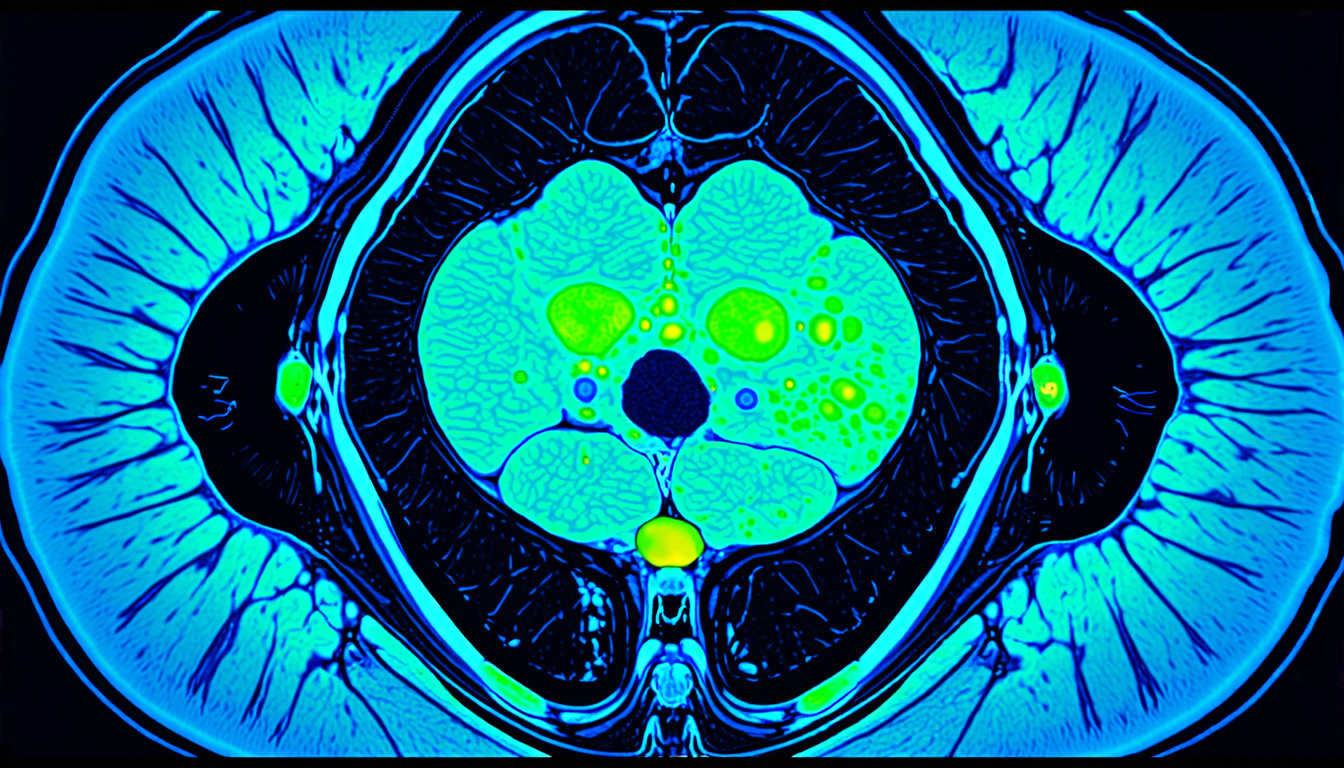
The study, published in a leading scientific journal, focuses on bi-parametric magnetic resonance imaging (bpMRI) scans, which are commonly used to screen for prostate cancer. However, the accuracy of these scans is limited by the presence of false positives, which can lead to unnecessary biopsies and treatments.
To address this issue, the researchers developed a two-stage approach that leverages the power of machine learning and radiomics features. The first stage involves extracting candidate regions of interest (ROIs) from the bpMRI scans using a data-driven radiomics method called RadHop. This technique analyzes the intensity patterns in the images to identify suspicious areas that may harbor cancer.
The second stage uses a custom convolutional neural network (CNN) called RadHop-Net to refine the ROIs and reduce false positives. The CNN is trained on a dataset of labeled bpMRI scans and learns to recognize the subtle differences between benign and malignant tissue. By incorporating radiomics features into the model, RadHop-Net can compensate for errors in the initial ROI selection and improve the overall accuracy of the diagnosis.
The researchers tested their approach on a large dataset of bpMRI scans from patients with prostate cancer and found that it significantly outperformed traditional methods in detecting true positives while reducing false positives. The study also demonstrated that the RadHop-Net model can be trained to recognize specific patterns of tumor growth, allowing for more accurate staging and treatment planning.
The implications of this research are significant, as it has the potential to improve patient outcomes by reducing unnecessary biopsies and treatments. By providing a more accurate diagnosis, doctors can make informed decisions about the best course of treatment for each patient, leading to better health outcomes and reduced healthcare costs.
Overall, this innovative approach combines the strengths of machine learning and radiomics features to develop a more accurate and efficient method for detecting prostate cancer. As medical imaging technology continues to evolve, researchers like these are pushing the boundaries of what is possible, paving the way for new treatments and improved patient care.
Cite this article: “Accurate Prostate Cancer Detection Using Machine Learning and Radiomics Features”, The Science Archive, 2025.
Prostate Cancer, Medical Imaging, Machine Learning, Radiomics, Bi-Parametric Mri, False Positives, Convolutional Neural Network, Diagnosis Accuracy, Patient Outcomes, Healthcare Costs.





