

Saturday 01 March 2025
The delicate dance of chaos and order in complex systems has long fascinated scientists. Researchers have been studying how these intricate networks behave, searching for clues about what drives their behavior and how they respond to perturbations.
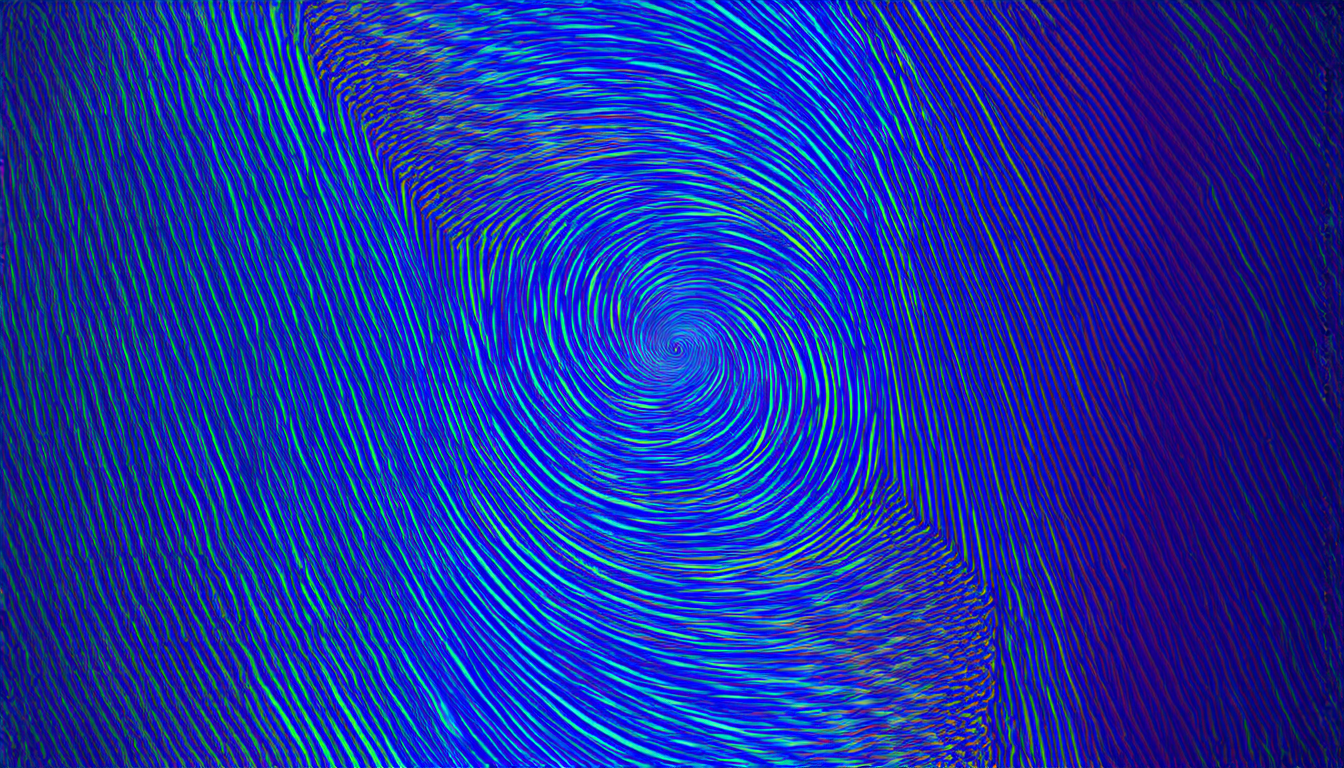
A recent paper takes a closer look at this phenomenon by examining the decay of normally hyperbolic invariant manifolds (NHIMs) – stable patterns that emerge in chaotic systems. The authors use a novel approach to visualize these patterns, creating a new tool for understanding complex dynamics.
The team’s research begins with an analysis of a classic example: the motion of an electron in a magnetic field. They show how this seemingly simple system exhibits chaotic behavior when perturbed, leading to the destruction of its stable patterns.
To better understand this process, the researchers developed a time delay function, which acts as an indicator for phase space structures. This tool allows them to visualize the decay of NHIMs and track their transformation into more complex patterns.
The results are striking: the team finds that the decay of NHIMs is accompanied by transient effects, where chaotic behavior appears briefly before giving way to new stable patterns. These transients play a crucial role in shaping the overall dynamics of the system.
The authors also explore the relationship between these transient effects and the internal dynamics of NHIMs. They find that the tangential instability of these manifolds is key to understanding how they decay and reform into new patterns.
This research has significant implications for our understanding of complex systems, from chemical reactions to climate modeling. By developing better tools for visualizing and analyzing these intricate networks, scientists can gain a deeper understanding of their behavior and make more accurate predictions about how they will respond to changes.
The team’s work offers a fascinating glimpse into the intricate dance between chaos and order in complex systems, and its implications are sure to resonate with researchers across multiple disciplines.
Cite this article: “Unraveling Chaos: A Novel Approach to Understanding Complex Dynamics”, The Science Archive, 2025.
Complexity, Chaos Theory, Invariant Manifolds, Phase Space, Time Delay Function, Transient Effects, Tangential Instability, Magnetic Field, Electron Motion, Dynamical Systems.





