

Saturday 01 March 2025
Scientists have made a significant breakthrough in understanding the behavior of Bose-Einstein condensates, exotic states of matter that occur at extremely low temperatures. By studying these condensates, researchers have been able to gain insights into the fundamental laws of physics and develop new technologies.
One of the most fascinating aspects of Bose-Einstein condensates is their ability to exhibit wetting behavior. Wetting occurs when a liquid spreads across the surface of another substance, such as water on glass or oil on metal. In the case of Bose-Einstein condensates, this wetting behavior can occur without the need for physical contact between the two substances.
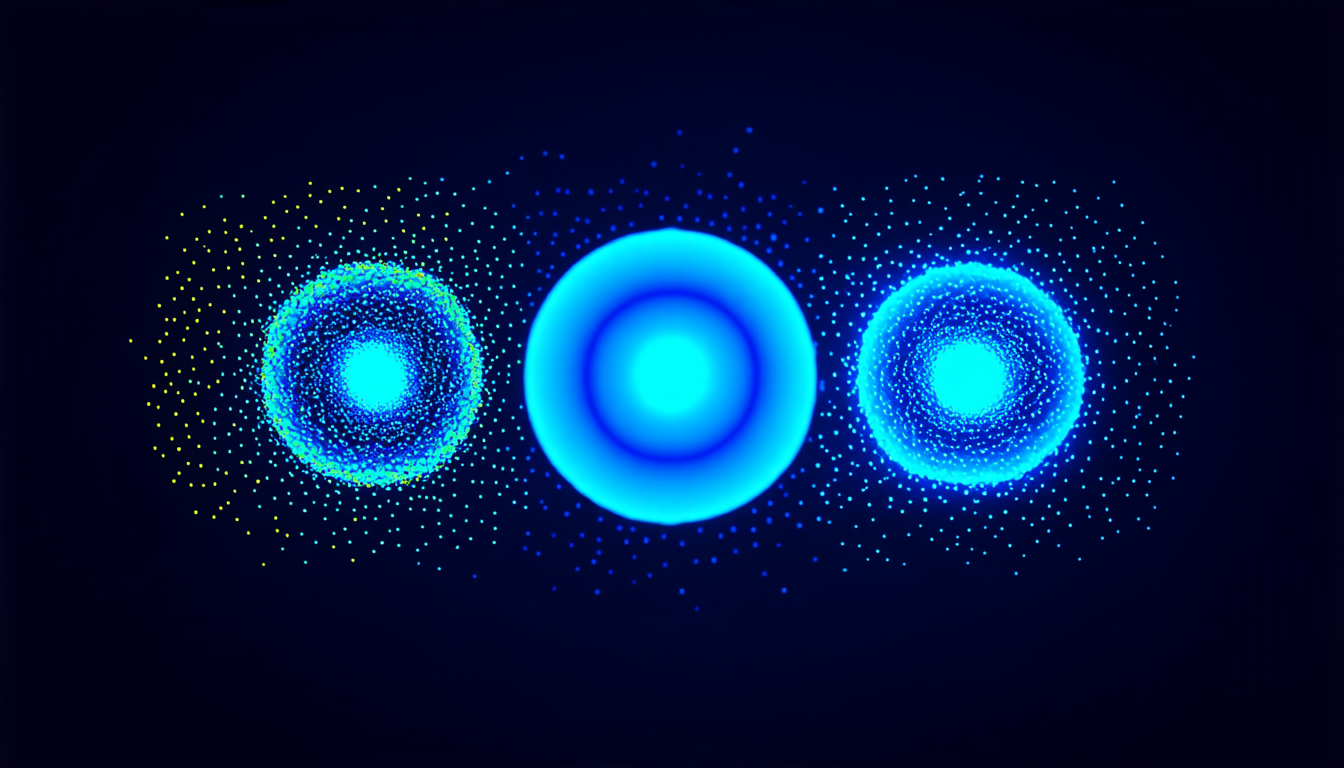
To study this phenomenon, researchers created a system consisting of three different components: two immiscible liquids and a surfactant that acts as a wetting agent. The immiscible liquids were chosen because they have different properties, such as density or viscosity, which affect how they interact with each other.
The researchers used computer simulations to model the behavior of these substances and found that the surfactant was able to induce wetting behavior between the two immiscible liquids. This behavior occurred at specific temperatures and concentrations of the surfactant.
In addition to understanding the fundamental physics behind this phenomenon, the study also has practical applications. For example, it could be used to develop new materials or technologies that are capable of wetting without physical contact.
The researchers believe that their findings could have significant implications for our understanding of the behavior of Bose-Einstein condensates and the development of new technologies.
Cite this article: “Wetting Behavior in Bose-Einstein Condensates: Insights into Fundamental Physics and Practical Applications”, The Science Archive, 2025.
Bose-Einstein Condensates, Wetting Behavior, Immiscible Liquids, Surfactant, Temperature, Concentration, Computer Simulations, Materials Science, Technology Development, Quantum Physics.





