

Saturday 01 March 2025
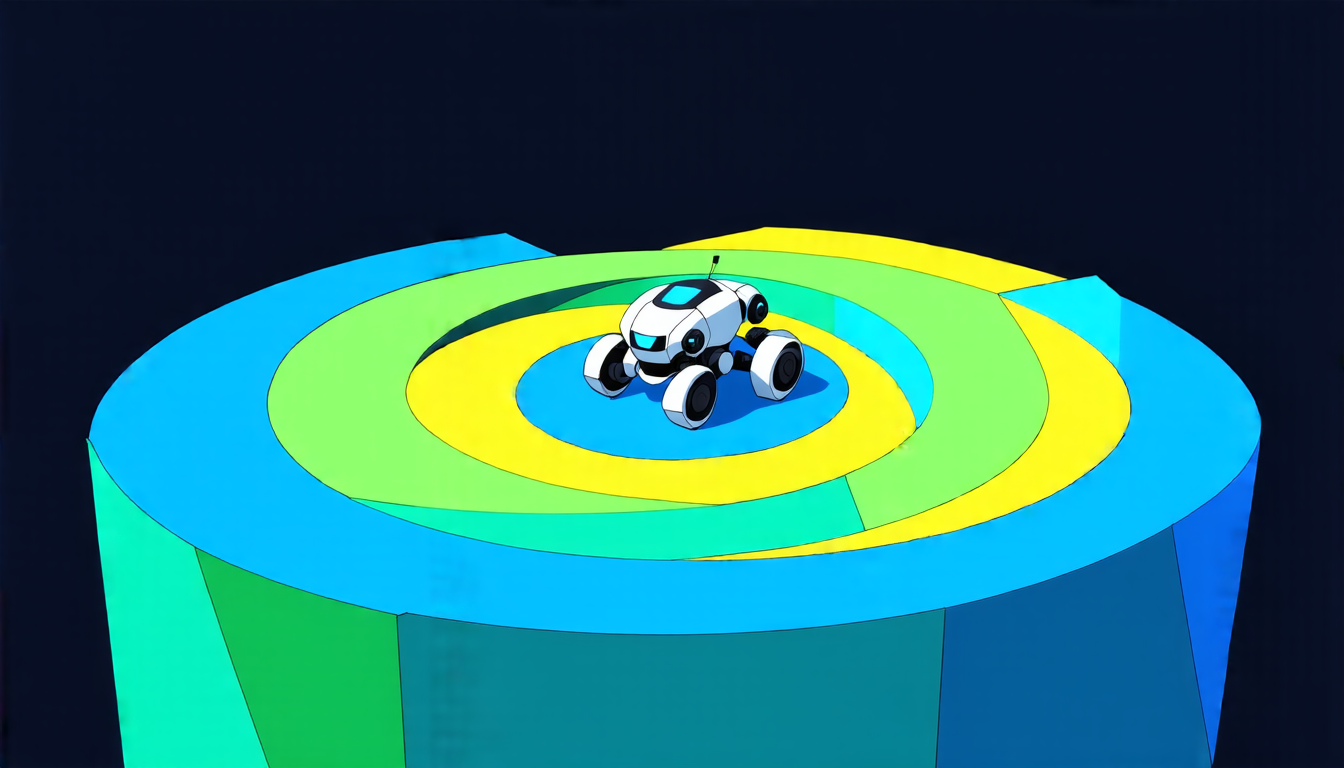
A team of researchers has developed a new approach for mobile robots to follow complex boundaries, such as those found in environmental monitoring or cleaning applications. The method uses a combination of curve fitting and vector fields to guide the robot along the boundary.
The traditional approach to boundary following involves using sensors to detect the boundary and then adjusting the robot’s motion accordingly. However, this can be slow and inaccurate, especially for complex boundaries. The new approach, on the other hand, uses a Fourier-based curve fitting method to approximate the boundary in real-time. This allows the robot to follow the boundary with greater precision and speed.
To control the robot’s motion, the researchers used a vector field approach. A vector field is a mathematical representation of a set of vectors that describe the direction and magnitude of forces acting on an object. In this case, the vector field is used to guide the robot along the boundary. The robot’s motion is controlled by adjusting the vector field in real-time to ensure that it stays on course.
The researchers tested their approach using a variety of simulated and experimental scenarios. They found that their method was able to accurately follow complex boundaries with high speed and precision. They also demonstrated its ability to adapt to changing boundary conditions, such as obstacles or changes in the boundary shape.
The implications of this research are significant for applications such as environmental monitoring, where robots may need to follow complex boundaries to detect pollution or other hazards. It could also be used in cleaning applications, such as sweeping or mopping, where a robot needs to follow a complex boundary to ensure thorough coverage.
Overall, the researchers have developed a powerful new approach for mobile robots to follow complex boundaries. Their method combines advanced curve fitting and vector field techniques to provide high-speed and precision motion control. Its potential applications are numerous and exciting, and it could have a significant impact on a range of industries.
Cite this article: “Following Complex Boundaries: A New Approach for Mobile Robots”, The Science Archive, 2025.
Mobile Robots, Boundary Following, Curve Fitting, Vector Fields, Fourier-Based, Real-Time, Environmental Monitoring, Cleaning Applications, Motion Control, Precision Navigation





