

Saturday 01 March 2025
Scientists have made a significant breakthrough in their quest to create defect-free arrays of atoms, a crucial step towards developing powerful quantum computers.
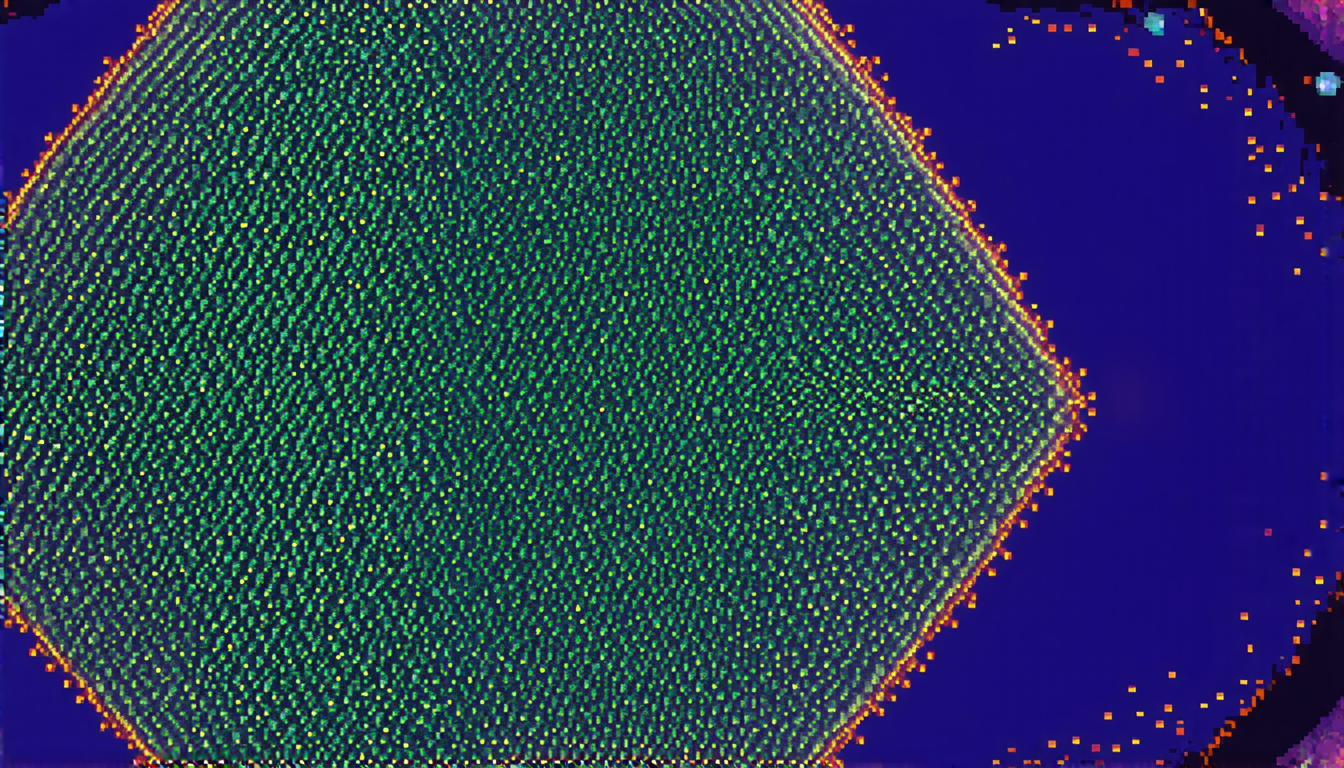
The team, led by researchers at the University of Chinese Academy of Sciences, has successfully assembled an array of 120 dual-isotope single atoms with a filling fraction of 98.6% and a defect-free probability of 14%. This achievement is a major milestone in the development of scalable and reliable quantum computing technology.
The scientists used a technique called heteronuclear atom-by-atom assembly to create the array. This method involves using optical tweezers to trap individual atoms and then rearranging them into a desired pattern. The team optimized their algorithm to minimize the number of moves required to assemble the array, reducing the likelihood of errors and defects.
One of the key challenges in creating large-scale arrays of atoms is ensuring that each atom is precisely positioned and aligned. To overcome this hurdle, the researchers used a combination of advanced optics and sophisticated algorithms to generate highly complex holograms that could manipulate individual atoms with precision.
The team’s achievement has significant implications for the development of quantum computing technology. Quantum computers have the potential to solve complex problems that are currently unsolvable by classical computers, making them useful for fields such as medicine, finance, and climate modeling.
However, creating large-scale arrays of atoms that can function reliably is a major challenge. The team’s success in assembling a defect-free array of 120 dual-isotope single atoms brings us one step closer to realizing the potential of quantum computing.
The researchers plan to continue refining their technique and scaling up their experiments to create even larger arrays of atoms. Their work has the potential to revolutionize the field of quantum computing and could lead to significant advancements in a wide range of fields.
In recent years, scientists have made rapid progress in developing quantum computing technology. However, creating large-scale arrays of atoms that can function reliably is a major challenge. The team’s achievement is a testament to their dedication and expertise, and it brings us one step closer to realizing the potential of quantum computing.
Cite this article: “Scientists Achieve Breakthrough in Assembling Defect-Free Arrays of Atoms for Quantum Computing”, The Science Archive, 2025.
Quantum Computers, Atom-By-Atom Assembly, Optical Tweezers, Holograms, Algorithms, Quantum Computing Technology, Defect-Free Arrays, Scalable, Reliable, Single Atoms





