

Saturday 01 March 2025
The researchers have been studying a fascinating topic – the relationship between perimeter, area, and Cheeger constant of planar domains. The Cheeger constant is a measure of how easily it is to move through a shape, much like how easy it is to walk through a park versus navigating through a dense forest.
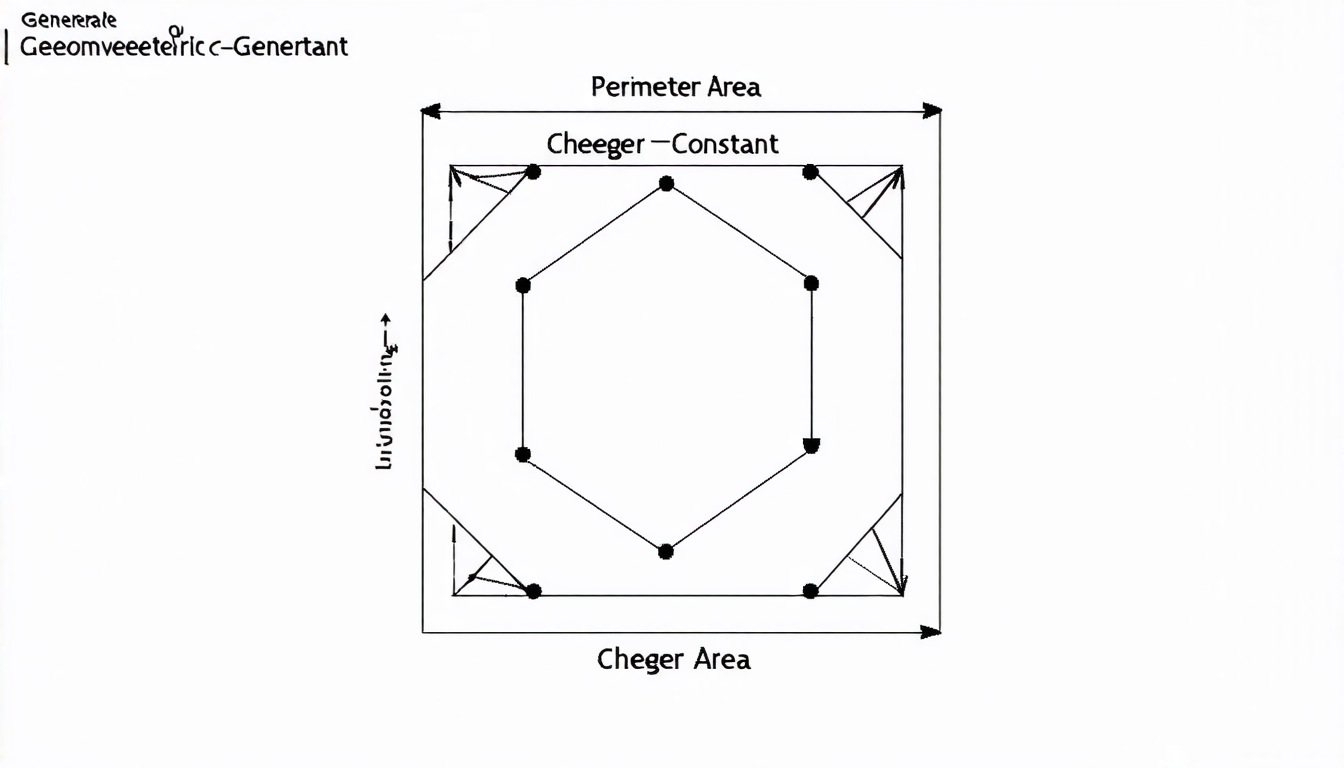
The team used a mathematical technique called Blaschke-Santaló diagrams to visualize these relationships. These diagrams are maps that show all the possible inequalities between perimeter, area, and Cheeger constant of different shapes. Think of it like a treasure map, where each point on the diagram represents a specific shape, and the lines connecting them show how those shapes relate to one another.
The researchers focused specifically on convex polygons – shapes with curved sides that are always within a certain distance from each other. They found that for these types of shapes, there is an upper boundary beyond which no other shape can have a smaller Cheeger constant while still having the same perimeter and area. This means that if you’re trying to minimize the Cheeger constant of a convex polygon, there’s a limit to how small you can get.
The team also discovered some surprising patterns in their diagrams. For example, they found that for certain types of polygons, the Cheeger constant is directly related to the perimeter and area. This means that if you know one of these values, you can almost exactly predict the other two.
The researchers used a combination of mathematical techniques and computational simulations to create their diagrams. They started by using existing knowledge about convex polygons to create a rough outline of what the diagram might look like. Then, they used computer simulations to fill in the gaps and refine their results.
One of the most interesting aspects of this research is its potential applications. For example, it could be used to design more efficient transportation systems or optimize the flow of materials through complex networks. It could even help scientists better understand how certain biological systems work, such as the way blood flows through the body.
The researchers’ findings have also opened up new avenues for further study. They’ve shown that there’s still much to learn about the relationships between perimeter, area, and Cheeger constant of planar domains, and they’re eager to continue exploring this fascinating topic.
Overall, the team’s work has shed new light on the intricate relationships between shape, size, and movement in planar domains. Their diagrams offer a powerful tool for understanding these complex connections and could have far-reaching implications for fields ranging from engineering to biology.
Cite this article: “Unveiling the Secrets of Shape, Size, and Movement in Planar Domains”, The Science Archive, 2025.
Perimeter, Area, Cheeger Constant, Planar Domains, Convex Polygons, Blaschke-Santaló Diagrams, Mathematical Techniques, Computational Simulations, Optimization, Transportation Systems





