

Sunday 02 March 2025
The Hubble tension, a discrepancy between measurements of the universe’s expansion rate, has long been a puzzle for cosmologists. Despite its significance, the issue remains poorly understood and continues to evade explanation. However, new research may have finally shed some light on this enigmatic problem.
According to the study, the key to understanding the Hubble tension lies in the realm of non-extensive statistical mechanics. This branch of physics explores the behavior of systems that defy traditional thermodynamic principles, where energy is not evenly distributed and entropy is not solely a function of temperature.
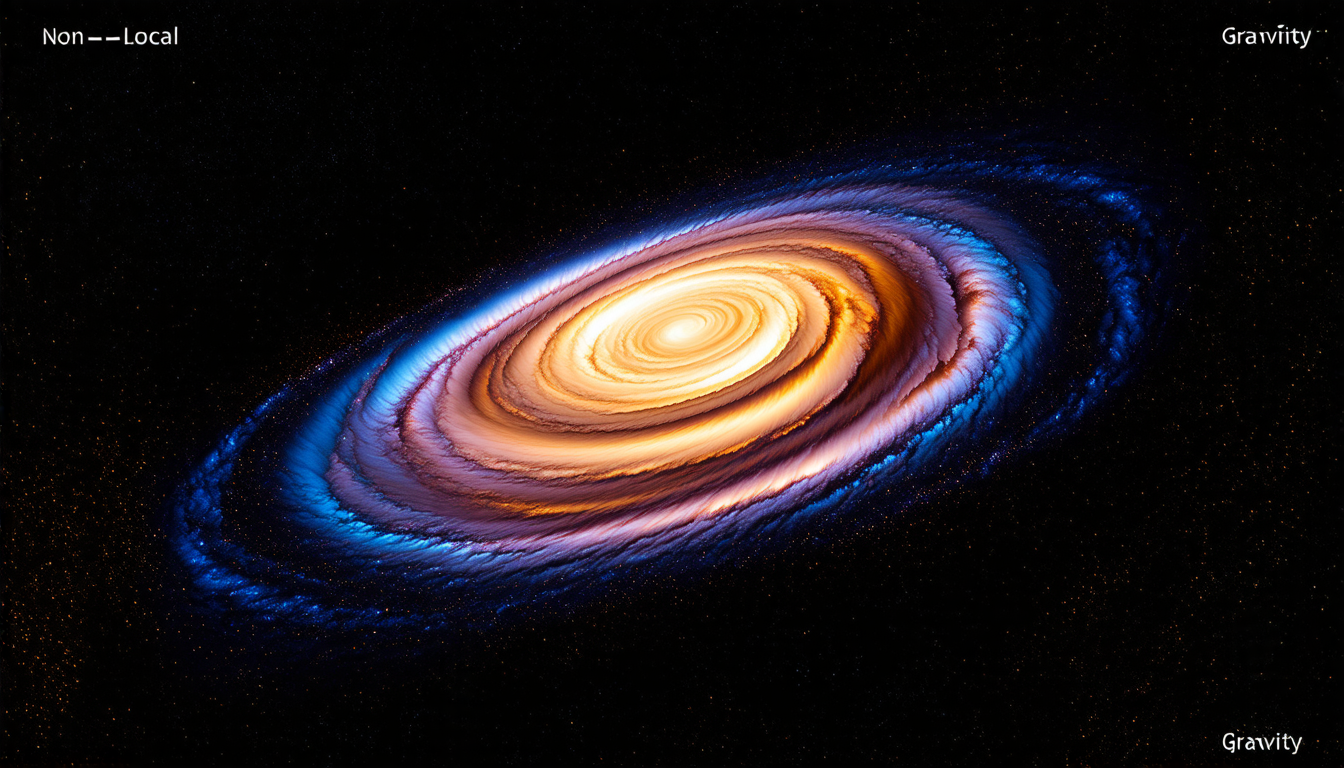
The researchers applied these concepts to the universe’s expansion rate, proposing that the observed discrepancy may be attributed to the non-extensivity of gravity itself. They demonstrated that by incorporating Tsallis statistics, a type of non-extensive statistical mechanics, into their calculations, they could reconcile the differing measurements of the Hubble constant.
Tsallis statistics is particularly relevant in this context because it allows for the possibility of non-additive entropy, meaning that the total entropy of a system is not simply the sum of its parts. This concept is crucial when considering the universe as a whole, where gravity’s non-local nature means that distant regions can interact with one another in complex ways.
The study’s findings suggest that the Hubble tension may be an illusion created by our attempts to apply traditional thermodynamic principles to the universe on large scales. By embracing non-extensive statistics, scientists may be able to reconcile the disparate measurements and gain a deeper understanding of the universe’s evolution.
This research has significant implications for our comprehension of the cosmos. If confirmed, it would indicate that gravity is not as well-behaved as previously thought, with far-reaching consequences for our understanding of black holes, dark matter, and the fabric of spacetime itself.
Moreover, this study highlights the importance of considering non-extensive statistical mechanics in the analysis of cosmological phenomena. By expanding our toolkit to include these novel concepts, scientists may uncover new insights into the workings of the universe, ultimately leading to a more complete understanding of its mysteries.
Cite this article: “Cracking the Hubble Tension with Non-Extensive Statistical Mechanics”, The Science Archive, 2025.
Hubble Tension, Non-Extensive Statistical Mechanics, Tsallis Statistics, Entropy, Gravity, Cosmology, Universe Expansion, Thermodynamics, Black Holes, Dark Matter
Reference: Naser Sadeghnezhad, “H0 tension in Tsallis and Renyi statistics” (2025).





