

Sunday 02 March 2025
Scientists have long struggled to make sense of complex data sets, often getting lost in a sea of information. But a new approach may be about to change that. Researchers have developed a novel method for extracting meaningful patterns from high-dimensional data, and early results are promising.
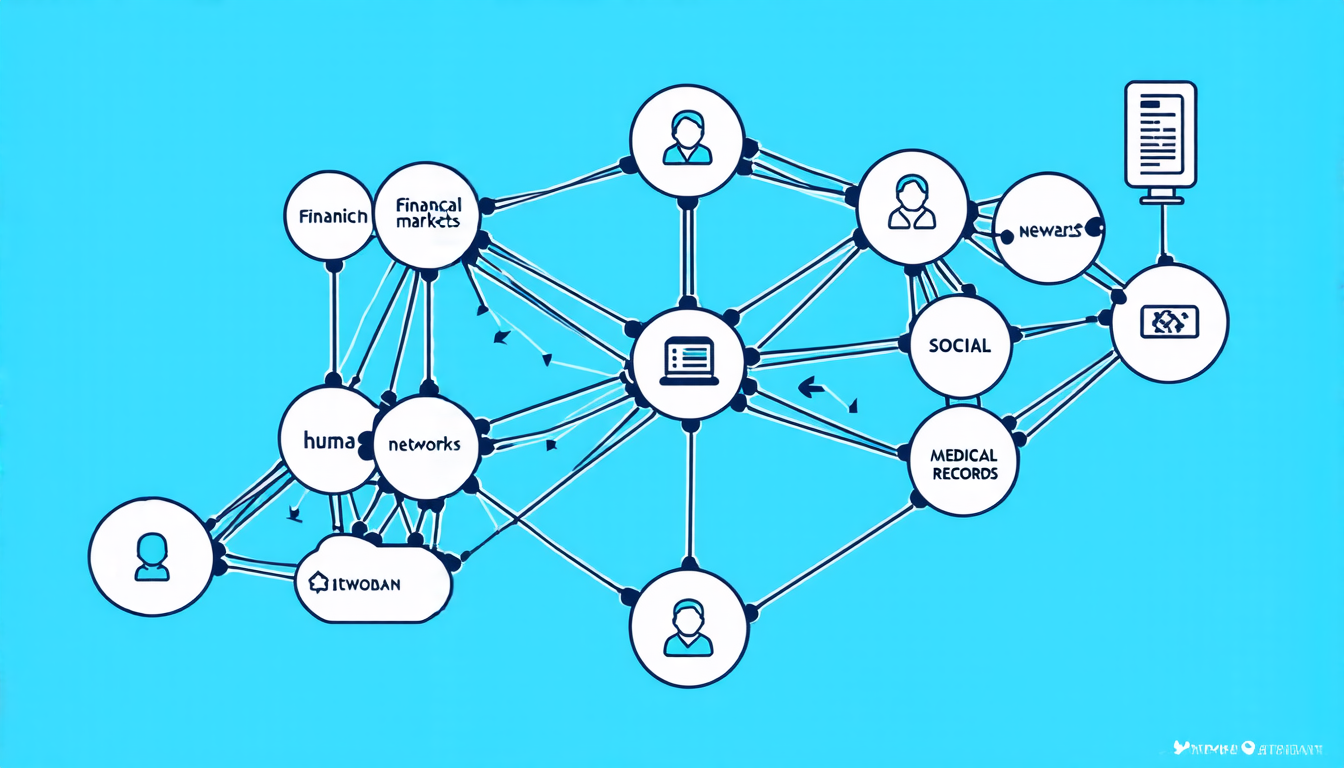
The problem is this: with the increasing availability of large datasets, scientists can now collect vast amounts of information on everything from financial markets to social networks to medical records. But as the amount of data grows, so does the difficulty of making sense of it all. Traditional methods for analyzing data often rely on simplifying assumptions or ignoring certain variables, which can lead to incomplete or inaccurate conclusions.
The new approach, dubbed FASIM (Factor Augmented Single-Index Model), aims to tackle this issue head-on. By incorporating latent factors – hidden patterns that influence the data – into a single-index model, researchers can identify more accurate and robust relationships between variables. This is particularly important in fields like finance, where small changes in market trends can have significant consequences.
To test the approach, scientists applied FASIM to two large datasets: one on financial markets and another on social networks. The results were striking: FASIM outperformed traditional methods in both cases, providing more accurate predictions and better insights into the underlying dynamics of the data.
But what really sets FASIM apart is its ability to handle high-dimensional data – that is, data with many variables and observations. Traditional methods often struggle with such data, becoming increasingly unreliable as the number of variables grows. FASIM, on the other hand, is designed specifically for this type of data, using a combination of factor analysis and sparse regression techniques to identify key relationships.
One of the most exciting aspects of FASIM is its potential applications in real-world scenarios. For example, financial analysts could use the approach to better predict market trends and identify potential risks. Social network researchers might apply FASIM to understand how online interactions influence public opinion or behavior. And medical researchers could use it to tease out patterns in large datasets of patient records.
Of course, like any new approach, FASIM is not without its limitations. For one thing, the method requires a good understanding of the underlying data – if the factors are not correctly identified, the results can be misleading. Additionally, FASIM may require significant computational resources for large datasets.
Despite these challenges, the early signs suggest that FASIM could be a game-changer in the world of data analysis.
Cite this article: “Unlocking Insights from Complex Data Sets with FASIM”, The Science Archive, 2025.
Data Analysis, High-Dimensional Data, Fasim, Factor Augmented Single-Index Model, Latent Factors, Single-Index Model, Financial Markets, Social Networks, Medical Records, Predictive Analytics





