

Sunday 02 March 2025
The pursuit of perfect graphs has long been a staple of mathematics, with researchers striving to create structures that are both beautiful and efficient. A recent breakthrough in this field has shed new light on the properties of prime number-based graphs, opening up fresh avenues for exploration.
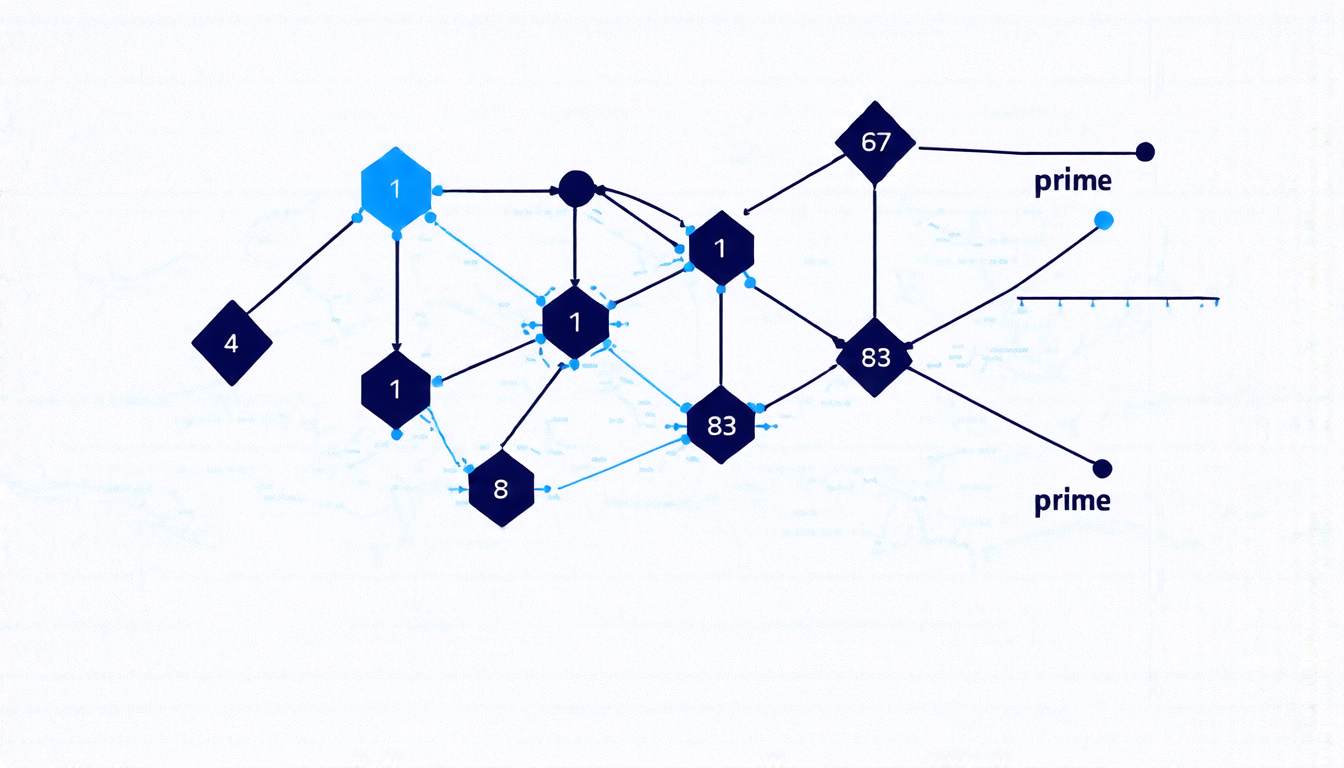
At its core, a graph is a collection of nodes connected by edges. In the case of prime number-based graphs, each node represents a prime number, and the edges represent the relationships between these primes. The connections are governed by a simple rule: two nodes are linked if their difference is also a prime number.
This seemingly innocuous constraint belies a rich tapestry of mathematical complexity. Researchers have long struggled to understand the properties of these graphs, particularly when it comes to finding Hamiltonian cycles – paths that visit every node exactly once and return to the starting point.
In recent years, significant progress has been made in this area. A series of papers has demonstrated that prime number-based graphs can be constructed with a high degree of regularity, featuring repeating patterns and symmetries. These findings have far-reaching implications for cryptography, coding theory, and other fields where graph structures play a critical role.
One of the most striking aspects of these new results is their connection to an ancient problem known as the Goldbach conjecture. First proposed in the 18th century, this conjecture states that every even number greater than 2 can be expressed as the sum of two prime numbers. While many special cases have been resolved, the general case remains unsolved – and its resolution has important implications for cryptography.
The new findings suggest that a deep connection exists between the properties of prime number-based graphs and the Goldbach conjecture. By studying these graphs, researchers may be able to gain valuable insights into the underlying structure of prime numbers themselves.
The applications of this research are already beginning to take shape. In coding theory, for example, the discovery of efficient algorithms for constructing Hamiltonian cycles in prime number-based graphs has significant implications for error-correcting codes and data compression schemes.
Furthermore, the connections between prime number-based graphs and cryptography are still being explored. The ability to construct these graphs with high regularity could have important implications for cryptographic protocols, such as public-key encryption and digital signatures.
As researchers continue to explore the properties of prime number-based graphs, it is clear that this field will remain a vibrant area of study in mathematics and computer science.
Cite this article: “Unraveling the Secrets of Prime Number-Based Graphs”, The Science Archive, 2025.
Graphs, Prime Numbers, Hamiltonian Cycles, Cryptography, Coding Theory, Goldbach Conjecture, Graph Structures, Mathematical Complexity, Pattern Recognition, Symmetry
Reference: Shamik Ghosh, “Prime Multiple Missing Graphs” (2025).





