

Sunday 02 March 2025
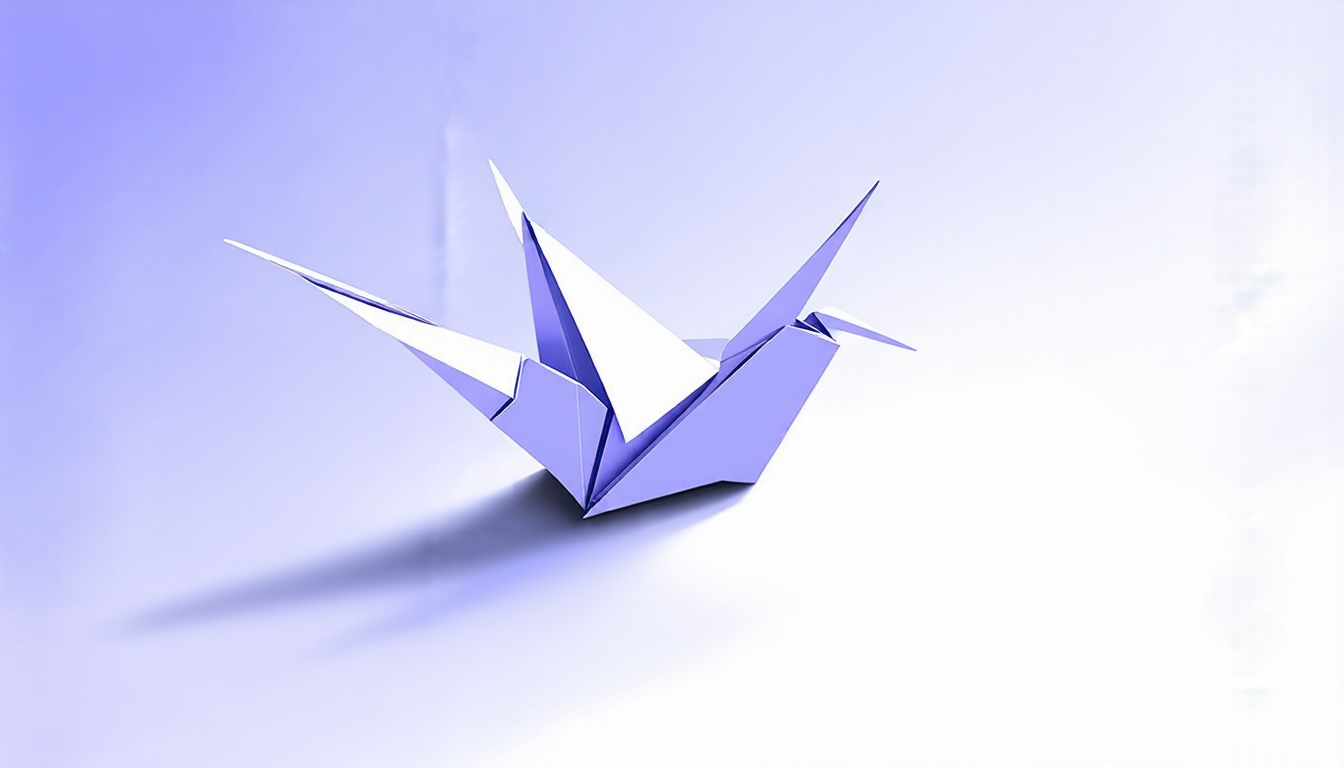
The intricate dance of origami has long fascinated mathematicians and scientists alike, as they attempt to unravel its secrets and apply them to real-world problems. Now, a team of researchers has made significant strides in this field by developing a new framework for understanding the kinematics of origami.
Kinematics is the study of how objects move without considering the forces that drive those movements. In the context of origami, it’s crucial to understand how the various components – edges, vertices, and faces – interact with each other as they fold and unfold.
The researchers have created a novel approach that uses algebraic topology, specifically cosheaves, to model the motion of origami surfaces. A cosheaf is a mathematical structure that assigns vector spaces to each cell in a complex geometric shape, such as an origami surface. These vector spaces capture important information about the relationships between cells and enable the calculation of global properties.
By applying this framework to origami kinematics, the team has been able to derive equations that describe how the various components move relative to each other. This is a significant achievement, as it provides a unified way of analyzing the motion of complex origami structures.
The implications of this work are far-reaching. For instance, it could be used to design new types of deployable structures for space exploration or medical devices that can be easily folded and unfolded. The framework also has potential applications in robotics, where understanding the kinematics of complex mechanisms is crucial for developing more agile and efficient machines.
One of the key benefits of this approach is its ability to handle the intricate topological properties of origami surfaces. Origami structures often have non-trivial topological features, such as holes or tunnels, that can affect their behavior. The cosheaf framework allows researchers to capture these features and incorporate them into their models.
The development of this new framework is a testament to the power of interdisciplinary collaboration. Mathematicians and computer scientists worked together with engineers and robotics experts to create a comprehensive understanding of origami kinematics.
As research in this area continues to evolve, it’s likely that we’ll see even more innovative applications of origami-inspired design. The study of origami has long fascinated mathematicians and scientists, but the development of this new framework is taking us one step closer to harnessing its potential for real-world problem-solving.
Cite this article: “Origami Kinematics: A New Framework for Understanding and Modeling Folded Surfaces”, The Science Archive, 2025.
Origami, Kinematics, Algebraic Topology, Cosheaves, Deployable Structures, Robotics, Space Exploration, Medical Devices, Interdisciplinary Collaboration, Mathematical Modeling
Reference: Zoe Cooperband, Robert Ghrist, “Unified Origami Kinematics via Cosheaf Homology” (2025).





