

Sunday 02 March 2025
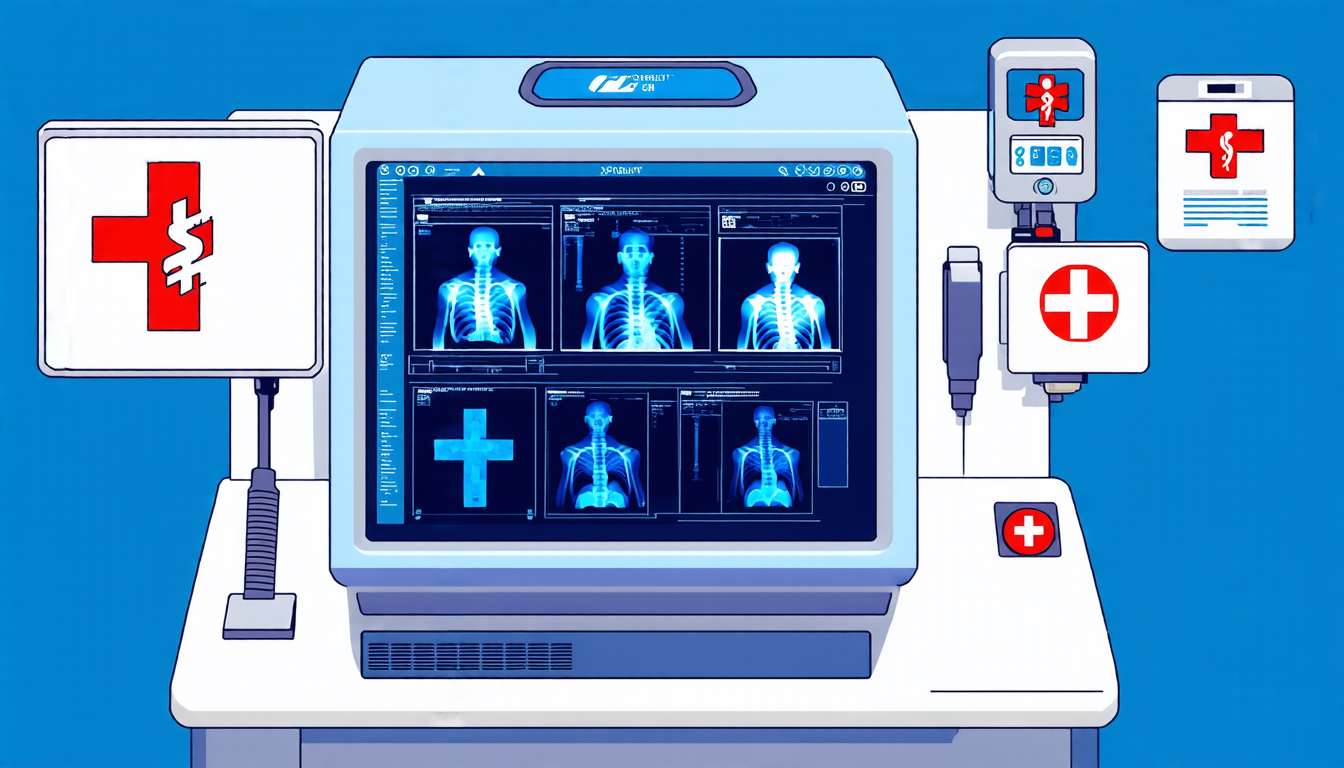
A significant breakthrough in medical imaging report generation has been achieved by a team of researchers, who have developed an approach that can accurately generate radiology reports from chest X-ray images. The method, which combines machine learning techniques and clinical knowledge, has been shown to outperform previous approaches in terms of both natural language generation (NLG) metrics and clinical accuracy.
The MIMIC Chest X-ray Database, a large publicly available dataset containing over 377,000 radiography images with corresponding free-text reports, was used as the basis for the study. The researchers employed their approach on this dataset to generate reports that matched the original reports in terms of both content and format.
One key innovation of the method is its use of curriculum learning, a technique that involves gradually increasing the difficulty of the training data as the model learns. This allows the model to focus on the most important aspects of the report generation task early on, and then refine its performance as it becomes more proficient.
Another important aspect of the approach is its incorporation of clinical knowledge, which is achieved through the use of a classification head that predicts the likelihood of certain diagnoses given the input image. This allows the model to generate reports that are not only accurate but also relevant to the patient’s condition.
The results of the study are impressive, with the generated reports achieving high scores on both NLG metrics and clinical accuracy metrics. The researchers also found that their approach outperformed previous methods in terms of both metrics, demonstrating its effectiveness in generating accurate and informative radiology reports.
The potential impact of this breakthrough is significant, as it could enable the automation of a critical step in medical imaging diagnosis and treatment. By allowing clinicians to focus on higher-level tasks such as interpreting images and making diagnoses, rather than writing reports, this approach could help streamline healthcare workflows and improve patient outcomes.
In addition to its clinical applications, this research also has implications for the broader field of natural language processing (NLP). The use of curriculum learning and clinical knowledge in report generation is a novel approach that could be applied to other NLP tasks, such as chatbots or virtual assistants.
Overall, this study represents an important step forward in the development of medical imaging report generation, and its potential impact on healthcare workflows and patient outcomes is significant. As researchers continue to refine and improve this approach, it will be exciting to see how it can be applied in real-world clinical settings.
Cite this article: “Breakthrough in Medical Imaging Report Generation: Accurate Radiology Reports from Chest X-Ray Images”, The Science Archive, 2025.
Medical Imaging, Report Generation, Machine Learning, Chest X-Ray, Radiology Reports, Natural Language Processing, Nlp, Curriculum Learning, Clinical Knowledge, Healthcare Workflows.





