

Sunday 02 March 2025
The quest for a seamless brain-computer interface (BCI) has long been a Holy Grail of neuroscience and computer science. For decades, researchers have been working to develop a system that can accurately decode brain signals into meaningful commands or messages. While significant progress has been made, the field still faces numerous challenges. A recent study published in a leading scientific journal offers a promising solution by harnessing the power of large language models (LLMs) to mitigate cross-subject variability in EEG signal decoding.
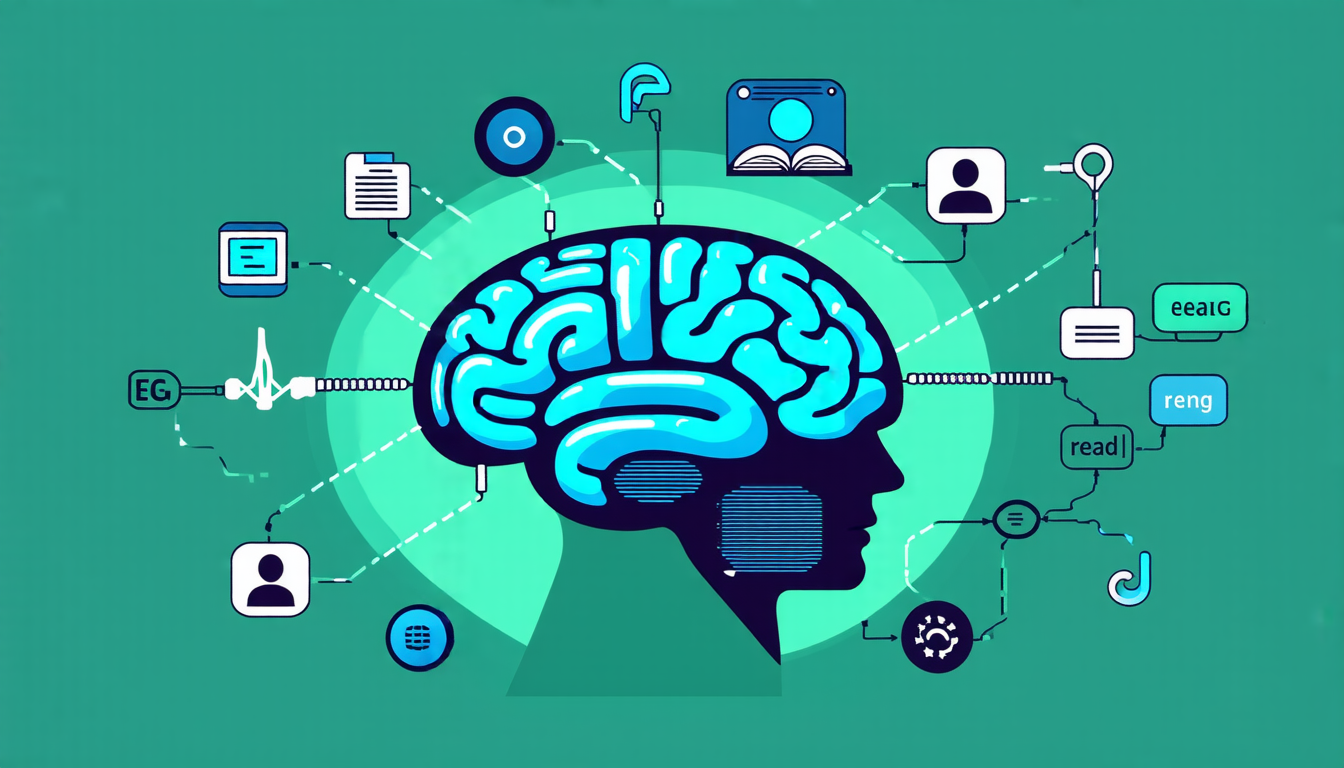
The researchers’ approach begins with the collection of electroencephalography (EEG) data from multiple subjects performing various cognitive tasks, such as reading or listening to sentences. This data is then fed into an LLM, which learns to extract subject-independent semantic features from the noisy EEG signals. The resulting embeddings are subsequently used to train a neural network that can accurately predict the original task performed by the subject.
The innovation lies in the use of LLMs as denoising agents, effectively reducing the impact of individual differences in brain anatomy and signal acquisition conditions on the decoding process. This allows for robust generalization across subjects, enabling the system to perform well even when trained on a subset of subjects or tested on unseen individuals.
To evaluate the effectiveness of this approach, the researchers conducted a series of experiments using EEG data from 64 subjects performing various cognitive tasks. The results demonstrate impressive accuracy and robustness, with the system achieving consistently high performance across different subject masks, including scenarios where up to 30% of subjects are unseen during training.
One of the most significant implications of this study is its potential to overcome the limitations of traditional machine learning approaches in BCI applications. By leveraging LLMs, researchers can develop more versatile and user-independent BCIs that can be deployed in a wider range of settings, from assistive devices for individuals with motor impairments to interactive gaming and cognitive monitoring in healthy populations.
The study’s findings also highlight the importance of incorporating multimodal data sources into BCI research. By combining EEG signals with other physiological or behavioral measures, researchers may be able to develop more accurate and comprehensive models of brain function and cognition.
While this study marks a significant step forward in BCI research, there are still many challenges to overcome before such systems can be widely adopted. Nevertheless, the prospect of developing BCIs that can accurately decode brain signals with unprecedented precision and flexibility is an exciting one, with far-reaching implications for our understanding of human cognition and behavior.
Cite this article: “Breaking Down Barriers: A Promising Solution for Seamless Brain-Computer Interfaces”, The Science Archive, 2025.
Brain-Computer Interface, Eeg, Large Language Models, Cross-Subject Variability, Denoising Agents, Neural Networks, Cognitive Tasks, Electroencephalography, Machine Learning, Bcis





