

Sunday 02 March 2025
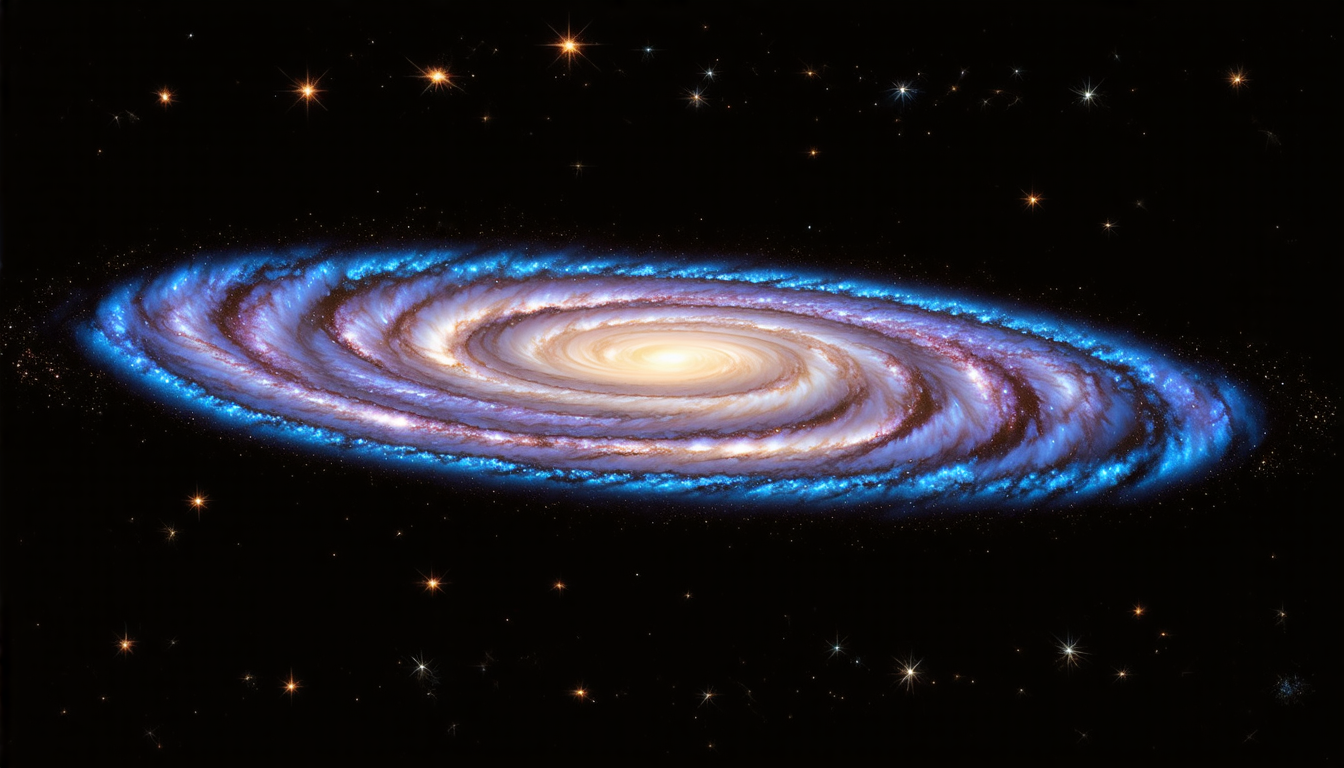
Scientists have long been fascinated by the spiral arms of galaxies, those majestic swirling patterns that crisscross the cosmos. But despite their beauty, these arms pose a puzzle: why do they appear to be stable, yet simultaneously prone to chaotic behavior? A new study sheds light on this conundrum, revealing that the key to stability lies in the distribution of stars within the galaxy’s disk.
The research team began by examining a type of galaxy known as an S0, which is characterized by its featureless disk and absence of gas. By simulating the evolution of these galaxies over time, they discovered that the presence of low-energy stars – those with relatively slow orbits around the center of the galaxy – plays a crucial role in stabilizing the spiral arms.
It turns out that when these low-energy stars are present in sufficient numbers, they help to balance out the effects of gravitational forces within the disk. This is achieved by reducing the amplitude of spiral waves, which are oscillations in the density of stars and gas that can lead to chaotic behavior.
The study also found that the removal of these low-energy stars from the galaxy’s disk can have a dramatic impact on its stability. Without them, the spiral arms become more prone to growth and instability, leading to the formation of strong bars and other non-axisymmetric structures.
These findings have significant implications for our understanding of galaxy evolution. They suggest that the presence or absence of low-energy stars in a galaxy’s disk can determine whether it will exhibit stable or chaotic behavior over time. This knowledge can be used to inform models of galaxy evolution, potentially shedding light on the mysteries of cosmic history.
The research also highlights the importance of considering the distribution of stars within a galaxy when studying its stability. By taking into account the subtle variations in star energy and motion, scientists can gain a more complete understanding of the complex dynamics at play in these celestial systems.
In the end, this study demonstrates that even the most seemingly stable galaxies are governed by intricate patterns of motion, and that a deep understanding of these patterns is crucial for unlocking the secrets of the universe.
Cite this article: “Stabilizing Spiral Arms: The Key Role of Low-Energy Stars in Galaxy Evolution”, The Science Archive, 2025.
Galaxies, Spiral Arms, Stability, Chaos, Stars, Galaxy Evolution, Gravitational Forces, Density Waves, Bars, Non-Axisymmetric Structures
Reference: J A Sellwood, R G Carlberg, “The quest for a stable disk” (2025).





