

Sunday 02 March 2025
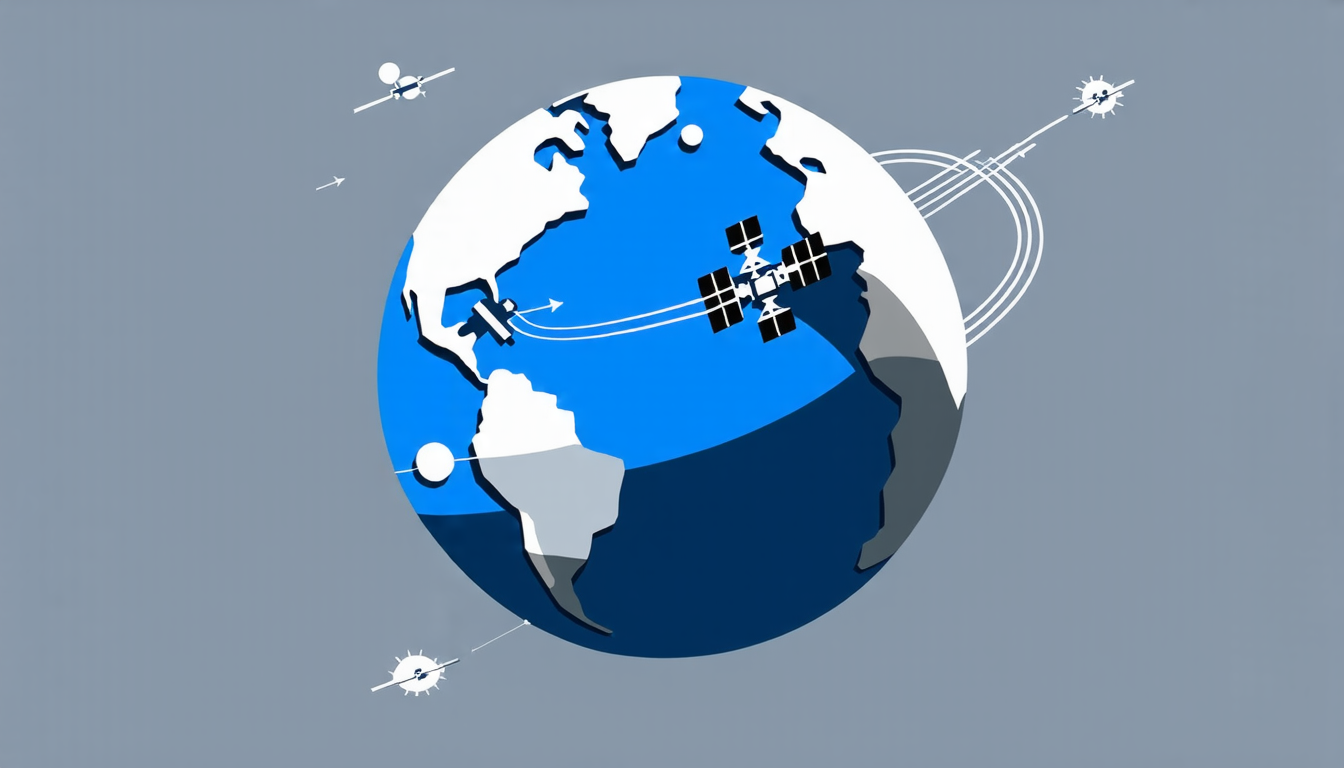
As satellite constellations continue to proliferate, concerns about collision avoidance have become increasingly pressing. With thousands of objects orbiting Earth, the risk of catastrophic collisions is rising. To mitigate this risk, researchers at Stanford University have developed a new approach to maneuver planning, using Markov decision processes (MDPs) to optimize satellite movements.
The problem of collision avoidance is complex. Satellites are constantly moving in unpredictable ways, and their positions can’t be perfectly known ahead of time. Traditional methods for avoiding collisions rely on fixed rule-based policies or offline calculations that don’t account for real-time updates. These approaches often result in suboptimal outcomes, such as excessive fuel consumption or missed opportunities to avoid collisions.
The Stanford researchers’ approach uses MDPs, a type of decision-making algorithm commonly used in robotics and artificial intelligence. In this context, the MDP is applied to the problem of satellite maneuver planning, where the goal is to find the optimal sequence of actions (such as thruster firings or course corrections) to avoid collisions while minimizing fuel consumption.
The researchers tested their approach using a simulated low Earth orbit environment, generating collision scenarios and evaluating the performance of their algorithm. They compared the results to traditional rule-based methods and found that their MDP-based approach outperformed them in terms of both fuel efficiency and collision avoidance success rates.
One key innovation of this research is its ability to incorporate real-time state updates into the decision-making process. By using current position and velocity data, the algorithm can adapt to changing circumstances and adjust its maneuvers accordingly. This capability allows for more efficient use of fuel and better overall performance.
The implications of this work are significant. As satellite constellations continue to grow in size and complexity, the need for robust and adaptive collision avoidance systems will only increase. The Stanford researchers’ MDP-based approach offers a promising solution to this challenge, one that could help ensure the safety and efficiency of satellite operations.
In practical terms, this technology could be used to optimize the movements of satellites in Earth orbit, reducing the risk of collisions and minimizing fuel consumption. It could also inform the development of autonomous spacecraft systems, where decision-making algorithms must adapt quickly to changing circumstances.
Overall, the Stanford researchers’ work represents a significant advancement in the field of satellite maneuver planning, one that has the potential to improve the safety and efficiency of space operations.
Cite this article: “Optimizing Satellite Maneuvers with Markov Decision Processes”, The Science Archive, 2025.
Satellite Constellations, Collision Avoidance, Markov Decision Processes, Mdps, Satellite Maneuver Planning, Fuel Consumption, Artificial Intelligence, Robotics, Low Earth Orbit, Autonomous Spacecraft.





