

Sunday 02 March 2025
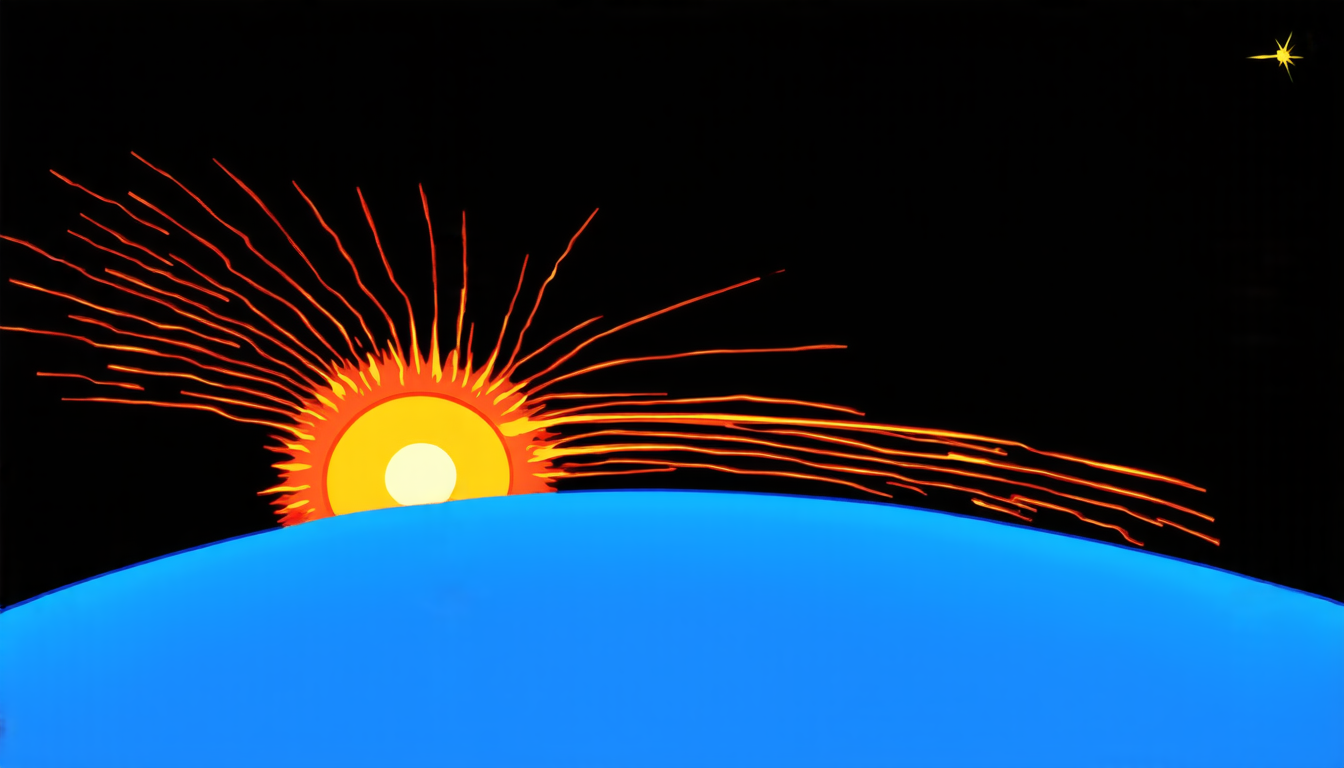
The solar wind, a stream of charged particles emanating from the sun, has long fascinated scientists and astronomers alike. For decades, researchers have sought to understand the mechanisms behind this phenomenon, driven by its profound impact on our understanding of the universe. Recently, a team of scientists made a significant breakthrough in their quest for knowledge, uncovering new insights into the solar wind’s behavior.
The solar wind is a complex and dynamic entity, comprising plasma – ionized gas – that flows away from the sun at incredible speeds. As it travels through space, this plasma interacts with magnetic fields, influencing the shape of these fields and shaping the course of the solar wind itself. This interplay has far-reaching implications for our understanding of the solar system’s evolution and the behavior of celestial bodies.
The researchers’ findings hinge on a clever application of the de Laval nozzle analogy. This concept, borrowed from fluid dynamics, describes how the shape of a nozzle affects the flow of a gas or plasma. In this case, the scientists applied the analogy to the solar wind, using it to explain the role of solar gravity in shaping the wind’s behavior.
Their work reveals that the action of solar gravity is equivalent to a renormalization of the wind channel area, effectively describing the density profile of the solar wind as seen from the sun. This finding has significant implications for our understanding of the solar wind’s acceleration and deceleration, as well as its interaction with magnetic fields.
The researchers’ results are based on both theoretical models and numerical simulations. By considering isothermal gas and polytropic gas models – which describe gases that expand or contract in a specific way – they were able to demonstrate the robustness of their findings across different scenarios.
The significance of this breakthrough cannot be overstated. A deeper understanding of the solar wind’s behavior has far-reaching implications for our comprehension of the universe. The solar wind plays a crucial role in shaping the solar system, influencing the magnetic fields and atmospheres of planets and moons alike.
Moreover, the insights gained from this research can inform our understanding of other astrophysical phenomena, such as stellar winds and cosmic rays. As scientists continue to probe the mysteries of the universe, breakthroughs like this one will remain crucial in driving our pursuit of knowledge.
The solar wind’s secrets are slowly being unraveled, thanks to innovative approaches like the de Laval nozzle analogy.
Cite this article: “Unveiling the Secrets of the Solar Wind”, The Science Archive, 2025.
Solar Wind, Plasma, Ionized Gas, Solar Gravity, Fluid Dynamics, De Laval Nozzle Analogy, Theoretical Models, Numerical Simulations, Isothermal Gas, Polytropic Gas Models





