

Sunday 02 March 2025
As scientists continue to probe the fundamental nature of matter and energy, a new study has shed light on an age-old question: what carries the baryon number in high-energy collisions? The answer, it seems, lies not with the gluon junctions that were once thought to be responsible, but rather with valence quarks.
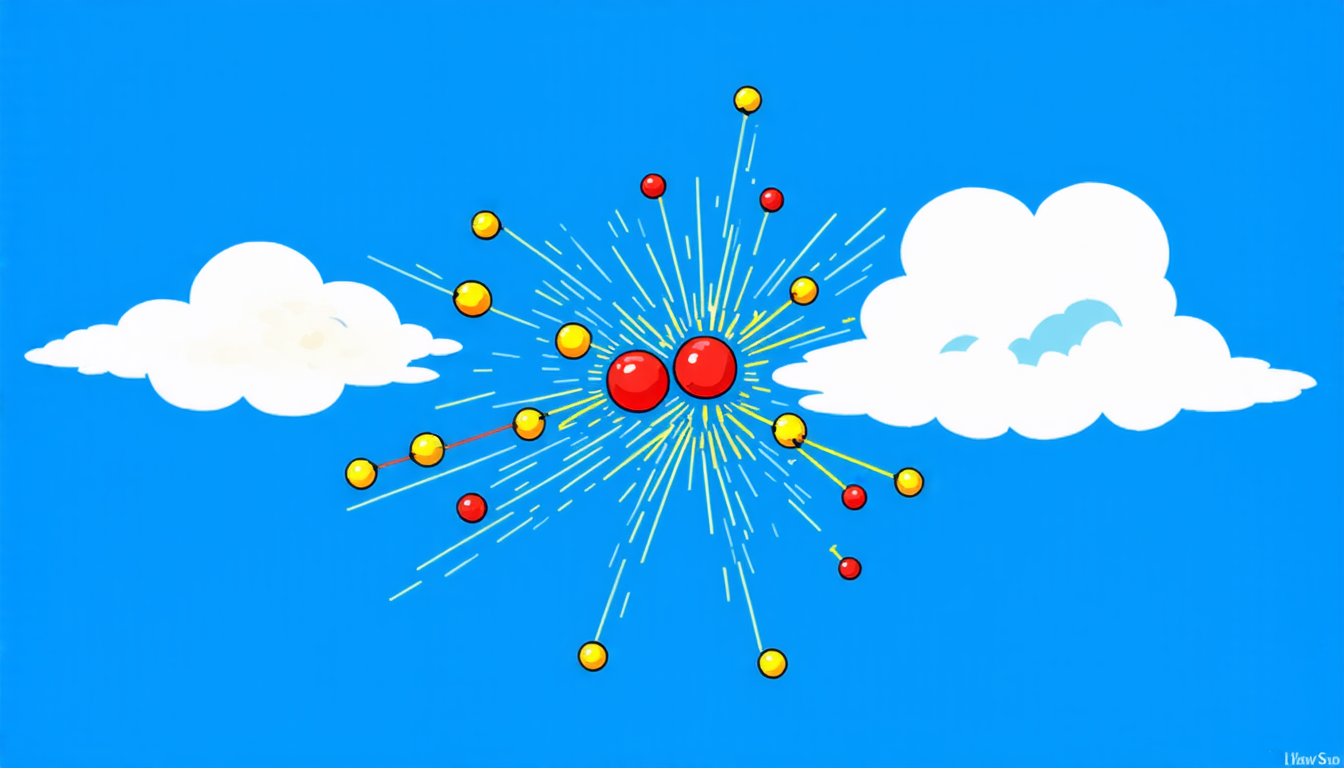
High-energy collisions are complex phenomena that involve the interactions of particles at incredibly high energies. In these collisions, particles such as protons and neutrons are smashed together, releasing a torrent of subatomic particles in the process. To understand what happens in these collisions, scientists use theoretical models to simulate the behavior of these particles.
One such model is the multi-source thermal model, which posits that the energy released in high-energy collisions comes from multiple sources, including both soft and hard processes. Soft processes involve the interactions between particles at low energies, while hard processes involve the interactions between particles at higher energies.
In the new study, researchers used this model to investigate what carries the baryon number – a measure of the total amount of matter in a system – in high-energy collisions. They found that the valence quarks, which are the outermost quarks in protons and neutrons, play a crucial role in carrying this number.
This finding has significant implications for our understanding of high-energy collisions. For years, scientists have believed that gluon junctions, which are regions where multiple gluons (particles that carry the strong nuclear force) interact with each other, were responsible for carrying the baryon number. However, the new study suggests that this is not the case.
Instead, it seems that valence quarks are the key players in high-energy collisions. These quarks are responsible for the majority of the energy released in these collisions, and they play a critical role in determining the properties of the particles produced.
The researchers used data from previous experiments to test their model, and found that it accurately predicted the behavior of particles produced in high-energy collisions. This suggests that the valence quark scenario is likely correct, and provides new insights into the fundamental nature of matter and energy.
The implications of this study are far-reaching, and could have significant impacts on our understanding of the universe. For example, it could help us better understand the behavior of particles in high-energy collisions, which is crucial for the development of new technologies such as particle accelerators.
Cite this article: “Valence Quarks Key Players in High-Energy Collisions”, The Science Archive, 2025.
High-Energy Collisions, Baryon Number, Valence Quarks, Gluon Junctions, Multi-Source Thermal Model, Particle Accelerators, Strong Nuclear Force, Quark Interactions, Matter And Energy, Subatomic Particles





