

Sunday 02 March 2025
Weather forecasting has long been a challenge for meteorologists, with predicting precipitation patterns being one of the most difficult tasks. While advances in numerical weather prediction (NWP) models have significantly improved forecasting accuracy, there’s still much room for improvement. A recent study published in a leading scientific journal takes a novel approach to high-resolution precipitation forecasting by combining deterministic and probabilistic modeling techniques.
The researchers developed a physics-inspired deep learning framework that incorporates atmospheric state variables as inputs to predict precipitation patterns at 0.05° resolution. This is significantly higher than the typical 0.25° resolution used in current NWP models, allowing for more accurate predictions of local weather phenomena.
To achieve this high level of detail, the model uses a combination of techniques. The deterministic component is based on a 3D SwinTransformer, which captures average precipitation patterns at mesoscale resolution. This is then combined with a probabilistic model that accounts for uncertainties in residual precipitation at convective scales using conditional diffusion in latent space.
During inference, ensemble forecasts are generated by randomly sampling Gaussian noise in the latent space. This allows the model to represent precipitation uncertainty and generate multiple possible outcomes, giving forecasters a better sense of the range of possible weather scenarios.
The researchers tested their framework using ERA5 and CMPA high-resolution precipitation datasets and found that it significantly outperformed traditional NWP models in terms of spatial resolution and forecast accuracy. The ensemble system was also found to be reliable and unbiased, with rank histograms indicating accurate representation of precipitation uncertainty.
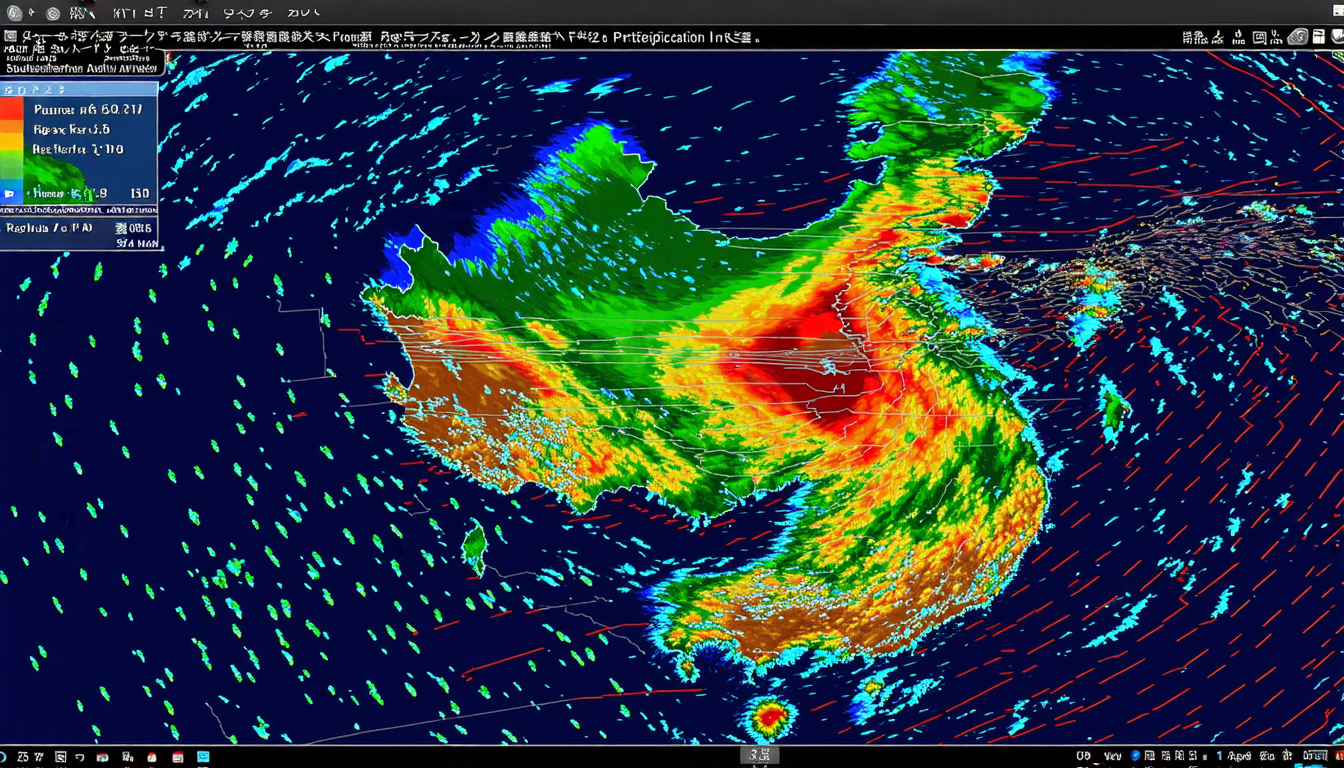
In a real-world application, the model was used to generate 5-day forecasts for heavy precipitation events in southern China. The results showed that the model’s outputs were more closely aligned with observed precipitation distributions than those from ERA5, demonstrating its ability to capture extreme weather events.
The implications of this research are significant. High-resolution precipitation forecasting has numerous applications, from improving weather warnings and emergency response planning to enhancing agricultural productivity and optimizing water resource management. With the increasing availability of high-performance computing resources and large datasets, it’s likely that we’ll see more advanced models like this one being developed in the future.
One potential limitation of the study is its reliance on ERA5 and CMPA datasets, which may not be representative of all regions or weather patterns. However, the researchers’ use of a physics-inspired framework and ensemble forecasting approach suggests that their model could be adapted to other datasets and applications.
Cite this article: “High-Resolution Precipitation Forecasting with Physics-Inspired Deep Learning Framework”, The Science Archive, 2025.
Weather, Forecasting, Precipitation, Deep Learning, Numerical Weather Prediction, Nwp Models, Atmospheric State Variables, Physics-Inspired Framework, Ensemble Forecasting, Probabilistic Modeling





