

Sunday 02 March 2025
Researchers have long struggled to understand the complex dynamics of urban traffic, particularly when multiple types of vehicles share the same roads. A recent study has shed new light on this phenomenon by applying principles from percolation theory, a field typically used to describe the behavior of fluids and gases.
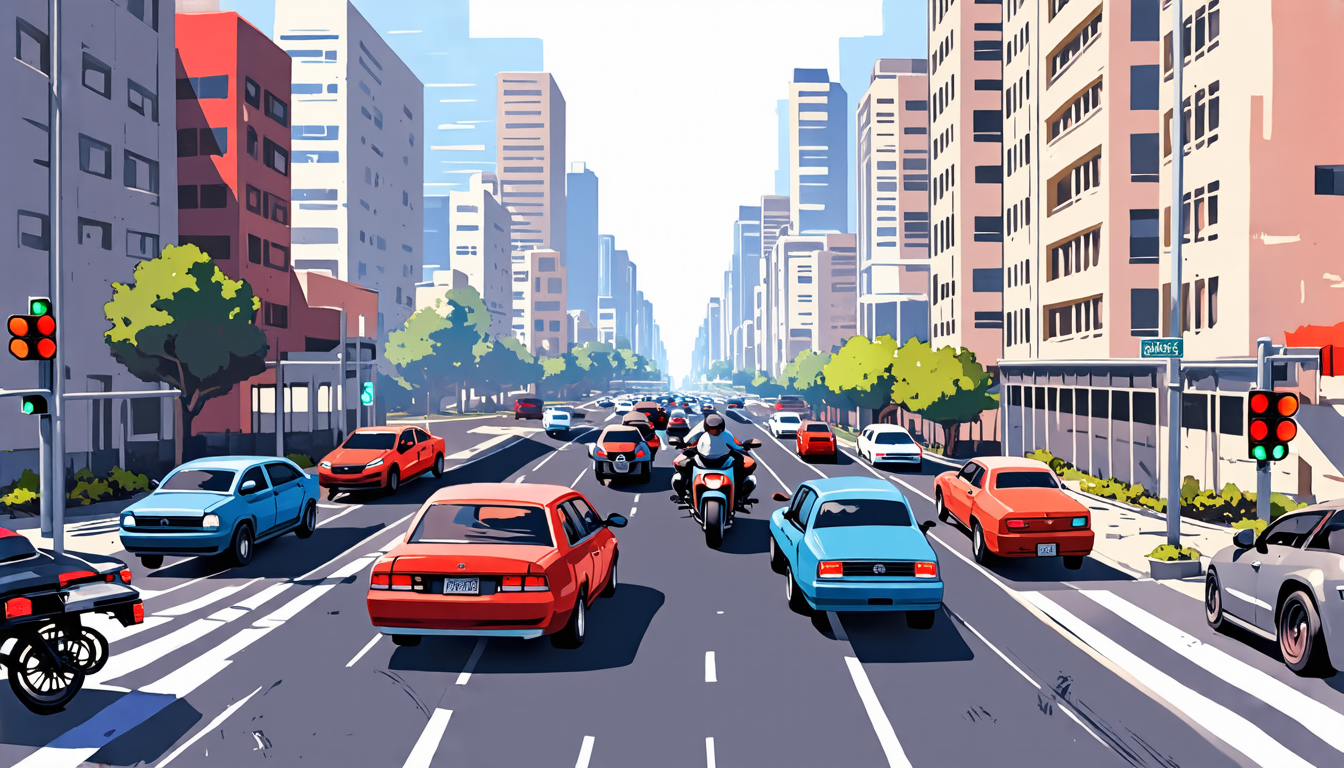
The researchers analyzed massive amounts of data collected from aerial footage of city streets in Athens, Greece. They focused on the interactions between cars and motorcycles, which often share the same roads but have different sizes and speeds. By modeling these interactions using percolation theory, they were able to identify a universal pattern that governs the behavior of mixed traffic.
In essence, the study found that when cars and motorcycles are mixed together, their movements can be described by a phase transition – a phenomenon commonly observed in physical systems, such as water freezing or metal melting. This means that there is a critical point at which the traffic flow changes from being disordered to ordered, much like the sudden change from liquid to solid state.
The researchers also discovered that the percolation threshold, where this phase transition occurs, depends on the density of cars and motorcycles. When there are more cars than motorcycles, the percolation threshold is lower, indicating that it takes less traffic congestion for the mixed flow to become disordered. Conversely, when there are more motorcycles than cars, the percolation threshold is higher, suggesting that it takes more traffic congestion for the mixed flow to become disordered.
These findings have significant implications for urban planners and transportation engineers. By understanding how different types of vehicles interact with each other, they can design more efficient and safe road networks. For example, they may be able to optimize traffic signal timing and lane allocation to reduce congestion and improve traffic flow.
The study also highlights the potential benefits of using percolation theory in urban traffic modeling. This approach allows researchers to simplify complex systems by identifying universal patterns that govern their behavior. By applying this theory to other areas of transportation, such as pedestrian flow or public transit, scientists may be able to uncover new insights and improve our understanding of these complex systems.
Overall, the study provides a new perspective on urban traffic dynamics, revealing a hidden order in the chaos of city streets. By combining cutting-edge research with real-world data, scientists are one step closer to creating more efficient, sustainable, and safe transportation systems for all.
Cite this article: “Unlocking the Hidden Order of Mixed Traffic”, The Science Archive, 2025.
Urban Traffic, Percolation Theory, Mixed Traffic, Phase Transition, Traffic Flow, Road Networks, Transportation Engineering, Urban Planning, Traffic Congestion, Pedestrian Flow
Reference: Georg Anagnostopoulos, Nikolas Geroliminis, “Universality in multispecies traffic” (2025).





