

Sunday 02 March 2025
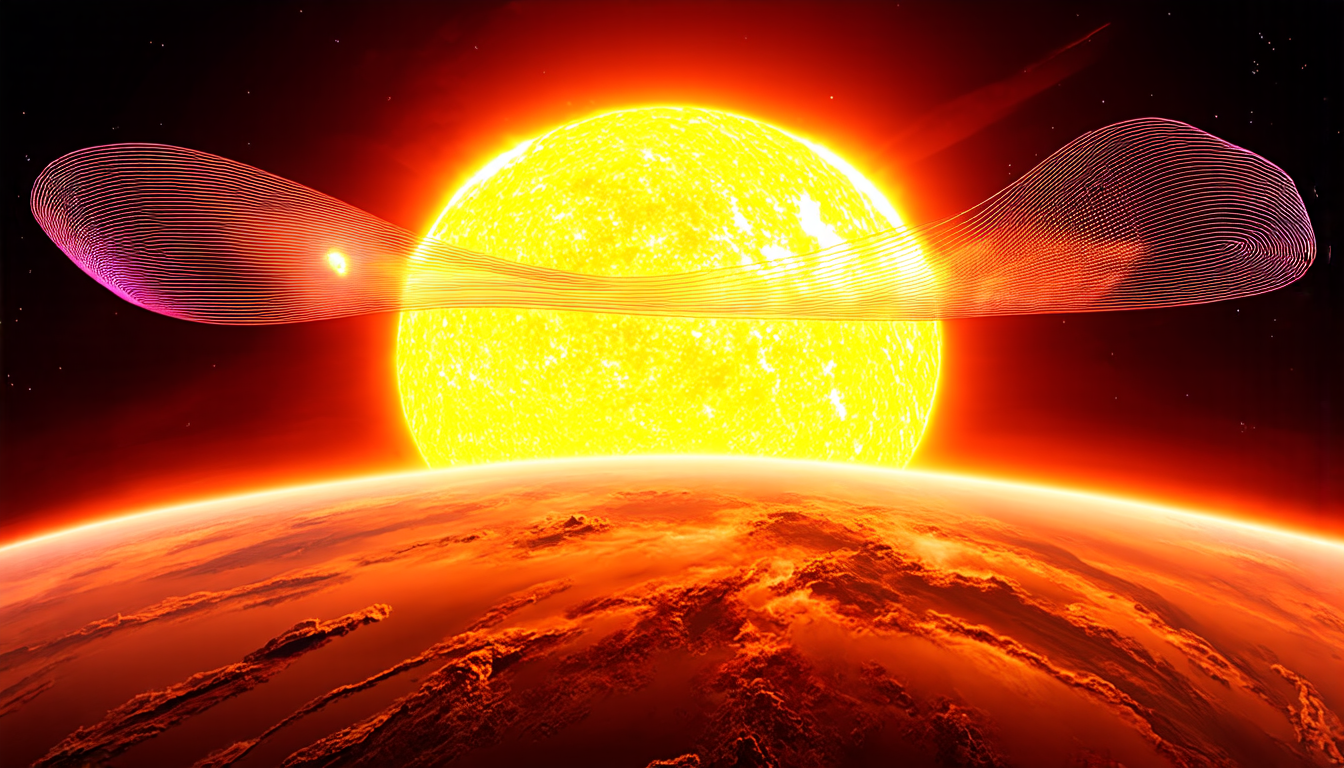
A new study published in Astronomy & Astrophysics has shed light on the complex dynamics of coronal loops, those towering arches of hot plasma that dance across the sun’s surface. By simulating the behavior of these loops using advanced computer models, researchers have gained a deeper understanding of how they oscillate and what this might reveal about the underlying magnetic fields that shape them.
Coronal loops are fascinating structures that can stretch thousands of kilometers into space. They’re formed when twisted magnetic field lines are stretched and compressed by the sun’s intense heat and rotation. As these loops oscillate, they can emit powerful bursts of energy in the form of X-rays and ultraviolet light. By studying these oscillations, scientists hope to learn more about the underlying physics that governs the behavior of coronal loops.
The researchers used a combination of computer simulations and observations from space-based telescopes to study the dynamics of coronal loops. They created detailed models of the loops’ structure and magnetic fields, which they then simulated using advanced algorithms. These simulations allowed them to explore how different factors might influence the loops’ behavior, such as changes in the density of the plasma or the strength of the magnetic field.
One key finding from the study is that coronal loops are not always what they seem. While they may appear to be simple, straight structures, they can actually exhibit complex oscillations and behaviors that are influenced by a variety of factors. The researchers found that changes in the density of the plasma or the strength of the magnetic field can cause the loops to oscillate at different frequencies, which can affect their ability to emit powerful bursts of energy.
The study also highlights the importance of considering the full 3D structure of coronal loops when studying their behavior. While previous research has focused on 2D models, this new work shows that taking into account the loops’ full three-dimensional shape is crucial for understanding their dynamics.
The findings from this study have important implications for our understanding of the sun’s internal dynamics and how it affects the solar system. By better understanding the behavior of coronal loops, scientists can gain insights into the underlying physical processes that drive the sun’s magnetic field and its impact on the surrounding space environment.
In practical terms, the research could also inform the development of new space weather forecasting tools. Coronal loops play a key role in shaping the solar wind, which can interact with Earth’s magnetic field to cause geomagnetic storms.
Cite this article: “Unraveling the Dynamics of Coronal Loops”, The Science Archive, 2025.
Coronal Loops, Solar Physics, Magnetic Fields, Plasma Dynamics, Oscillations, X-Rays, Ultraviolet Light, Space Weather, Geomagnetic Storms, 3D Modeling.





