

Sunday 02 March 2025
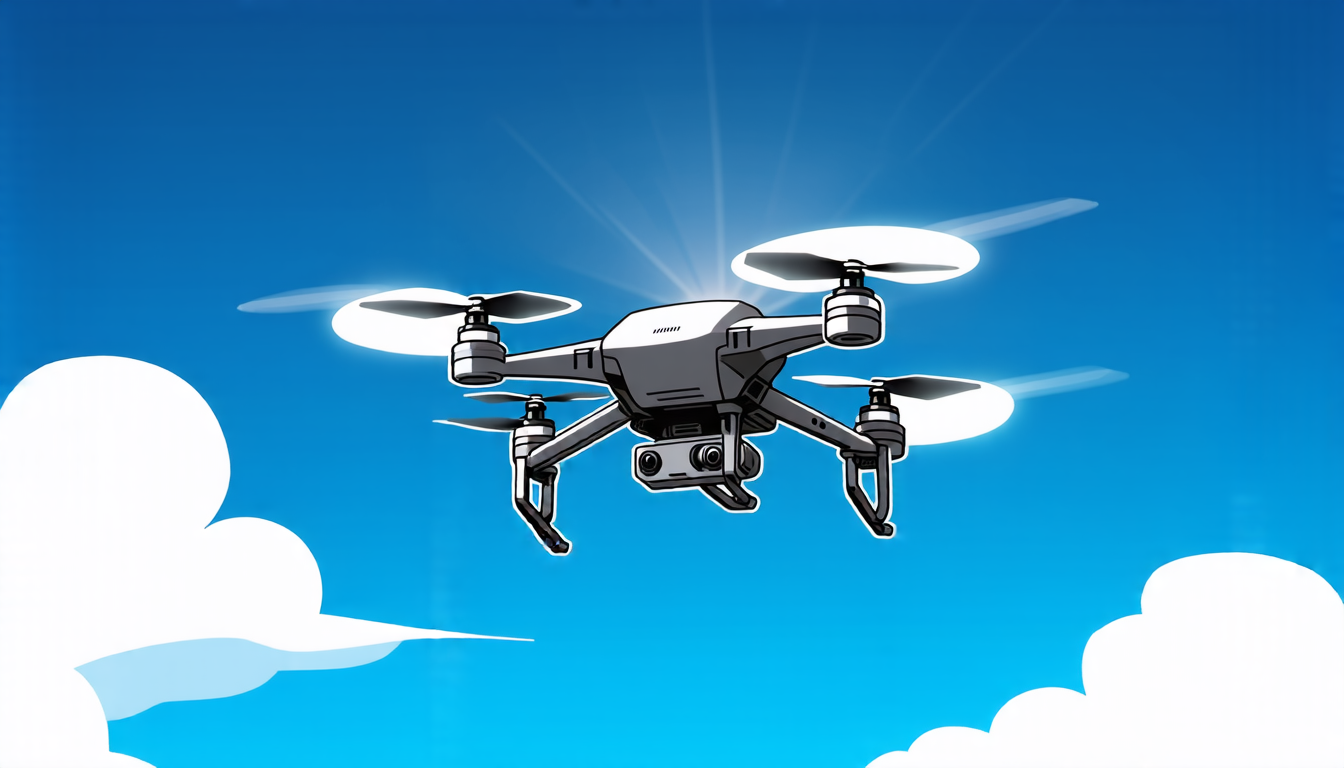
Scientists have long been fascinated by the energy dynamics of multirotor unmanned aerial vehicles (UAVs), also known as drones. These machines are incredibly efficient, capable of performing complex tasks such as package delivery and surveillance while consuming relatively little power. But what’s behind their remarkable efficiency? A new study has shed light on this mystery, revealing a fundamental relationship between the energy consumption rate of UAVs and their mass.
The researchers used advanced mathematical models to simulate the flight dynamics of multirotor drones under various conditions. They discovered that, surprisingly, the optimal pitch angle (the angle at which the rotors spin) remains constant regardless of the vehicle’s weight. This finding has significant implications for the design and operation of UAVs, as it suggests that engineers can optimize energy efficiency by focusing on the pitch angle rather than the mass.
Another key insight from the study is that the minimum energy consumption rate (normalized by mass) remains constant with respect to mass. In other words, heavier drones are not necessarily more efficient than lighter ones. This challenges a common assumption in the field, where it’s often thought that larger vehicles would be more fuel-efficient due to their increased mass.
The researchers’ findings have far-reaching implications for the development of UAVs and their applications. For instance, engineers can design drones with optimal pitch angles from the outset, rather than relying on trial and error. This could lead to significant energy savings, which in turn could extend mission durations and range.
Furthermore, the study’s results suggest that drone manufacturers may not need to focus solely on increasing mass to improve efficiency. Instead, they can explore other avenues, such as optimizing rotor design or improving propulsion systems. This could lead to more efficient drones with reduced power consumption, making them better suited for tasks that require long-range flights or extended operation.
The research also highlights the importance of considering the fundamental physical dynamics of UAVs when designing and operating them. By understanding these principles, engineers can create more efficient machines that are better equipped to perform complex tasks.
In practical terms, the study’s findings could be applied in various industries, such as logistics, surveillance, and agriculture. For example, companies could use drones with optimized pitch angles for package delivery, potentially reducing energy consumption and extending flight times. In surveillance applications, researchers could design drones that can stay aloft for longer periods, providing more accurate data on environmental monitoring or search and rescue operations.
Cite this article: “Unlocking Efficiency in Multirotor Drones”, The Science Archive, 2025.
Uavs, Drones, Energy Efficiency, Pitch Angle, Mass, Rotor Design, Propulsion Systems, Logistics, Surveillance, Agriculture





