

Sunday 02 March 2025
A new study has shed light on the mysterious dynamics of the Beta Pictoris planetary system, offering insights into how planets might shape their surrounding disks of dust and debris.
For decades, astronomers have been fascinated by Beta Pictoris, a young star located just 63 light-years from Earth. This star is surrounded by a dusty disk that’s home to at least two known planets, Beta Pic b and c, as well as an unseen planet or two. The system is of particular interest because it offers a unique window into the early days of planetary formation.
To better understand how the planets interact with their surroundings, scientists used computer simulations to recreate the dynamics of the Beta Pictoris system. They found that one or more additional planets could be hiding in the system, waiting to be discovered. These unseen worlds would likely have masses similar to those of Jupiter and Saturn, but would orbit much farther from their star.
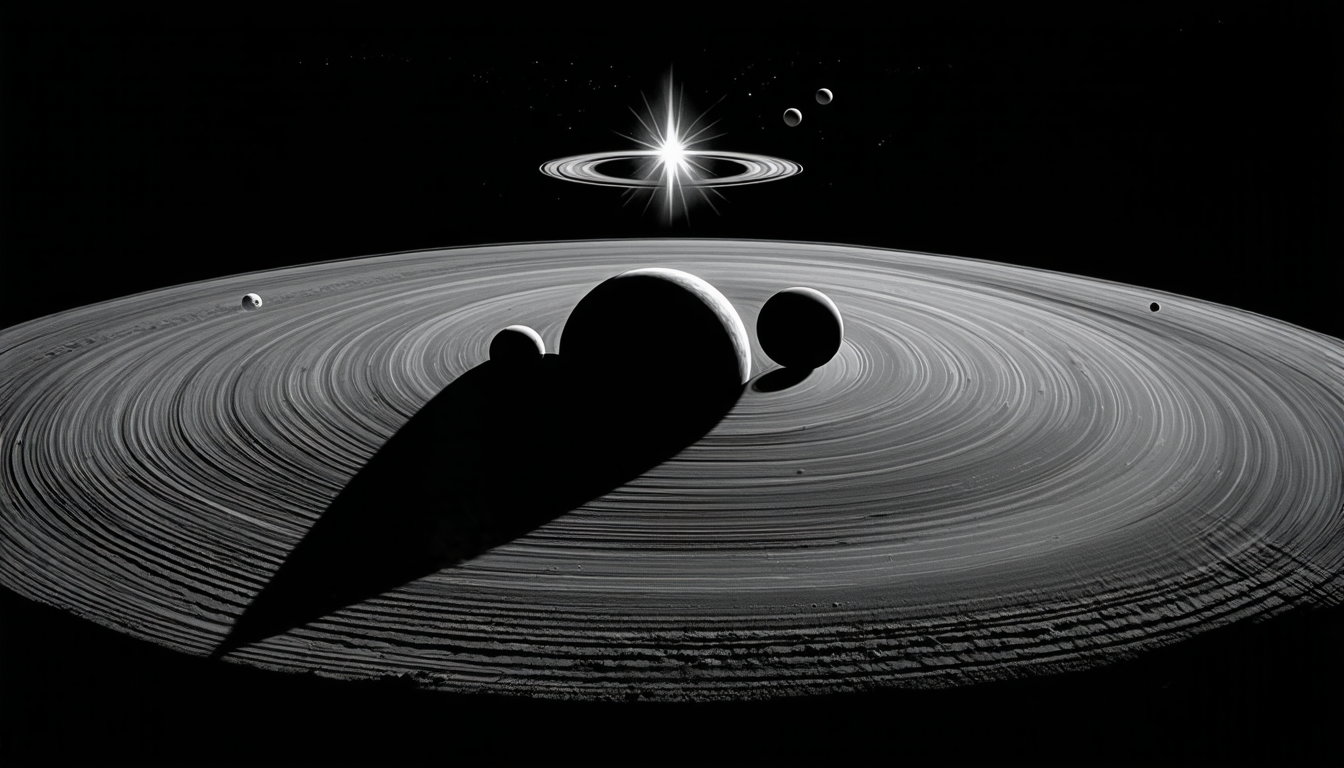
The team’s simulations suggest that these distant planets could be responsible for carving out a region around 50 astronomical units (AU) from the star, where the dusty disk is eerily quiet. An AU is the average distance between Earth and our sun, so we’re talking about a relatively large gap in the system.
But here’s the really interesting part: the simulations also indicate that these distant planets could be responsible for creating the asymmetries and clumps observed in the dusty disk. These features are thought to arise when the disk is perturbed by gravitational forces from nearby objects, like planets.
The study’s findings have important implications for our understanding of planetary formation and evolution. For one, they suggest that multiple planets can coexist within a system without disrupting each other’s orbits. This challenges our previous assumptions about how planets interact with their surroundings.
Furthermore, the simulations imply that the distant planets could be influencing the disk in ways we’re not yet aware of. This raises questions about the role of gravity in shaping the formation of planetary systems and the origins of life beyond Earth.
While the study doesn’t provide direct evidence for the existence of these unseen planets, it does offer a compelling case for their presence. Future observations with next-generation telescopes could help confirm or rule out the presence of these distant worlds, providing a deeper understanding of the Beta Pictoris system and its place in the universe.
For now, the study serves as a reminder that there’s still much to be learned about the mysteries of planetary formation and evolution.
Cite this article: “Uncovering the Secrets of Beta Pictoris: A New Window into Planetary Formation”, The Science Archive, 2025.
Beta Pictoris, Planetary System, Dust Disk, Planet Formation, Gravitational Forces, Multiple Planets, Coexistence, Planetary Evolution, Life Beyond Earth, Astronomy.





