

Sunday 02 March 2025
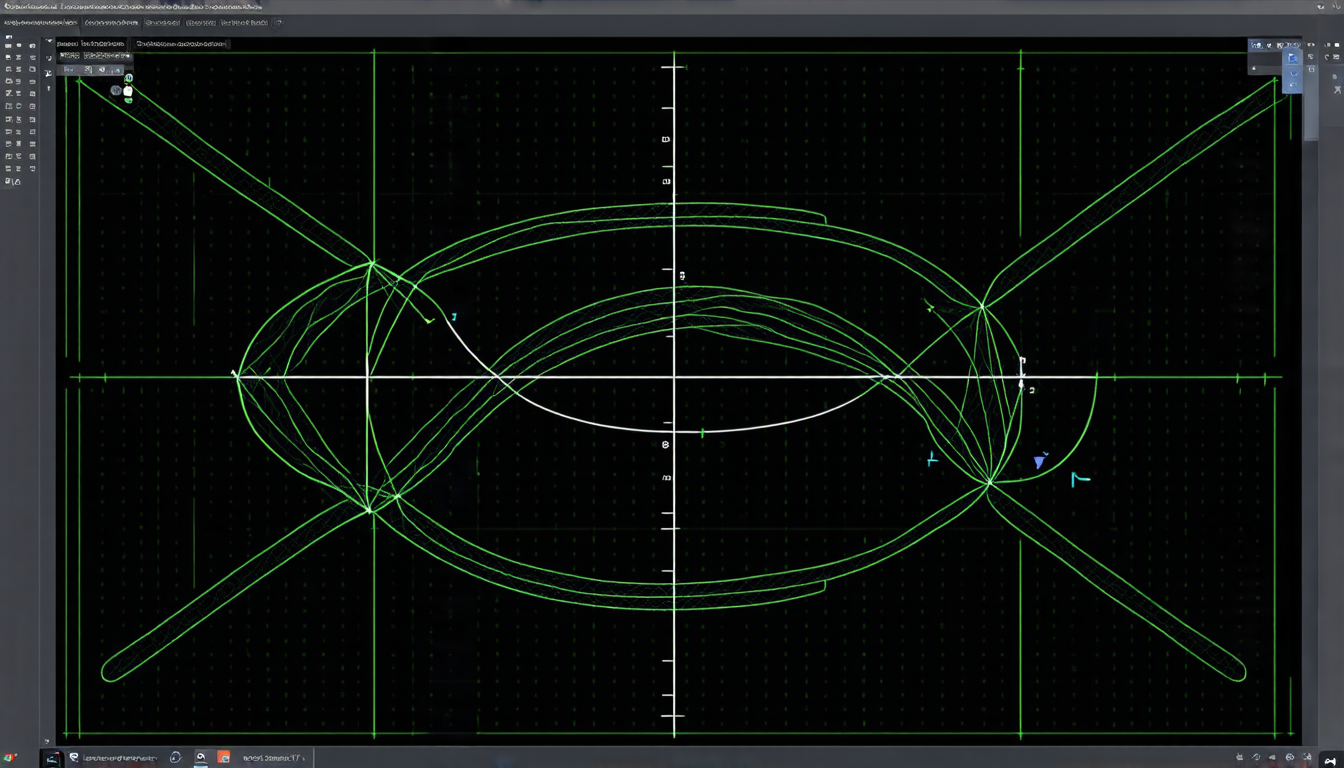
A team of mathematicians has made a significant breakthrough in understanding how elliptic curves behave when subjected to quadratic twists, a process that can have a profound impact on their properties and behavior.
Elliptic curves are mathematical objects that have been studied for centuries, and they have many real-world applications in areas such as cryptography and coding theory. A quadratic twist is a way of modifying an elliptic curve by multiplying its defining equation by a quadratic polynomial. This process can change the shape and properties of the curve, and it has long been known to be useful in understanding the behavior of elliptic curves.
The mathematicians used a combination of mathematical techniques, including algebraic geometry and number theory, to study the local data of elliptic curves under quadratic twists. Local data refers to the information about an elliptic curve that can be obtained by looking at its behavior near a specific point or singularity. In this case, the researchers focused on the local data of the curve near its singularities.
The team found that the local data of an elliptic curve is closely related to its Kodaira-Neron type, which is a way of classifying elliptic curves based on their geometric and algebraic properties. They also discovered that the local Tamagawa number, which is a measure of the size of the group of points on the curve near a singularity, can be used to determine the global Tamagawa number, which is a measure of the size of the group of points on the entire curve.
The researchers’ findings have important implications for cryptography and coding theory. For example, they could potentially be used to develop new cryptographic algorithms that are more secure than those currently in use. They could also be used to improve the efficiency of coding schemes, which are used to transmit data reliably over noisy channels.
The study is a significant advance in our understanding of elliptic curves and their behavior under quadratic twists. It has the potential to lead to major breakthroughs in cryptography and coding theory, and it may also have applications in other areas such as computer science and physics.
The researchers’ approach was based on the use of algebraic geometry and number theory to study the local data of elliptic curves under quadratic twists. They used a combination of mathematical techniques, including the Weierstrass model and the Kodaira-Neron classification, to analyze the behavior of the curves near their singularities.
Cite this article: “Mathematical Breakthrough in Understanding Elliptic Curves Under Quadratic Twists”, The Science Archive, 2025.
Elliptic Curves, Quadratic Twists, Algebraic Geometry, Number Theory, Kodaira-Neron Type, Local Data, Tamagawa Numbers, Cryptography, Coding Theory, Weierstrass Model.





