

Monday 03 March 2025
The quest for private data analysis has reached a new milestone, thanks to researchers who have developed a method to generate graph embeddings – a type of network representation – under differential privacy guarantees. This breakthrough has significant implications for industries that rely heavily on sensitive information, such as healthcare and finance.
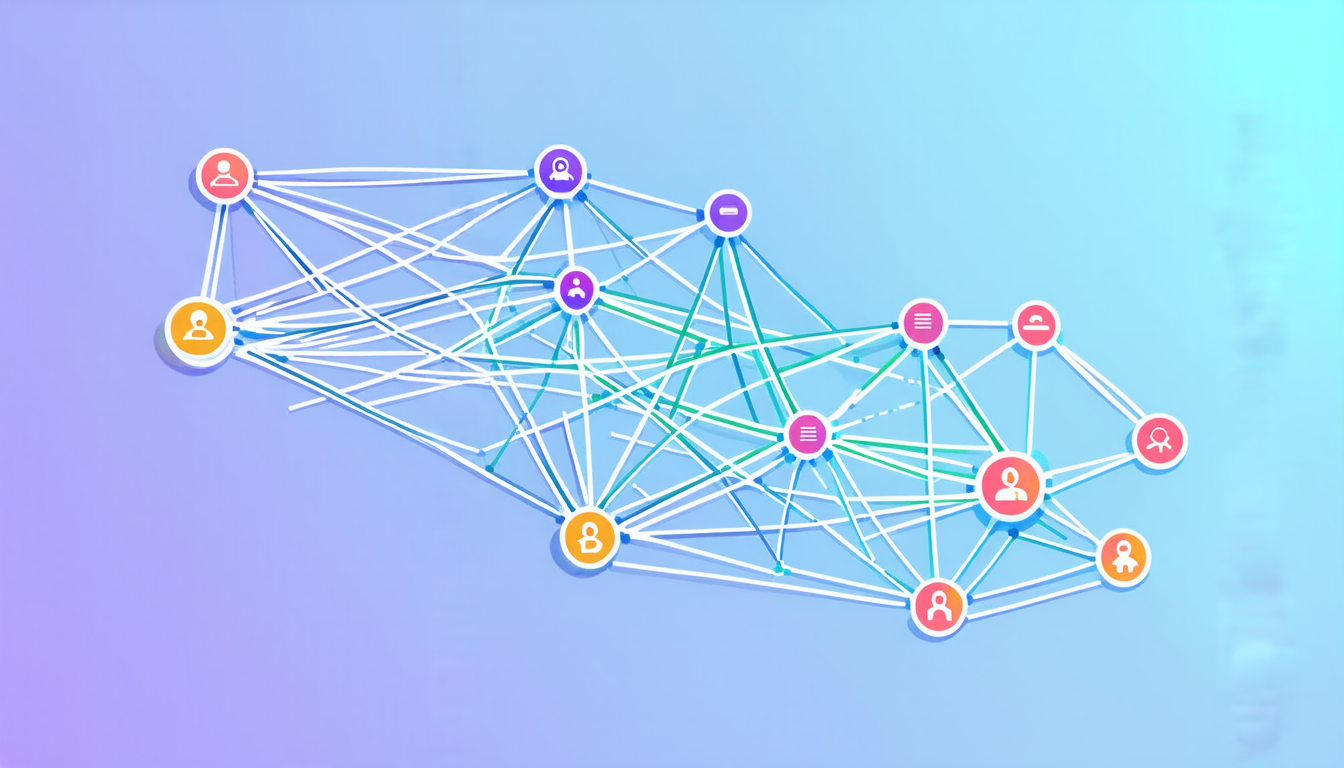
Graph embeddings are used to analyze complex networks, like social media platforms or biological systems, by converting them into lower-dimensional vector spaces. These vectors can then be used for tasks like link prediction, node classification, and clustering. However, traditional methods for generating graph embeddings often involve processing large amounts of sensitive data, which raises concerns about privacy.
Differential privacy is a statistical technique that aims to ensure the confidentiality of individual records within a dataset. It does this by adding random noise to the data, making it difficult for an attacker to identify specific individuals or patterns. But traditional differential privacy methods are often computationally expensive and can result in significant loss of accuracy when applied to graph embeddings.
The researchers developed a novel approach that combines skip-gram, a popular method for generating node representations, with noise tolerance mechanisms. Skip-gram works by predicting the context of a node based on its neighboring nodes. However, this process is sensitive to individual data points, making it vulnerable to privacy attacks.
To address this issue, the researchers introduced a mechanism that perturbs non-zero vectors, allowing them to maintain arbitrary structure preferences while preserving predictive accuracy. This approach ensures that the generated graph embeddings are robust against differential privacy attacks and can be used for tasks like link prediction and node classification.
The results of their experiments demonstrate significant improvements in both privacy and utility compared to existing methods. The proposed approach achieves a better balance between privacy protection and performance, making it more suitable for real-world applications.
This breakthrough has far-reaching implications for industries that rely on sensitive data analysis. By providing a method for generating private graph embeddings, researchers can now develop more robust and secure data analysis tools, enabling the development of novel applications in areas like healthcare, finance, and social network analysis. As our digital lives become increasingly intertwined with complex networks, the need for private data analysis methods becomes ever more pressing.
Cite this article: “Private Graph Embeddings: A Breakthrough in Data Analysis”, The Science Archive, 2025.
Here Are The Keywords: Differential Privacy, Graph Embeddings, Network Representation, Sensitive Data, Private Data Analysis, Skip-Gram, Noise Tolerance, Link Prediction, Node Classification, Healthcare, Finance





