
Monday 03 March 2025
The intricate dance of celestial mechanics has long fascinated scientists and the general public alike. The study of how planets, stars, and other objects in our universe move and interact with each other is a complex and ever-evolving field. Recently, researchers have made significant strides in understanding the stability of certain types of orbital systems.
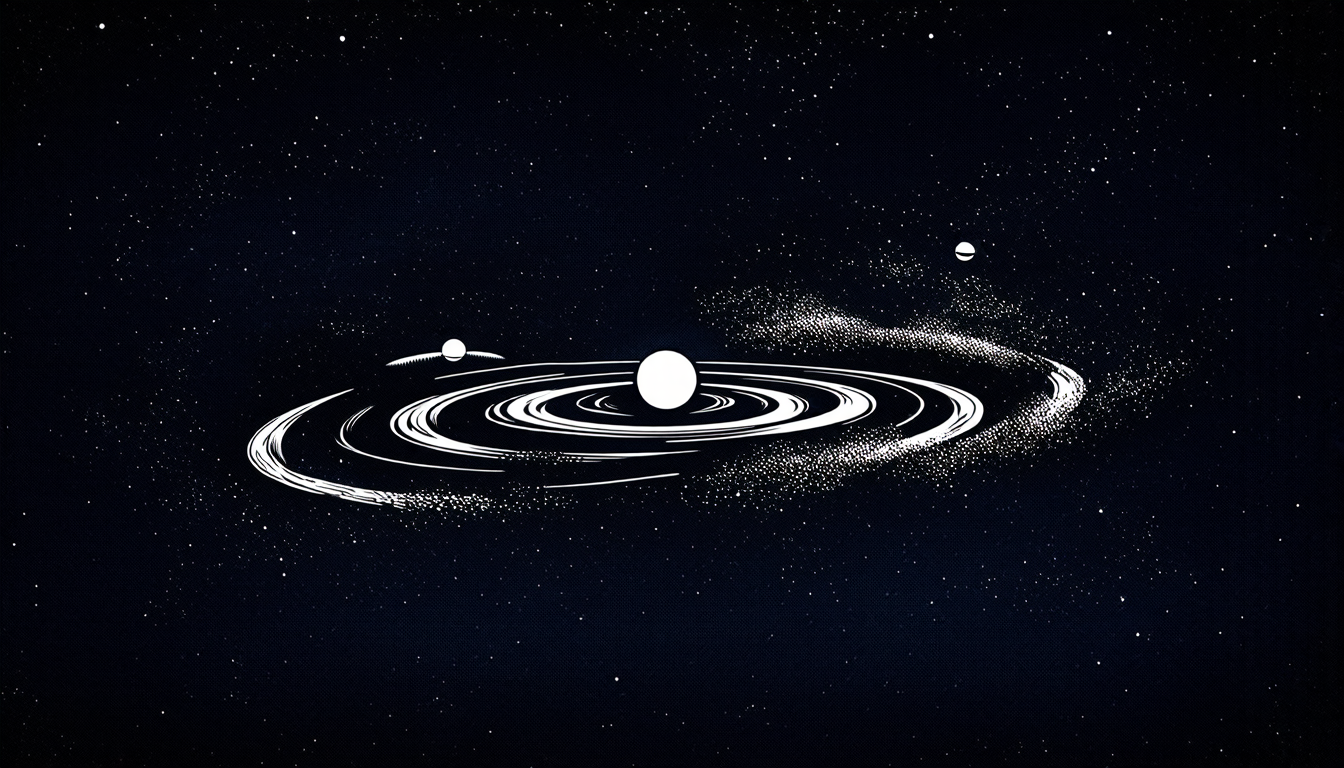
One particular area of focus has been the three-body problem, where three celestial bodies orbit each other in space. This seemingly simple scenario belies the incredible complexity that arises when trying to predict their movements over time. The equations governing these interactions are notoriously difficult to solve, and small changes in initial conditions can lead to drastically different outcomes.
A recent study has shed new light on this problem by examining a specific type of three-body system known as an isosceles solution. In this configuration, two of the bodies are identical and orbit each other while being attracted to a third body, which remains stationary at the center. The researchers used advanced mathematical techniques to analyze the stability of these systems under various conditions.
Their findings suggest that certain types of isosceles solutions exhibit parametric instability, meaning that small changes in the initial conditions can cause the system to become unstable and eventually collapse. This has significant implications for our understanding of celestial mechanics and the behavior of planetary systems.
The study’s authors used a combination of analytical and numerical methods to investigate these systems. They found that the stability of the isosceles solutions depends on the specific parameters involved, such as the masses and velocities of the bodies. By exploring the boundaries between stable and unstable regions, they were able to identify key factors that contribute to the instability.
One of the most interesting aspects of this research is its potential application to real-world astrophysical systems. The authors suggest that their findings could be used to better understand the behavior of binary star systems, where two stars orbit each other while being gravitationally attracted to a third body, such as a black hole or neutron star.
The study’s results also highlight the importance of considering multiple parameters and initial conditions when modeling complex celestial mechanics. By taking into account these subtle variations, scientists can gain a deeper understanding of the intricate dance that governs our universe.
The implications of this research stretch far beyond the realm of pure scientific curiosity. A better grasp of celestial mechanics has significant practical applications in fields such as astrobiology, where researchers seek to understand how life might arise and evolve on distant planets.
Cite this article: “Stabilizing Celestial Mechanics: Insights into the Three-Body Problem”, The Science Archive, 2025.
Celestial Mechanics, Three-Body Problem, Isosceles Solution, Parametric Instability, Stability, Planetary Systems, Binary Star Systems, Black Hole, Neutron Star, Astrobiology, Orbital Dynamics.