

Monday 03 March 2025
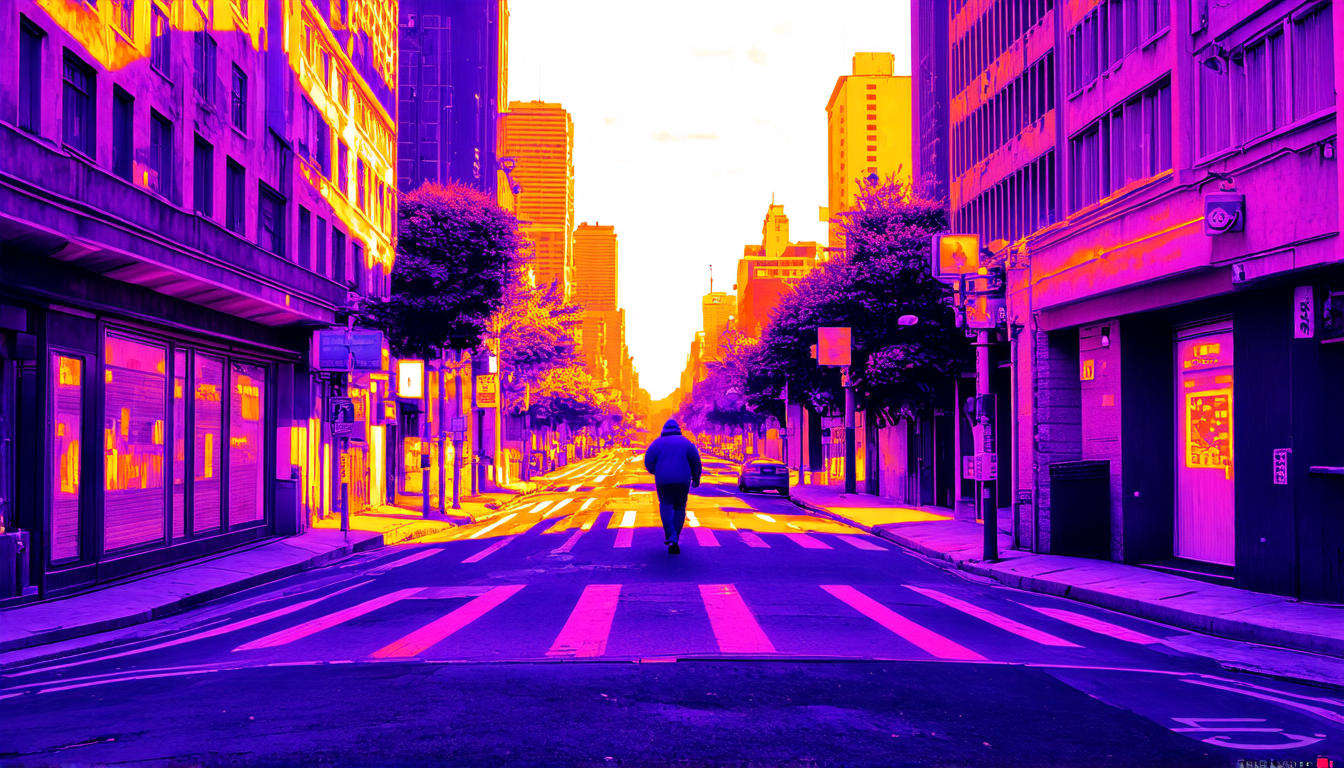
A team of researchers has made a significant breakthrough in developing a new method for tracking objects using both visible light and thermal infrared cameras, known as RGB-T tracking. This technology has the potential to revolutionize various fields such as surveillance, autonomous vehicles, and search and rescue missions.
The challenge of RGB-T tracking lies in combining information from two different modalities: visible light and thermal infrared images. Visible light cameras capture high-resolution images with detailed textures and colors, while thermal infrared cameras detect heat signatures, allowing them to penetrate through smoke, fog, or darkness. However, these two types of images are captured at different resolutions and frequencies, making it difficult to fuse them seamlessly.
The researchers tackled this problem by introducing a novel framework called BTMTrack, which stands for Bridging Temporal Modalities Track. This system uses dual-templates to learn the patterns in both modalities and then bridges the gap between them using a Temporal-Dual Template Bridging (TDTB) module.
The TDTB module is the key innovation behind BTMTrack. It allows the system to dynamically filter tokens, which are small units of information extracted from the images, based on their relevance to the target object. This filtering process reduces background noise and improves the accuracy of the tracking results.
To evaluate the performance of BTMTrack, the researchers tested it on three benchmark datasets: LasHeR, RGBT210, and RGBT234. The results showed that BTMTrack outperformed existing state-of-the-art methods in terms of precision, success rate, and norm precision.
One of the most impressive aspects of BTMTrack is its ability to handle challenging scenarios such as occlusion, low illumination, high illumination, and fast motion. In these situations, other tracking algorithms often struggle or fail entirely. However, BTMTrack’s TDTB module allows it to adapt quickly and accurately to changing conditions.
The implications of this technology are vast and varied. For example, in surveillance applications, BTMTrack could be used to track individuals through crowded areas or detect anomalies in a scene. In autonomous vehicles, it could enable the detection of pedestrians or other obstacles even in poor lighting conditions. And in search and rescue missions, it could help locate missing persons or pets in dense forests or buildings.
The researchers are optimistic about the potential of BTMTrack to transform various fields and improve our daily lives.
Cite this article: “RGB-T Tracking Breakthrough: Revolutionizing Object Detection and Surveillance”, The Science Archive, 2025.
Rgb-T Tracking, Surveillance, Autonomous Vehicles, Search And Rescue, Thermal Infrared Cameras, Visible Light Cameras, Object Tracking, Image Fusion, Computer Vision, Artificial Intelligence





