

Monday 03 March 2025
The quest for a unified theory of everything has been a long-standing challenge in physics. For decades, scientists have been working on developing a framework that can explain all fundamental forces and phenomena in the universe. Recently, researchers made a significant breakthrough in this endeavor by proposing a new model that combines gravity, electromagnetism, and the strong and weak nuclear forces into one cohesive theory.
The new model is an extension of the Rastall theory, which was first proposed in the 1970s. This theory suggests that the energy-momentum tensor, which describes the distribution of mass and energy in space-time, has a non-zero divergence even in flat spacetime. In other words, the Rastall theory proposes that there is a fundamental imbalance between matter and energy in the universe.
The new model builds upon this idea by introducing an additional source term to the Einstein-Hilbert action. This term represents the gravitational decoupling of the electromagnetic force from the strong and weak nuclear forces. By incorporating this term, the researchers were able to derive a set of equations that unify the four fundamental forces of nature.
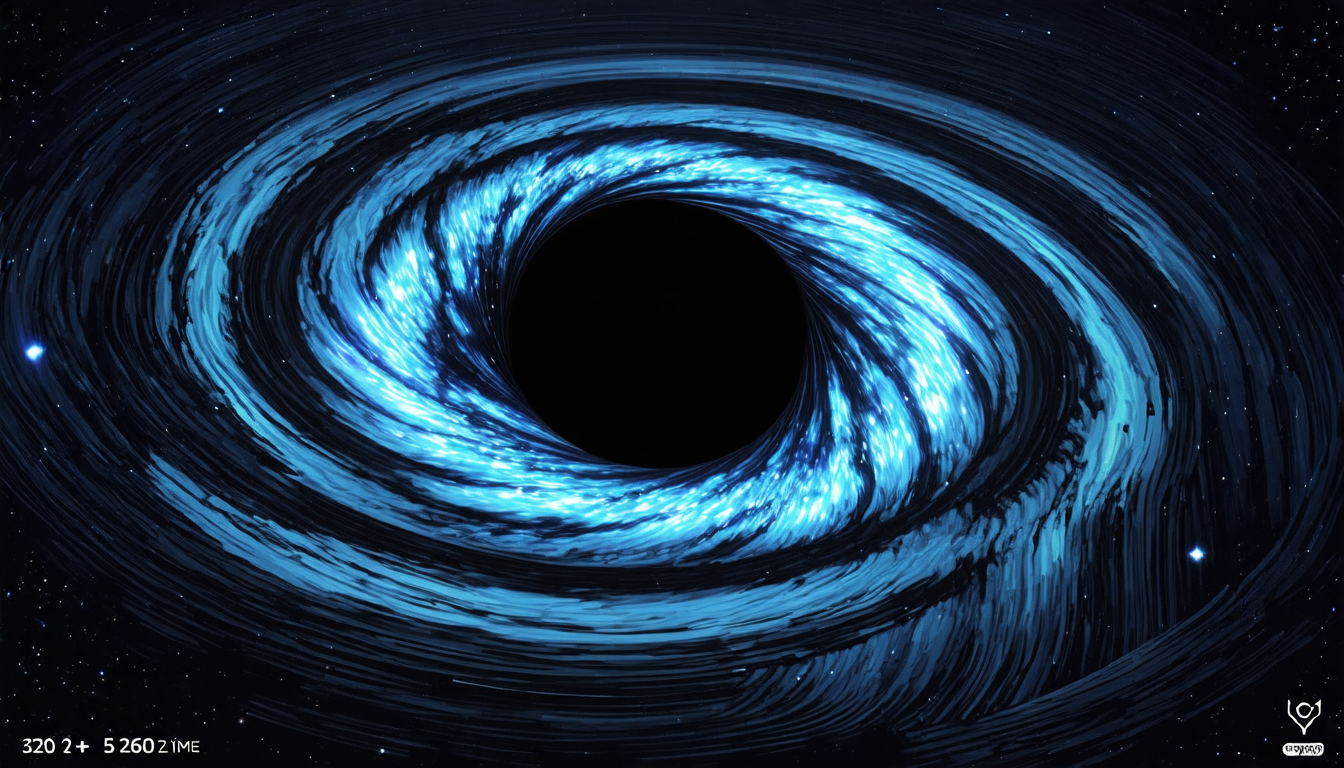
One of the most striking aspects of this new model is its ability to describe the behavior of black holes in a more accurate way than previous theories. According to general relativity, black holes are characterized by their mass and angular momentum, but they lack any internal structure or properties. The new model, however, predicts that black holes have an internal structure that is determined by their gravitational decoupling from the electromagnetic force.
This prediction has significant implications for our understanding of black hole physics. For example, it suggests that black holes may be able to emit particles and radiation through a process known as Hawking radiation. This process was first proposed by Stephen Hawking in the 1970s and is based on the idea that black holes have a temperature and entropy.
Another important aspect of this new model is its ability to describe the behavior of gravitational waves. These waves are ripples in spacetime that were predicted by Einstein’s theory of general relativity and were first detected directly in 2015. The new model predicts that gravitational waves will be affected by the gravitational decoupling of the electromagnetic force, which could provide a new way of testing the theory.
Overall, this new model represents a significant advancement in our understanding of the fundamental forces of nature. It provides a more complete and accurate description of black hole physics and offers new opportunities for testing the theory through observations of gravitational waves.
Cite this article: “A Unified Theory of Everything: A Breakthrough in Physics”, The Science Archive, 2025.
Physics, Unified Theory, Rastall Theory, Einstein-Hilbert Action, Black Holes, Gravitational Waves, Electromagnetism, Strong Nuclear Force, Weak Nuclear Force, Hawking Radiation





