

Monday 03 March 2025
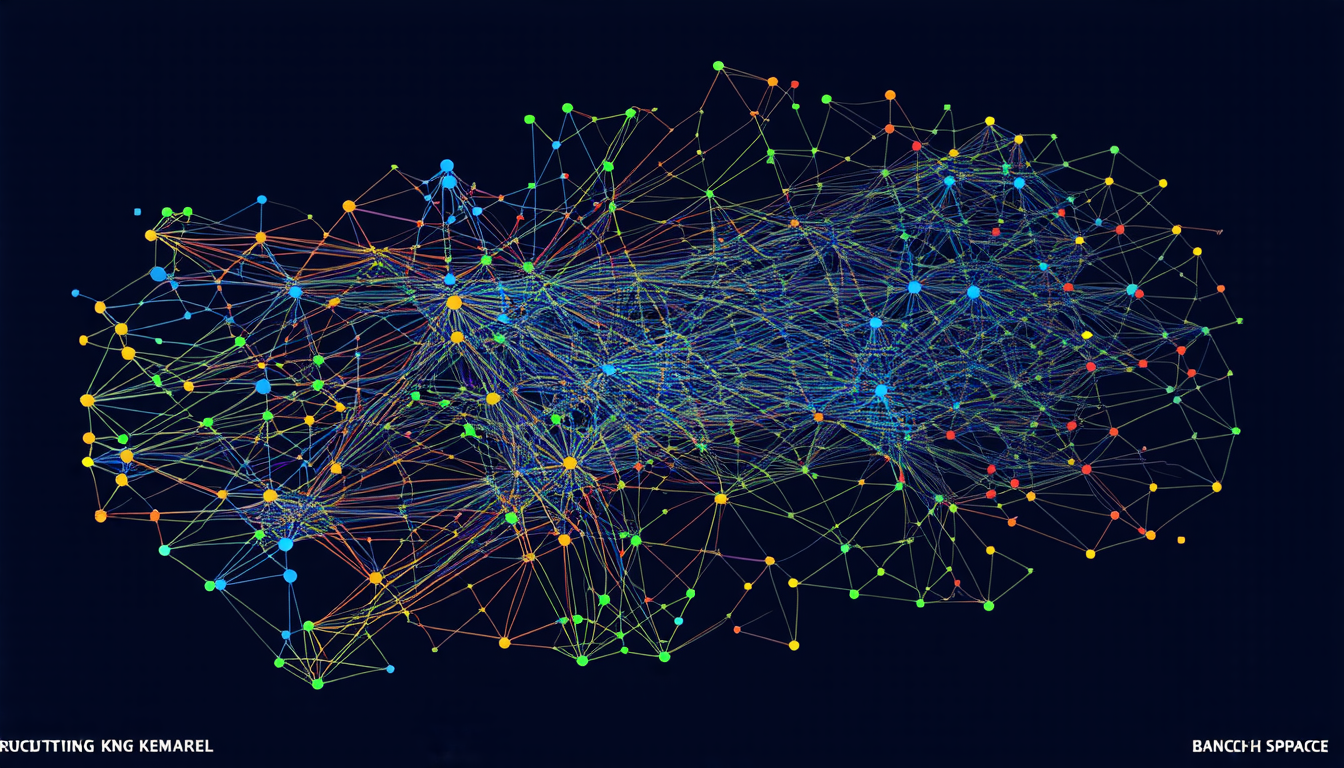
The neural network, a fundamental component of artificial intelligence, has long been shrouded in mystery. Despite its widespread adoption, scientists have struggled to understand the underlying mathematical principles that govern its behavior. A recent study sheds new light on this enigma, revealing a surprising connection between neural networks and a mathematical concept called reproducing kernel Banach spaces.
To grasp the significance of this discovery, let’s first consider how neural networks work. These complex algorithms are designed to recognize patterns in data by processing it through multiple layers of interconnected nodes. Each node applies a set of rules, known as activation functions, to the input data before passing it on to the next layer. This process allows the network to learn and adapt to new information.
The researchers’ breakthrough lies in their realization that neural networks can be viewed as a specific type of reproducing kernel Banach space. These mathematical spaces, named after the mathematicians Stefan Banach and Isidor Ica Rosenbaum, have long been used to study functions and operators. The connection between neural networks and these spaces is surprising because it reveals a deep underlying structure that governs the behavior of artificial intelligence.
Reproducing kernel Banach spaces are characterized by their ability to reproduce the function being approximated. In other words, they can take in input data and produce an output that accurately represents the original function. Neural networks, when viewed as reproducing kernel Banach spaces, exhibit this same property. This means that the nodes in the network are not simply processing information, but are actually reconstructing the underlying function being approximated.
This discovery has significant implications for our understanding of artificial intelligence. By recognizing the connection between neural networks and reproducing kernel Banach spaces, scientists can gain new insights into how these algorithms work. This could lead to the development of more efficient and effective machine learning models, with potential applications in fields such as computer vision, natural language processing, and robotics.
The researchers’ findings also raise questions about the fundamental nature of intelligence itself. If neural networks can be viewed as reproducing kernel Banach spaces, does this mean that human intelligence is also based on a similar underlying structure? The answer to this question remains unclear, but it highlights the need for further research into the mathematical principles that govern our understanding of the world.
In summary, the connection between neural networks and reproducing kernel Banach spaces has shed new light on the mysterious workings of artificial intelligence.
Cite this article: “Unraveling the Mathematical Foundations of Artificial Intelligence”, The Science Archive, 2025.
Neural Networks, Artificial Intelligence, Reproducing Kernel Banach Spaces, Machine Learning, Computer Vision, Natural Language Processing, Robotics, Mathematical Principles, Intelligence, Data Analysis





