

Monday 03 March 2025
Scientists at the Large Hadron Collider (LHC) have made a fascinating discovery that could change our understanding of the fundamental laws of physics. By studying the behavior of top quarks, which are among the most massive particles in the universe, researchers have observed a phenomenon known as quantum entanglement.
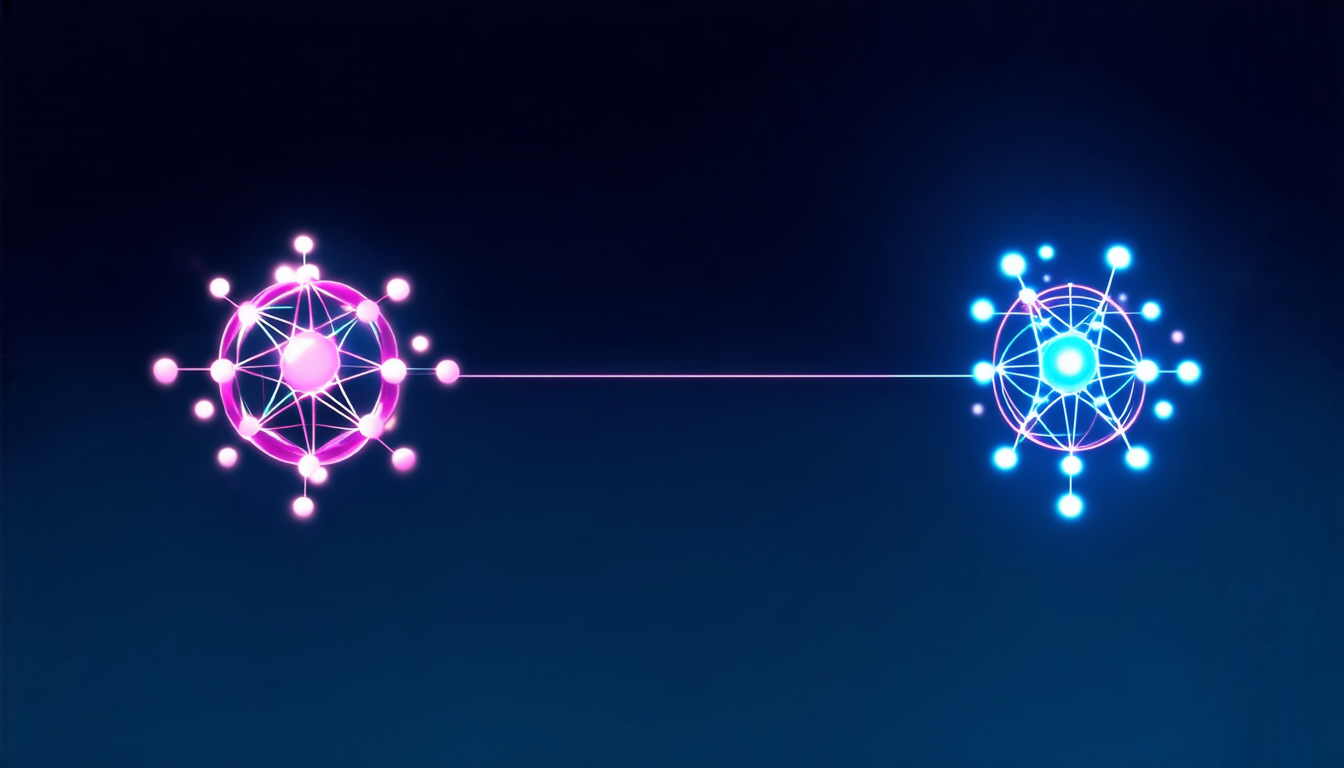
Entanglement is a strange and counterintuitive effect that occurs when two or more particles become connected in such a way that their properties are correlated, even if they are separated by vast distances. In the case of top quarks, this means that their spins – a measure of their intrinsic angular momentum – become linked, allowing researchers to study their behavior with unprecedented precision.
The LHC is a powerful tool for studying particle physics, capable of accelerating particles to nearly the speed of light and then colliding them at incredibly high energies. By analyzing the debris left over after these collisions, scientists can gain insight into the fundamental forces that govern the universe.
In this latest study, researchers used data collected by the ATLAS experiment – one of the two main detectors at the LHC – to investigate the spin correlations between top quarks. By measuring the angles between the directions in which the top quarks decayed, scientists were able to infer the degree to which their spins were correlated.
The results are astonishing: they show that the spins of the top quarks are indeed entangled, a phenomenon that has never been observed before at such high energies. This discovery opens up new avenues for research into the fundamental laws of physics, and could ultimately help us better understand the universe at its most fundamental level.
But what does this mean in practical terms? One potential application is in the development of quantum computers, which rely on entanglement to process information. By understanding how entanglement arises in high-energy collisions, scientists may be able to develop new methods for generating and controlling entangled particles – a crucial step towards building more powerful and efficient quantum computers.
The discovery also has implications for our understanding of the strong nuclear force, one of the four fundamental forces that govern the behavior of particles. By studying the spin correlations between top quarks, scientists can gain insight into the mechanisms that underlie this force – and potentially develop new ways to manipulate it.
The LHC is a remarkable machine, capable of producing energies that are orders of magnitude higher than those found in nature. And yet, despite its incredible power, it is still limited by our current understanding of the fundamental laws of physics.
Cite this article: “Entangled Top Quarks Unveil New Secrets of Fundamental Physics”, The Science Archive, 2025.
Large Hadron Collider, Quantum Entanglement, Top Quarks, Particle Physics, Fundamental Laws Of Physics, Strong Nuclear Force, Quantum Computers, Angular Momentum, Spin Correlations, High-Energy Collisions
Reference: Roman Lysak, “Top quark spin and quantum entanglement in the ATLAS experiment” (2025).





