

Monday 03 March 2025
Deep learning has revolutionized the field of computer vision, enabling machines to recognize and classify images with unprecedented accuracy. But what happens when these systems are faced with distorted or warped images? Fisheye cameras, commonly used in autonomous vehicles, can introduce significant distortions that throw off traditional convolutional neural networks (CNNs).
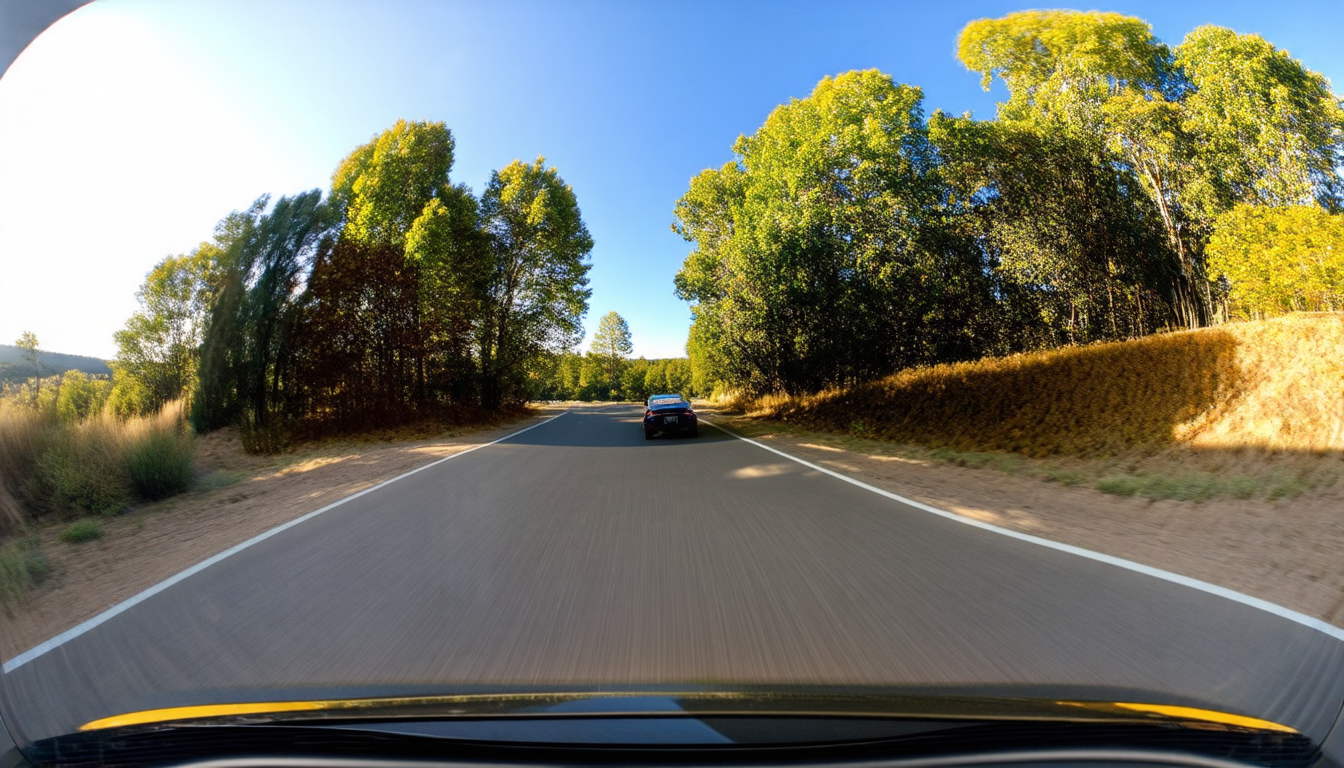
Researchers have long struggled to develop models that can effectively process fisheye camera images. These cameras capture a wide field of view, but at the cost of severe distortion, making it challenging for machines to accurately segment objects within the image.
One approach has been to use specialized algorithms designed specifically for fisheye cameras. However, these methods often rely on complex mathematical transformations and can be computationally expensive. Another approach is to simply retrain traditional CNNs on distorted images, but this requires a large dataset of labeled examples, which can be time-consuming and costly to collect.
A new paper proposes an innovative solution that combines the strengths of both approaches: Graph Neural Networks (GNNs). GNNs have been successfully applied to a range of tasks, from social network analysis to molecular dynamics. By representing images as graphs, where nodes correspond to pixels or features and edges capture relationships between them, GNNs can model complex contextual dependencies that are lost in traditional CNNs.
The researchers developed a novel architecture that incorporates GNNs into the segmentation pipeline. The model consists of an encoder that extracts hierarchical features from the image, followed by a graph-based bottleneck that refines these features by capturing long-range relationships between nodes. Finally, a decoder upsamples the refined features to produce the final segmentation mask.
The results are impressive: on the WoodScape dataset, which features fisheye camera images of road scenes, the GNN-based model outperforms traditional CNNs and even outperforms state-of-the-art methods designed specifically for fisheye cameras. The model is also robust to varying levels of distortion, making it suitable for deployment in real-world applications.
The implications are significant. By enabling machines to accurately segment objects within distorted images, this technology has the potential to improve the safety and reliability of autonomous vehicles. Moreover, the approach can be applied to a range of other domains, from medical imaging to surveillance systems.
While there is still much work to be done, this paper represents an exciting step forward in the development of computer vision for distorted images.
Cite this article: “Graph Neural Networks Improve Object Segmentation in Distorted Images”, The Science Archive, 2025.
Computer Vision, Deep Learning, Fisheye Cameras, Convolutional Neural Networks, Graph Neural Networks, Image Segmentation, Autonomous Vehicles, Distorted Images, Object Recognition, Machine Learning





