

Monday 03 March 2025
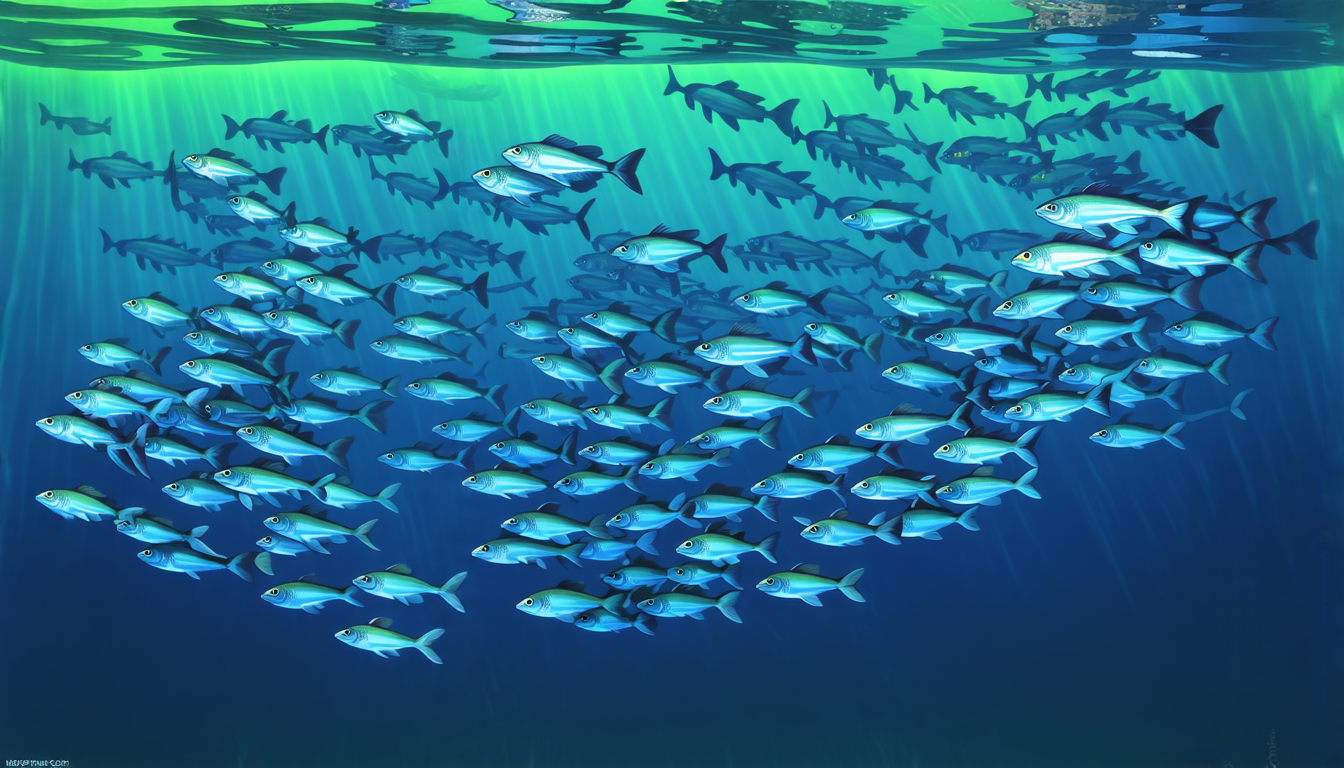
For decades, scientists have been fascinated by the phenomenon of flocking – when animals or particles move together in a coordinated manner, often without explicit leadership. From schools of fish to flocks of birds, this behavior has puzzled researchers and inspired new approaches to understanding complex systems.
A recent study delves deeper into the math behind flocking, exploring how tiny changes in individual movements can have a profound impact on the collective behavior of the group. By analyzing the kinetic Fokker-Planck equation – a mathematical model that describes the evolution of probability distributions over time – researchers have uncovered new insights into the dynamics of flocking.
The study focuses on the interplay between individual and collective behavior, highlighting how small variations in an animal’s movement can ripple through the group and influence its overall direction. By modeling these interactions using advanced mathematical techniques, scientists can better understand the intricate dance between individual actions and collective outcomes.
One key finding is that even tiny changes in individual movements can have a significant impact on the flock’s behavior. This has important implications for understanding how flocks adapt to changing environments or respond to external stimuli. The research also sheds light on the role of noise and uncertainty in shaping the group’s dynamics, revealing how these factors can influence the emergence of complex patterns.
The study’s findings have far-reaching implications beyond just understanding flocking behavior. By applying similar mathematical techniques to other complex systems, researchers may uncover new insights into phenomena such as traffic flow or financial markets. The work also highlights the importance of considering individual-level interactions in modeling collective behavior, a crucial step in developing more accurate predictions and interventions.
The research builds on earlier work in the field, which has sought to understand the mechanisms driving flocking behavior. By combining mathematical models with empirical observations, scientists have made significant progress in deciphering the intricate dynamics at play. This study takes that understanding to the next level, providing a deeper look into the subtle interplay between individual and collective behavior.
As researchers continue to probe the mysteries of flocking, their work may yet uncover new secrets about the natural world and its many complex systems. By delving deeper into the math behind this phenomenon, scientists are taking us one step closer to understanding the intricate dance of life itself.
Cite this article: “Unraveling the Math Behind Flocking Behavior”, The Science Archive, 2025.
Flocking, Math, Biology, Physics, Complex Systems, Individual Behavior, Collective Behavior, Kinetic Fokker-Planck Equation, Probability Distributions, Noise And Uncertainty





