

Monday 03 March 2025
The dimming of GRS 1915+105, a black hole binary system located some 40,000 light-years from Earth, has long fascinated astronomers. This enigmatic object has been emitting intense radiation and outflows for over two decades, making it one of the most studied celestial bodies in our galaxy. Recently, scientists using the Neutron Star Interior Composition Explorer (NICER) and Insight-Hard X-ray Modulation Telescope (HXMT) have uncovered new insights into this phenomenon.
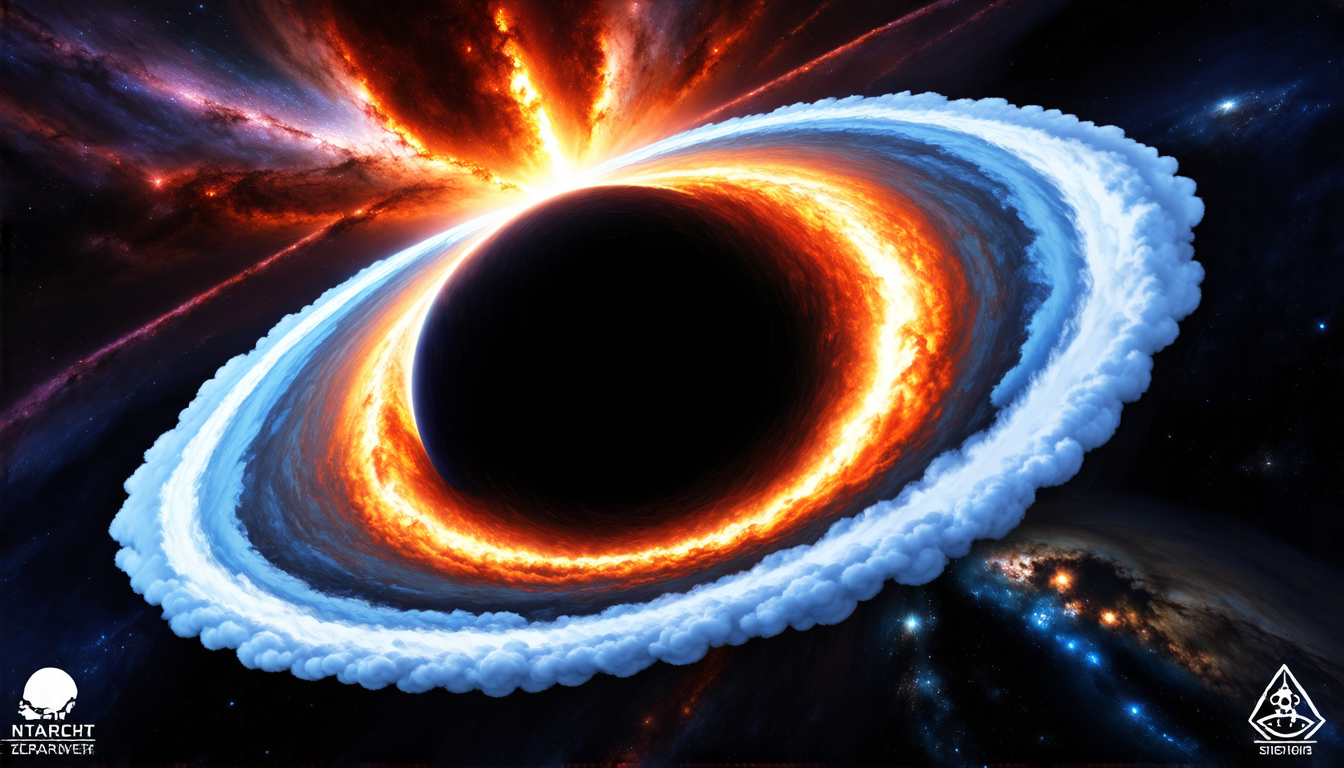
GRS 1915+105 is a binary system consisting of a black hole and a companion star, which feeds matter onto the former through an accretion disk. As material spirals towards the event horizon, it releases enormous amounts of energy in the form of X-rays and gamma rays. The system’s brightness has been steadily increasing since its discovery in 1992, leading researchers to believe that the black hole is slowly growing more massive.
The new findings suggest that the dimming of GRS 1915+105 may not be a uniform process. By analyzing the data from NICER and HXMT, scientists have discovered that the system’s X-ray emission decreases in intensity during certain periods. These dips are thought to be caused by the formation of ionized winds emanating from the accretion disk. These winds, which are rich in heavy elements such as iron and nickel, can absorb some of the radiation emitted by the black hole.
The researchers also observed a correlation between the frequency of quasi-periodic oscillations (QPOs) in the X-ray emission and the photon index, a measure of the energy distribution of the radiation. QPOs are thought to be caused by fluctuations in the accretion disk’s density and temperature. The connection between QPO frequencies and photon indices suggests that these fluctuations play a key role in shaping the system’s X-ray spectrum.
One of the most intriguing aspects of GRS 1915+105 is its ability to transition between different states, including a soft state characterized by intense radiation emission and a hard state marked by reduced activity. The new data indicates that the ionized winds may be more prevalent during the transition from the soft to the hard state.
The discovery of these winds has significant implications for our understanding of black hole binary systems like GRS 1915+105. It suggests that these objects are capable of producing complex, dynamic phenomena that can affect their radiation emission and overall behavior.
Cite this article: “Unraveling the Enigma: New Insights into GRS 1915+105s Dimming Phenomenon”, The Science Archive, 2025.
Black Holes, Binary Systems, Accretion Disk, X-Rays, Gamma Rays, Radiation Emission, Ionized Winds, Quasi-Periodic Oscillations, Photon Index, Grs 1915+105





